
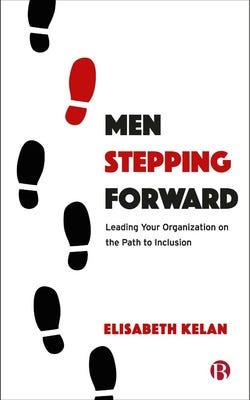
We begin our series of the winners and finalists of the Management Publication of the Year 2024 with the overall winner and category winner for Social Enterprise & Innovation, Professor Elisabeth Kelan, for her book Men Stepping Forward, published by Bristol University Press in 2023.

The Leadership Challenge
Many leaders recognise the importance of gender equality for their organisation. However, managers, particularly men in leadership roles, often report uncertainty about where to begin, what is expected of them, and how to contribute without ‘getting it wrong’.
Many leaders see gender equality as an add-on to other pressing priorities rather than something they can integrate into their everyday leadership. Others see gender equality as a women’s issue to which they feel they have little to contribute, while still others frame it primarily as a compliance requirement.
The consequence is that many men limit their support for gender equality to symbolic gestures, such as endorsing flexible working policies, without actually changing their practices. However, gender inequality is regularly created in routine interactions such as meetings, hiring decisions or performance evaluations. It is precisely in these everyday moments that men can make meaningful and concrete contributions to gender equality.
Research Insights
In my book ‘Men Stepping Forward’, I draw on in-depth qualitative research to show the specific ways in which men can support gender equality through their leadership. I describe these practices as visioning, enabling, and modelling.
First, visioning involves men in leadership positions articulating their personal case for gender equality. Leaders often recur to the business case or the social justice case when they justify their support for gender equality. However, what is most effective is to explain why gender equality matters to them personally. This often involves sharing stories about their own experiences or epiphany moments that shaped their perspective on gender equality.
Second, enabling means removing barriers for women to succeed. Leaders are often tempted to focus on leading high-profile initiatives. However, they do not need to spearhead formal programmes to act as effective change agents. My research shows that men who support gender equality amplify the voices of others, create space for participation, and respond constructively when challenged. They make an effort to understand perspectives they do not share and learn from them. Importantly, they validate others’ experiences rather than minimising or explaining them away, and they frame gender equality as a systemic rather than an individual issue.
Third, modelling means demonstrating inclusive behaviour in everyday interactions or in other words, ‘walking the talk’. Men acting as change agents actively disrupt exclusionary behaviour. What does this look like in practice? When they notice biased hiring patterns or see that a woman’s contribution is overlooked, they explicitly raise this. They also advocate for women when they are not in the room, for example, by sponsoring them or suggesting them for stretch opportunities.
Implications for Leadership Practice
The research suggests that for gender equality to shift in organisations, it must move from being a policy issue to becoming central to how leadership is practised. Leadership is a key site for change towards gender equality. Small-scale actions by managers and leaders can act as a powerful conduit for gender equality. Leaders do not need to take on an additional priority but by changing how they lead, they foster inclusion.

But what about the fear of getting it wrong? Becoming a change agent for gender equality is a learning journey. Men will get it wrong at times. In fact, many of the men I observed in their daily interactions did not always get it right. What distinguished them, however, was their willingness to reflect on their actions and adjust their behaviour. Getting it wrong is therefore not a failure, but part of the process of developing more inclusive leadership practices.
Over time, these small, everyday adjustments accumulate. Actions such as amplifying a woman’s voice, questioning a decision, or acknowledging bias may seem minor in isolation. Yet together they contribute to shifting organisational norms. Inclusive leadership is therefore less about adding new responsibilities and more about rethinking how leadership is enacted in practice.
Key Takeaways
Men in management and leadership roles play a central role in advancing gender equality. The key insight is that this does not require doing more, but doing everyday leadership differently. Leaders should reflect on how they articulate their vision for gender equality, ideally grounding it in a personal commitment. They should consider how they can remove barriers for women, for example by amplifying women’s voices and validating their experiences. They can also support gender equality by role modelling inclusive behaviour, such as calling out unfair practices. Over time, these micro-practices accumulate, showing how small-scale changes can lead to broader organisational transformation.
Elisabeth Kelan is Professor of Leadership and Organisation at King’s Business School, King’s College London. Her research focuses on gender, leadership, and the future of work, including the role of AI. She is the author of Men Stepping Forward, which explores how men can act as change agents for gender equality.
Thanks for reading Business Research Unpacked! This post is public so feel free to share it.
Comments
Nothing yet. Say the first thing.
Sign in to join the conversation.