
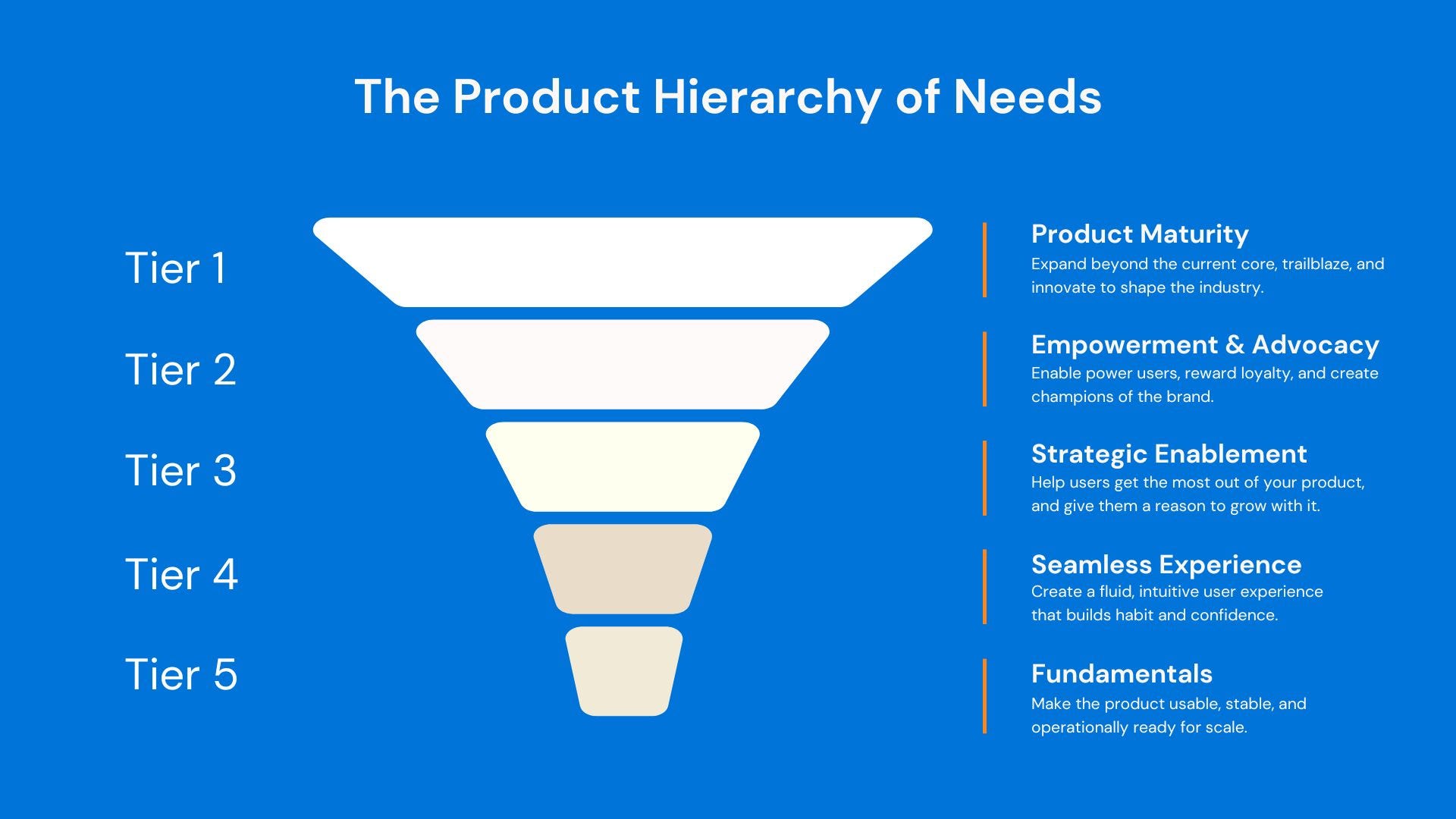
This post explores a core concept from the Product Hierarchy of Needs — a framework that helps product teams assess and evolve their product’s maturity. You don’t need to have read the full framework to get value here — but if you’d like the full picture, you can start with the overview here.
Let’s dive into Tier 5: Fundamentals, where the majority of hidden churn, friction, and underperformance issues quietly live.
The Reality Check: Most Teams Aren’t Building on a Solid Foundation
We all want to scale. We talk about onboarding, product-led growth, retention loops. But too often, teams try to build all of this on top of a shaky product core.
Growth problems are often just stability problems in disguise. You don’t need to dig deep to find the cracks:
Sluggish UI in key flows
Mobile bugs that keep resurfacing
Feature abandonment because users never truly understood how it works
Workarounds and duct-tape fixes becoming permanent
You’re not growing because customers are too busy fighting the product to experience its value.
Here’s what happens when you gloss over the basics:
Customers churn silently — no complaints, just drop-off.
Your team burns cycles answering the same support tickets again and again.
You build new features… that no one trusts enough to try.
Feedback becomes inconsistent — because no one’s sticking around long enough to become power users.
You think you’re in a product growth phase. But you’re actually stuck in product survival.
This layer is about one thing: operational readiness for scale.
This doesn’t mean being “done.” It means your core product:
Works reliably
Feels intuitive
Is supported by clear internal processes
It’s the difference between a tool that looks good in a pitch deck, and one your users can actually trust.
Not sure if you’re here? These are the most common symptoms to look out for in your own product:
Bugs & Instability
Recurring technical issues in key journeys
Inconsistent behavior across platforms (e.g. web vs. mobile)
Broken edge cases that never get prioritized
Confusing UX or Dead Ends
Drop-offs during onboarding or activation flows
Inconsistent UI patterns that create friction
Users clicking “Back” or closing tabs to start over
Missing Product Ops Foundations
No structured bug reporting or feedback intake
Roadmap is invisible or outdated
No scalable way to collect and prioritize feature requests
Real world example:
One startup had onboarding drop-off rates >50% and couldn’t figure out why.
After running a UX audit, they discovered a mobile flow where new users couldn’t progress past the second screen if permissions weren’t granted. It looked like a churn issue. It was a Foundation Layer failure - yet nobody knew about it nor reported it.
Here’s how to stop leaking value and start building trust.
1. Clean Up the UX Clutter
Run a Friction Log exercise: map out where users hesitate, click back, or repeat actions
Simplify unnecessary steps in sign-up or onboarding
Align patterns across platforms (mobile should not feel like a knock-off)
2. Establish Product Ops
Bug intake → triage → resolution loop
Feedback form that routes to the right team (not a black hole)
Public or semi-public roadmap so users know what’s coming
3. Clarify Core Flows
Define your critical success paths (e.g. First Value actions)
Instrument them. Fix drop-offs.
Create in-app guidance, tooltips, or videos if needed — but only after the journey itself is solid
4. Audit With a PHoN Lens
Are users able to reach value without help?
Are internal teams drowning in support tickets for core functionality?
Are you proud to show your current onboarding flow?
If the answer to any of those is “not really,” you’re still here — and that’s okay. Now you know where to focus.
Realising that your product might not be nailing the fundamentals is hard enough to accept. Fixing those issues or figuring out where to start could be even more daunting. That’s why I created a basic Foundation Readiness Checklist for you to self-assess before moving up the product maturity ladder:

It’s easy to treat usability as a surface-level issue. But the cost of weak fundamentals runs deeper — and compounds over time:
Struggle with the basics leads to poor adoption.
Poor adoption means fewer problems solved.
Fewer problems solved means less perceived value.
Less value means no transformation.
And without transformation, your product never achieves its intended impact.
The Foundation Layer isn’t glamorous. It won’t win awards or get applause on LinkedIn. But it’s what everything else rests on.
Especially if you want customers to:
Stick around
Advocate for you
Try new features
Upgrade their plans
You need to earn their trust first.
And that trust starts with a product that just works.
This concept is part of the broader Product Hierarchy of Needs, a framework designed to help product teams assess what level they’re truly operating at — and what’s holding them back.
If you’re currently reinforcing your foundation, you’re doing the work that matters.
If you’re skipping it, you’ll feel it — in churn, rework, and missed potential.
Want to explore the rest of the hierarchy?
👉 Read the full PHoN framework here
Or subscribe to be notified when Tier 4: The Seamless Experience Layer drops!
Comments
Nothing yet. Say the first thing.
Sign in to join the conversation.