
Most product teams want to scale.
We want more users, higher engagement, bolder innovation.
But here’s the problem:
We try to fly before we’ve learned to walk.
Our ambitions are valid — but they’re often layered over a weak foundation.
We add more features, invest in growth loops, and push for new markets…
Meanwhile, users are still getting stuck in onboarding.
Bug reports are piling up.
Nobody knows what the roadmap is — including the team.
This isn't a failure of vision. It’s a failure of product maturity.
And it’s more common than most teams admit.
Why Does This Happen?
There are a few common culprits:
We’re not asking the right questions about the stage of our product
We mistake velocity for progress, shipping more without revisiting the basics
We assume customers see our product's value — even when they’re still wrestling with friction
Worse, many of the pains customers feel are latent, not realized.
They don’t say, “this onboarding flow is confusing.”
They just disengage.
They don’t complain that they can’t find a feature.
They just think the product doesn’t do what they need.
The result? We build forward without fixing backward.
That’s why I created the Product Hierarchy of Needs — a simple but powerful framework to help you identify where your product is actually operating… and what’s holding it back.
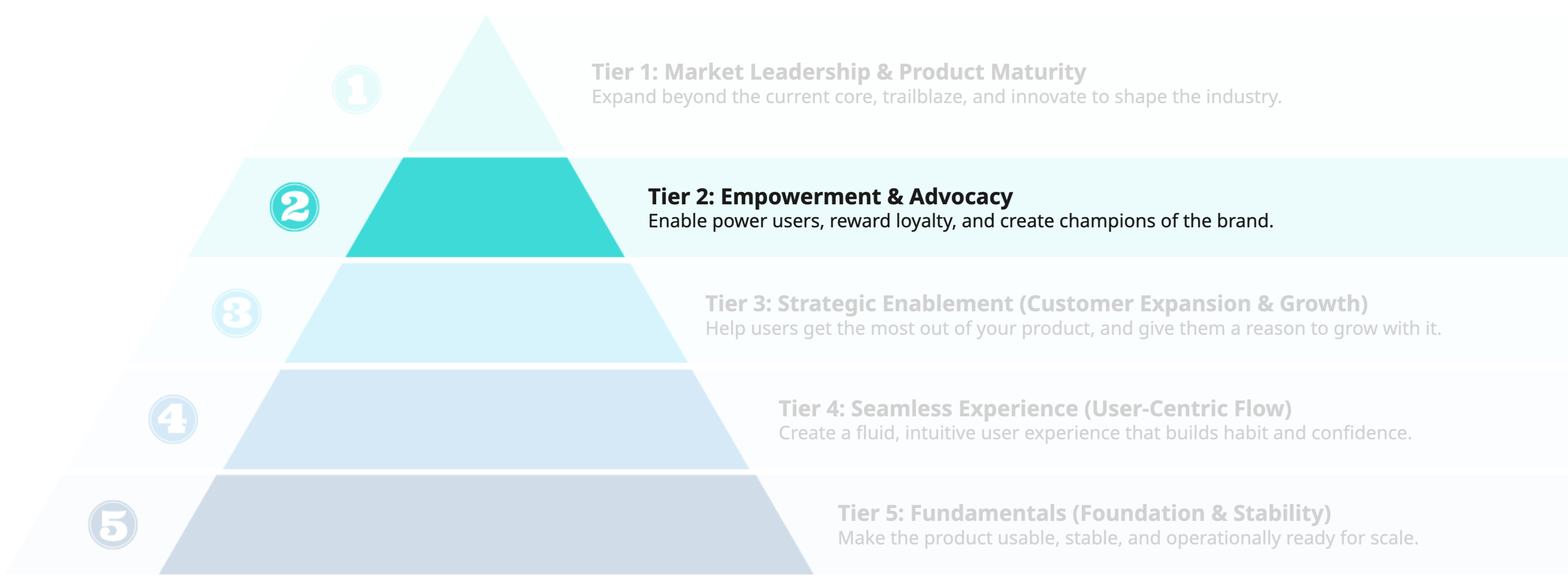
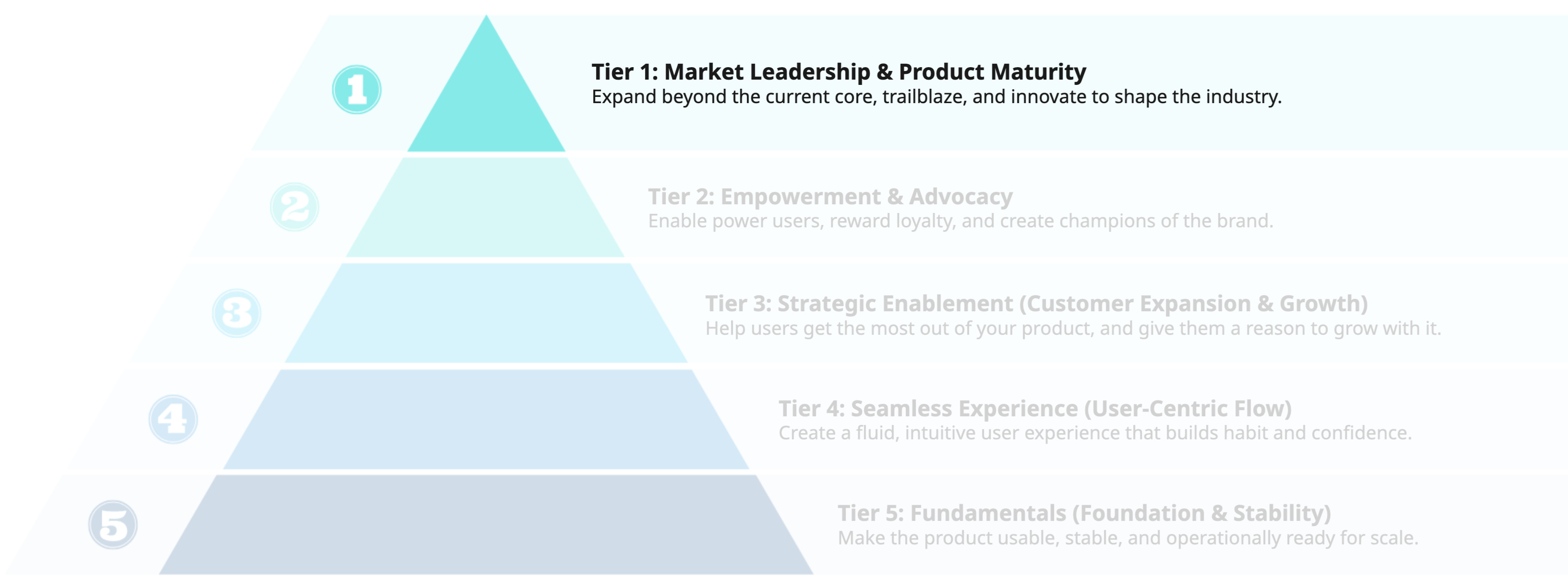
The Product Hierarchy of Needs (PHoN)
The Product Hierarchy of Needs framework helps you assess the current state of your product and it’s maturity, so you can prioritize the right problems — not just ship more.
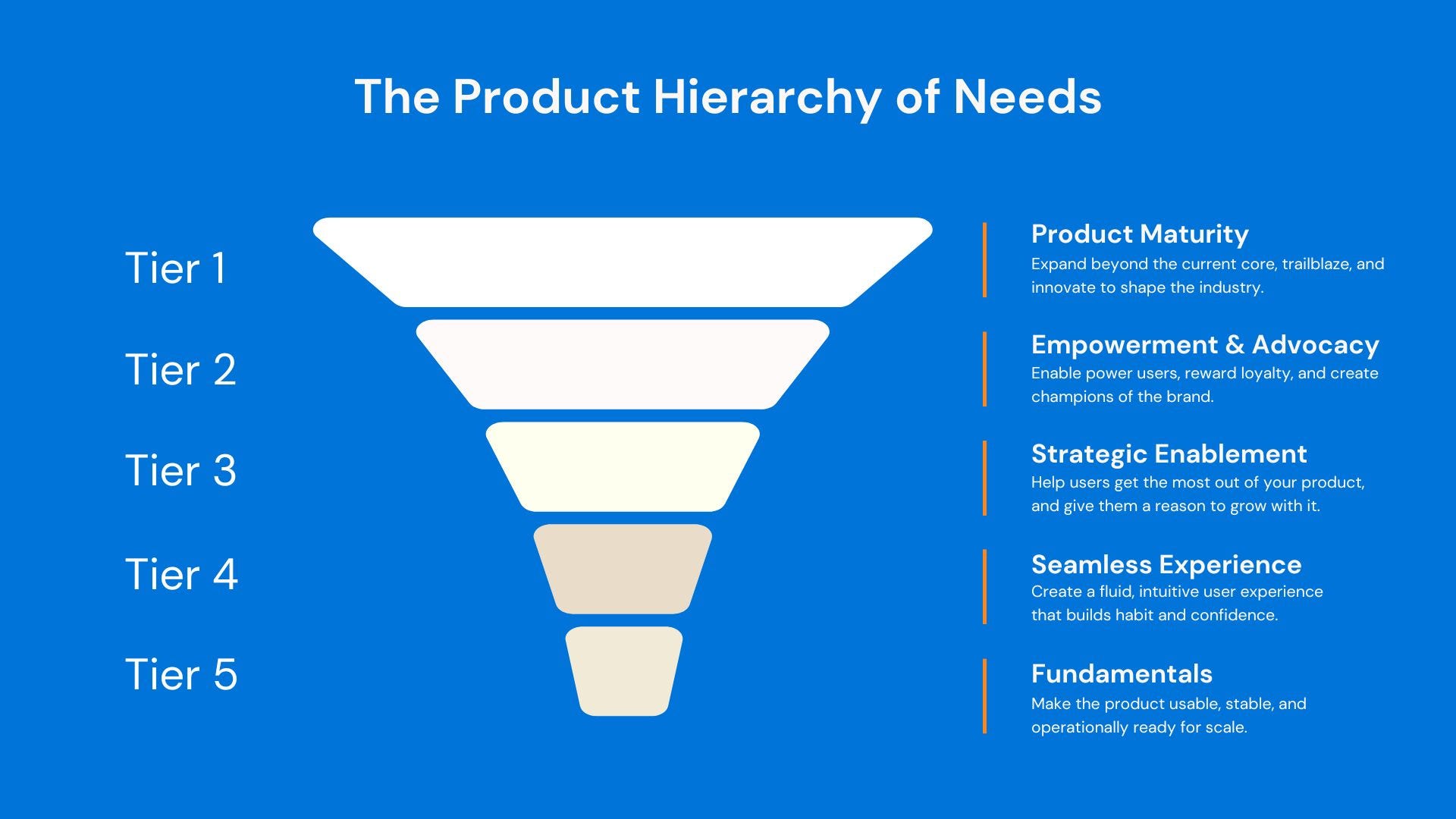
Here are the five tiers:
Tier 5: Fundamentals (Foundation & Stability)
Tier 4: Seamless Experience (User-Centric Flow)
Tier 3: Strategic Enablement (Expansion & Growth)
Tier 2: Empowerment & Advocacy
Tier 1: Market Leadership & Product Maturity
This isn’t about completing each level 100% before advancing.
Product maturity is non-linear — great teams move up and down the hierarchy depending on current needs and strategy.
Let’s break each tier down.
Tier 5: Fundamentals (Foundation & Stability)
The base layer. Without this, everything else is unstable. This tier is about ensuring your product works — technically, functionally, and operationally.
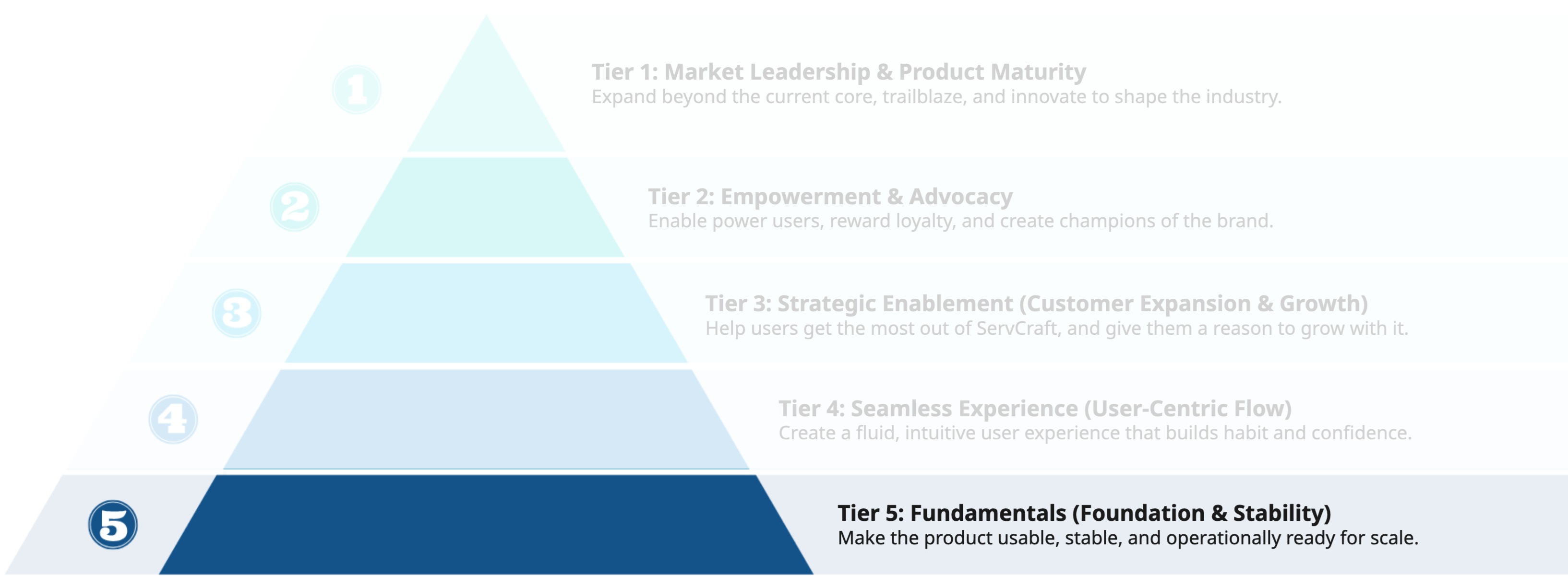
Focus areas:
Clean, intuitive UX and UI
Eliminate friction (mobile dead ends, confusing flows)
Core functions must work across all user environments
Operational setup:
Bug tracking + resolution loops
Feedback channels
A roadmap that’s visible (even if basic)
If customers are struggling with core functionality, they’ll never reach your real value. They’re too busy trying to get the basics to work.
Tier 4: Seamless Experience (User-Centric Flow)
Once stability is achieved, it’s time to smooth out the experience. This tier focuses on making the product easy, intuitive, and habit-forming.
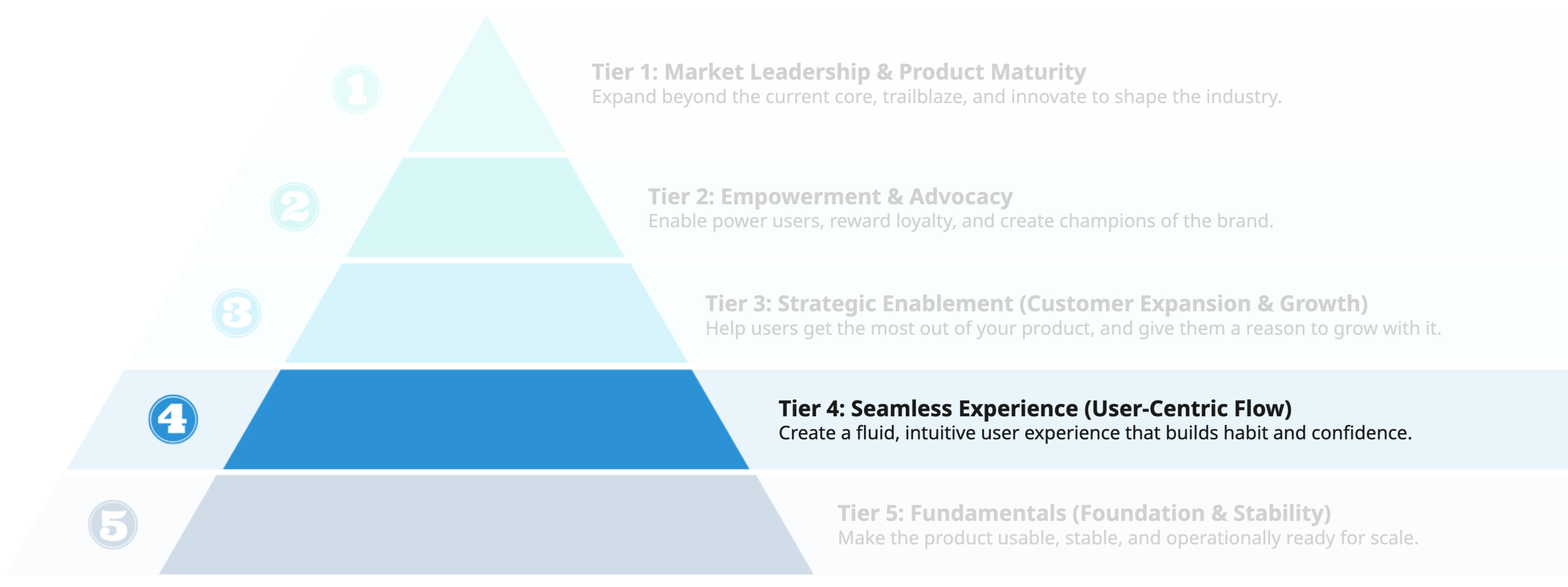
Focus areas:
Consistent UX across devices
Reduce time-to-value (optimize onboarding, tooltips, first flows)
Improve clarity around what features do (microcopy, empty states, in-app nudges)
Preempt churn with tools like a Customer Health Score
Support user learning through product academies, help docs, or onboarding journeys
Products that live in Tier 4 feel polished. They create momentum and confidence — users feel like “this just works.”
Tier 3: Strategic Enablement (Customer Expansion & Growth)
Now that users can use the product easily, you can start helping them grow with it. This tier is about encouraging deeper usage, team adoption, and longer-term commitments.
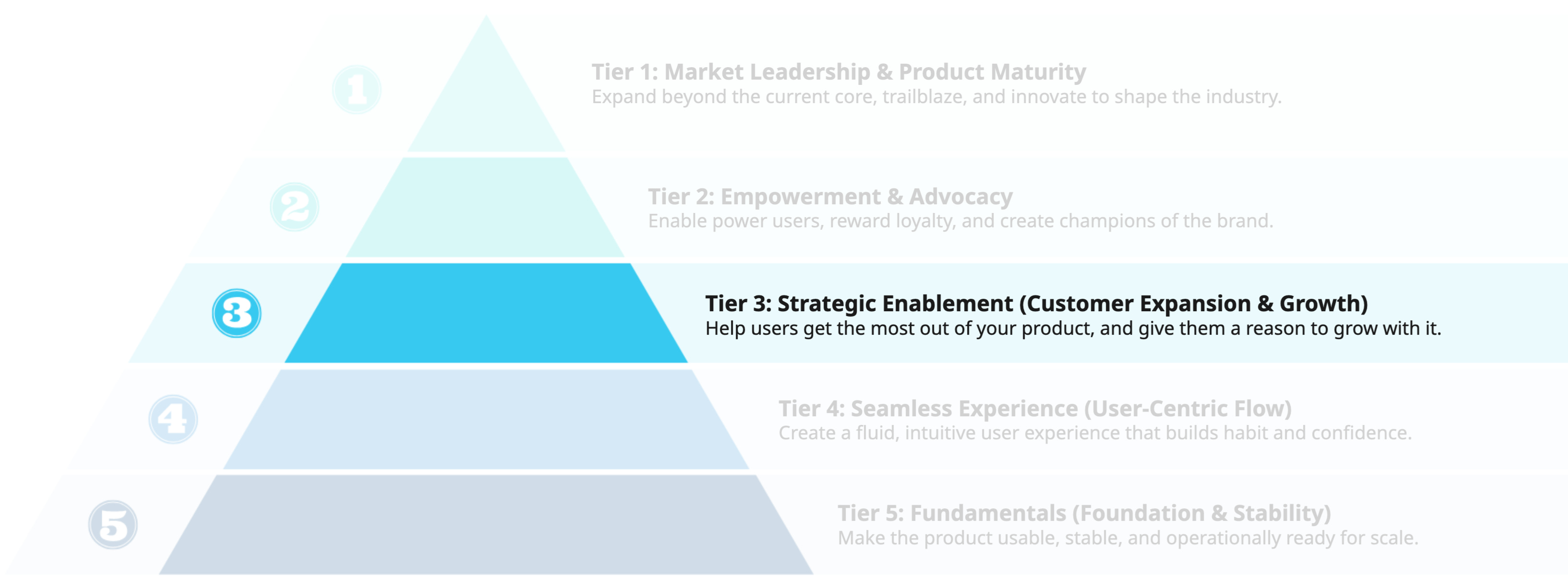
Focus areas:
Improve feature depth and coverage (based on usage and feedback)
Encourage usage expansion (multi-user flows, sharing, inviting)
Add smart upsells: annual pricing, add-ons, advanced tiers
Incentivize loyalty: referral programs, bonus credits
This is the level where customer lifetime value starts to compound. You’re now helping users see not just value — but strategic value.
Tier 2: Empowerment & Advocacy
When customers love your product and have fully adopted it, help them become advocates. This tier turns power users into contributors and champions.
Focus areas:
Highlight successful customers (case studies, social proof)
Build a customer community or forum
Co-create: invite power users to beta programs, roadmap discussions, feature validation
Build spotlight content: “How our top customers use X to drive Y”
Advocacy isn’t luck — it’s cultivated. This tier is about building the relationships and systems that generate word of mouth and deepen engagement.
Tier 1: Market Leadership & Product Maturity
The top of the pyramid — where you shape your industry rather than react to it. This is where innovation, vision, and brand dominance live.
Focus areas:
Launch “big bet” features (e.g. predictive AI, new verticals)
Expand into new markets or personas
Invest in deep integrations, modularity, or platformization
Push content and thought leadership across your industry
Products that operate here are setting trends — not following them. But they’ve earned the right to do that by solidifying every layer below.
Is the Product Hierarchy of Needs Linear?
Not at all. You don’t need to perfect Tier 5 before starting Tier 3.
But if you’re skipping levels entirely — you’ll feel it.
Good product teams move up and down this hierarchy constantly:
A quarter focused on improving onboarding (Tier 4)
While simultaneously launching a beta program (Tier 2)
While also chipping away at tech debt (Tier 5)
The key is awareness: knowing where your weaknesses are and balancing your roadmap accordingly.
How to Assess Your Product’s Maturity
Ask yourself (and your team):
Are customers complaining about bugs or friction?
Is your onboarding flow generating activation consistently?
Are you fielding more support tickets about “how to use” than “how to do more”?
Do you have advocates… or just users?
Is your roadmap full of features — or full of value?
You can also check:
Length of your bug backlog
Age and usability of core flows
Whether you're still relying on legacy scaffolding
If new features follow best practices… or feel improvised
Pitfalls to Watch For
Here are some of the most common pitfalls to watch out for when it comes to your product.
📦 The Feature Factory
Shipping new features constantly without fixing what’s broken. Creates a tangled mess of functionality without cohesion or clarity.
🧩 The MFP Trap (Minimum Functional Piece)
Shipping tiny, disconnected fragments of a bigger idea to "test interest." It leads to fragmented UX and misleading validation. I’ll cover this more in my upcoming MVP series.
🎯 Feature Parity Syndrome
You’re chasing competitors, not leading. You match feature for feature without asking if it aligns with your positioning or vision. This will tie into my Product Positioning series that’s also coming soon.
Final Thought: Compound Product Value
The value of your product is compound — the easier it is to start, the more time users have to explore deeper layers.
But if the basics are broken, the user never sees your brilliance.
They churn before they understand why your product matters.
The Product Hierarchy of Needs is your map.
It helps you zoom out and see what’s really blocking impact — and gives you a structured way to fix it.
Coming Soon
In this ongoing series, I’ll break down each of the 5 tiers in greater detail.
We’ll look at:
Examples of real-world symptoms
Tactics to level up
Checklists and self-assessments you can use with your team
Don’t miss out on the series of the Product Hierarchy of Needs where I break down each tier in detail. Subscribe for free to get the latest released article!
Comments
Nothing yet. Say the first thing.
Sign in to join the conversation.