
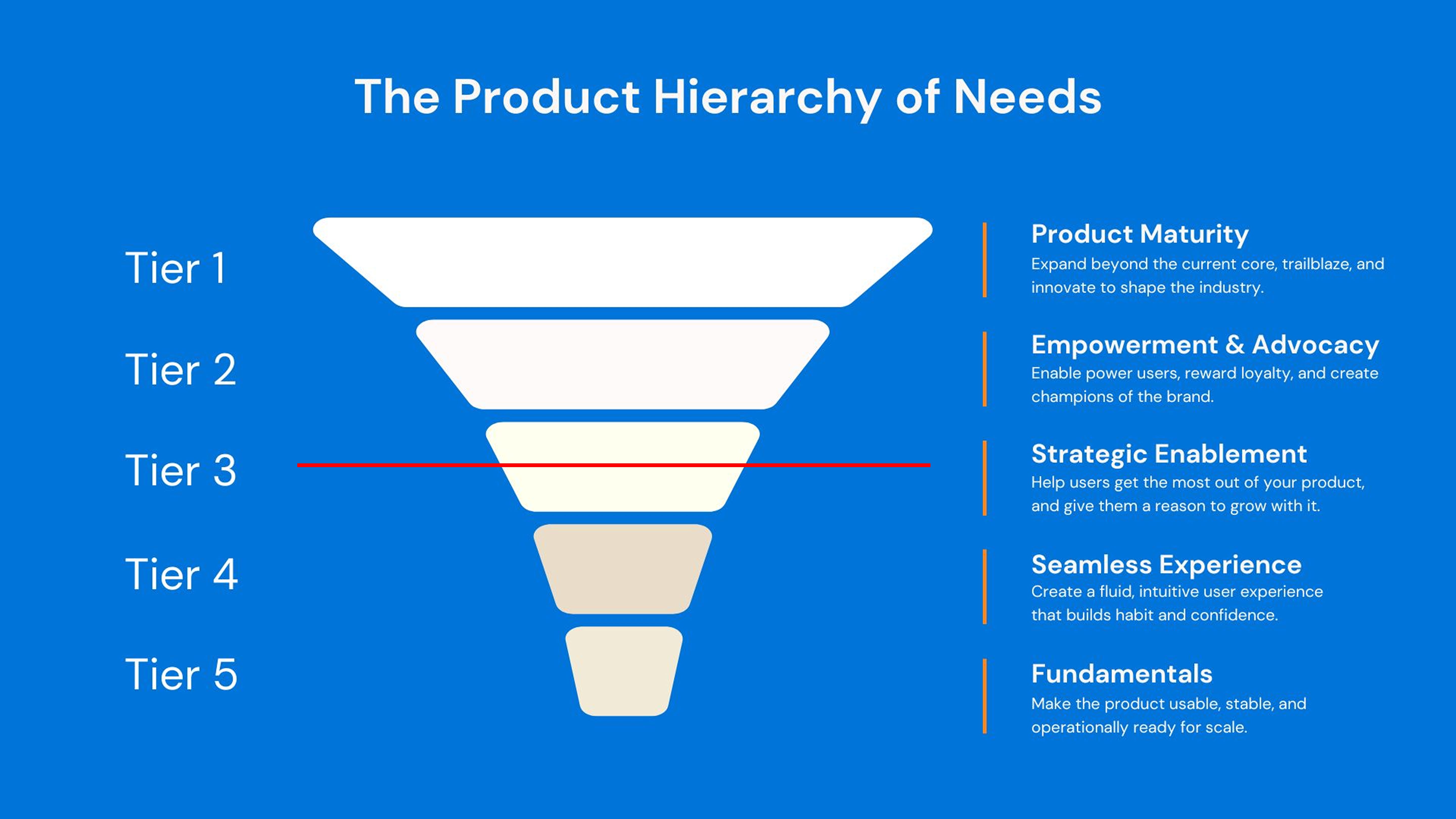
This post is part of a broader framework called the Product Hierarchy of Needs — a model that helps teams assess product maturity and prioritize the right work at the right time. You don’t need to read the full framework to get value here — but if you want the big picture, start here.
Today’s focus is on what I call the Enablement Layer — the part of your product journey where retention becomes expansion, and usage turns into growth.
Retention is no longer the end goal. It’s the starting point for sustainable, scalable product growth.
Once users trust your product and can rely on it (Foundation Layer), and once they can navigate it smoothly (Experience Layer), they’re ready for more.
This is the moment your product shifts from being “a tool” to becoming a strategic assistant.
It’s not just about keeping users around — it’s about helping them win.
Enablement isn't just education. It’s about removing blockers, highlighting opportunities, and nudging users toward better outcomes.
It’s making sure users not only can do more — but that they want to and see the value in doing it.
That’s when you start seeing:
Higher plan upgrades
Multi-user account expansion
Referrals from successful use cases
A jump in lifetime value (LTV)
If you’re seeing these signs, you’re likely stuck between Tier 2 and 3:
Power users plateau after setup — usage levels off
Features are technically available, but underutilized
Teams adopt your tool, but only one person uses it actively
Users are solving problems, but don’t know what’s next
You’re retaining users, yes — but you’re not growing with them.
Let’s look at a real-world example:
One B2B platform noticed that many of their customers were using the product for a single feature. Instead of adding more features or pushing upgrades, they ran enablement audits.
Turns out, users had no idea what else the platform could do.
They didn’t need upselling — they needed unlocking.
The result?
+28% increase in feature adoption
+17% in team invites
And a big spike in expansion revenue — without a single pricing change.
The team rolled out contextual nudges, micro-training inside the product, and guided next steps.
Here’s how to embed this into your product roadmap:
What features are meant to follow core usage?
Are users seeing those paths?
What’s stopping them from expanding?
Use journey analytics + CHS (Customer Health Score) to identify drop-offs.
In-product prompts at the right moment (“Try with your team,” “Create a template from this”)
Tooltips, banners, or emails based on usage patterns
Value-based, not salesy — always show the why
Build shareable actions or artifacts
Add “invite” flows where collaboration is logical
Support admin controls, role management, and handoff flows
If you’re still thinking about individual users in a team-based product — you’re leaving growth on the table.
Smart monetization ≠ paywalling basic features
Let usage lead the upsell. Example:
“You’ve created 3 projects — want to save time with templates?”
Don’t interrupt progress to offer more — show how to go further, faster
No enablement → no expansion
No expansion → limited value realization
Limited value → no long-term retention
No retention → no champions
No champions → no referrals, no scale, no movement
If users aren’t growing with your product, they’re eventually growing out of it.
Use this to assess whether your product is truly enabling growth:
Are users naturally progressing to secondary/advanced features?
Are team-based accounts seeing increased collaboration or invites?
Do users understand how to level up inside your product?
Are there guided nudges helping them expand or go deeper?
Is your monetization aligned with deeper engagement (not basic access)?
If most of these are unclear or underperforming — you're likely stuck here.
Strategic enablement is the layer that turns functional products into essential ones.
If users can’t see what’s next, they stall.
If they stall, they drift.
If they drift, they churn.
This isn’t about pushing features — it’s about opening doors.
This post builds on the Seamless Experience layer — where usability and flow are resolved, but users may still stall.
At this point, the question becomes:
Are you just keeping users… or are you helping them grow?
Strategic Enablement is where you remove hidden blockers, unlock deeper adoption, and empower users to get more from your product — and pay more for it.
If users are sticking around but not expanding…
If upsells feel forced…
If your best customers plateau instead of scale…
You’re probably here.
If this is your first time here:
👉 Start with the full Product Hierarchy of Needs framework
If you missed the last piece:
⬅️ Read: The about the Seamless Experience layer – Designing Product Experiences That Feel Invisible
If you’re ready for what’s next:
Be sure you’re subscribed to get the next drop — From Users to Champions: How to Turn Power Users into a Growth Engine
Comments
Nothing yet. Say the first thing.
Sign in to join the conversation.