
This post is part of a broader framework called the Product Hierarchy of Needs — a model that helps teams assess product maturity and prioritize the right work at the right time. If you haven’t read the full breakdown, you can start here — but this article stands on its own.
Today we’re diving into the Empowerment & Advocacy Layer — where satisfied users become power users, and power users become advocates.
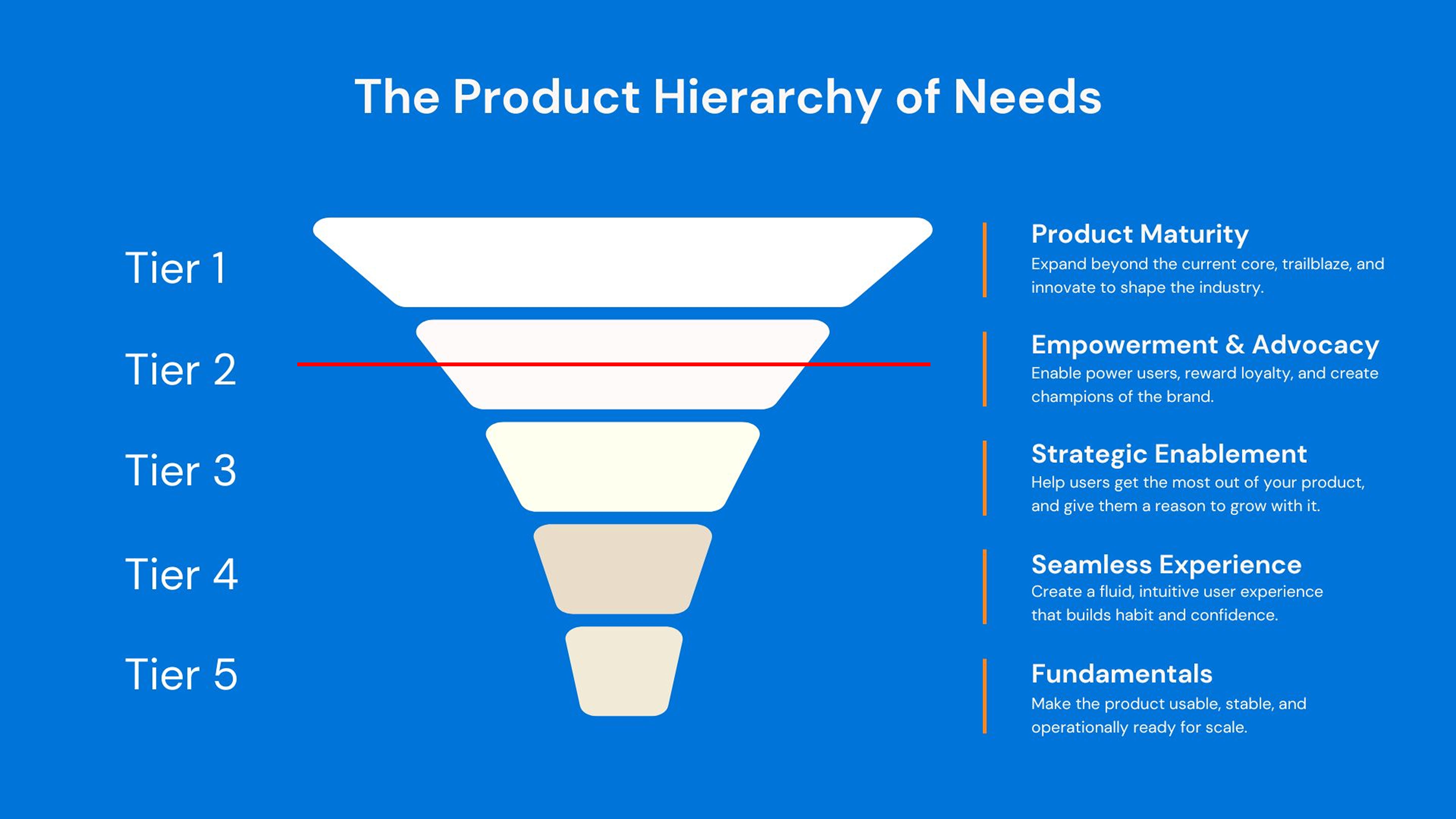
If your users are consistently getting value from your product and you’ve enabled deeper adoption, you’ve done good work. But here’s the question most teams forget to ask:
Are your best users helping you grow — or just quietly succeeding?
The Empowerment & Advocacy layer is where your product starts building social capital.
It’s not just about usage anymore — it’s about influence.
This is where champions emerge, advocacy takes root, and the growth engine starts to become community-powered.
Advocacy is not a viral loop. It’s not a shoutout on LinkedIn.
It’s when users:
Share your product in team meetings because it’s indispensable
Volunteer for your next beta without being asked
Refer others not because of a reward — but because it’s genuinely helpful
Shape your roadmap with constructive, visionary input
This layer is about empowering your users to have a voice in the product, not just with it.
Looking for the classic tell-tale signs to know if you’re stuck here?
You have loyal users, but no real brand advocates
No one shares your product organically — it’s all paid or pushed
You’ve never had a user co-create with you or offer early feedback unprompted
Case studies and social proof are hard to come by
There’s no dedicated “place” for your best users to connect
Let’s look at a real world example
A B2B SaaS tool had a 90%+ renewal rate — but flat referral numbers and little inbound buzz.
Users were satisfied, but isolated. The company had no system for early access programs, no user community, and no mechanism for showcasing customer wins.
They introduced lightweight feedback groups, launched an “insiders” program, and featured 3 user-led success stories on their blog.
Within 2 quarters:
Case studies tripled
Referrals spiked 22%
Power users started requesting webinars, panels, and speaking opportunities
They didn’t create advocates.
They recognized and supported the ones already waiting to speak.
Who's consistently using advanced features?
Who’s solving meaningful problems with your product?
Who gives great feedback — even when it’s tough?
Recognize them early. Invite them deeper.
Create early access/beta tester programs
Offer roadmap previews and feedback loops
Use their input to influence, not override, product strategy
Power users love to contribute — if you give them a channel.
Slack groups, forums, user meetups, peer cohorts
Curate conversations — don’t just dump users into empty spaces
Consider tiers of engagement (observer → contributor → co-creator)
Offer story templates for case studies
Run “customer spotlight” posts
Share screenshots of real use cases (with permission)
Advocacy dies in silence. Give it a microphone.
No empowerment → no champions
No champions → no social proof
No social proof → no trust from prospects
No trust → higher acquisition costs
High acquisition costs → weaker growth economics
Your best advocates are already inside your product.
If you don’t empower them, your competitors eventually will.
Use this to check if your product is nurturing real champions:
Do you know who your most successful users are?
Do you have a space or program that supports power users?
Are you getting unsolicited praise, referrals, or feedback?
Do you have systems to capture and share customer stories?
Are advocates helping shape product direction (without derailing it)?
Do you have powerful testimonials or case studies
If these aren’t in motion, this is the layer to focus on.
Empowered users aren’t just retained — they’re invested.
They invite others in. They co-create. They spread belief.
And they become your most resilient source of growth in any market.
Advocacy isn’t a bonus.
It’s a strategic asset — when you know how to unlock it.
This layer is part of the Product Hierarchy of Needs, a framework for mapping product maturity and identifying what to focus on next.
If you’re already seeing strong engagement and feature adoption, you’re likely here.
If you’re not seeing referrals, social proof, or inbound love — this is your next move.
If this is your first time here:
👉 Start with the full Product Hierarchy of Needs framework
If you missed the last piece:
⬅️ Read: The about the Strategic Enablement layer – Don’t Just Retain Users — Help Them Grow With You
If you’re ready for what’s next:
Be sure you’re subscribed to get the next drop — Shaping the Category: How Mature Products Drive Innovation
Comments
Nothing yet. Say the first thing.
Sign in to join the conversation.