
I spent the last week in beautiful Chicago at the biggest cancer conference in the world (ASCO: the American Society of Clinical Oncology). There were thousands of new discoveries presented, in posters and talks — here are the best ones.
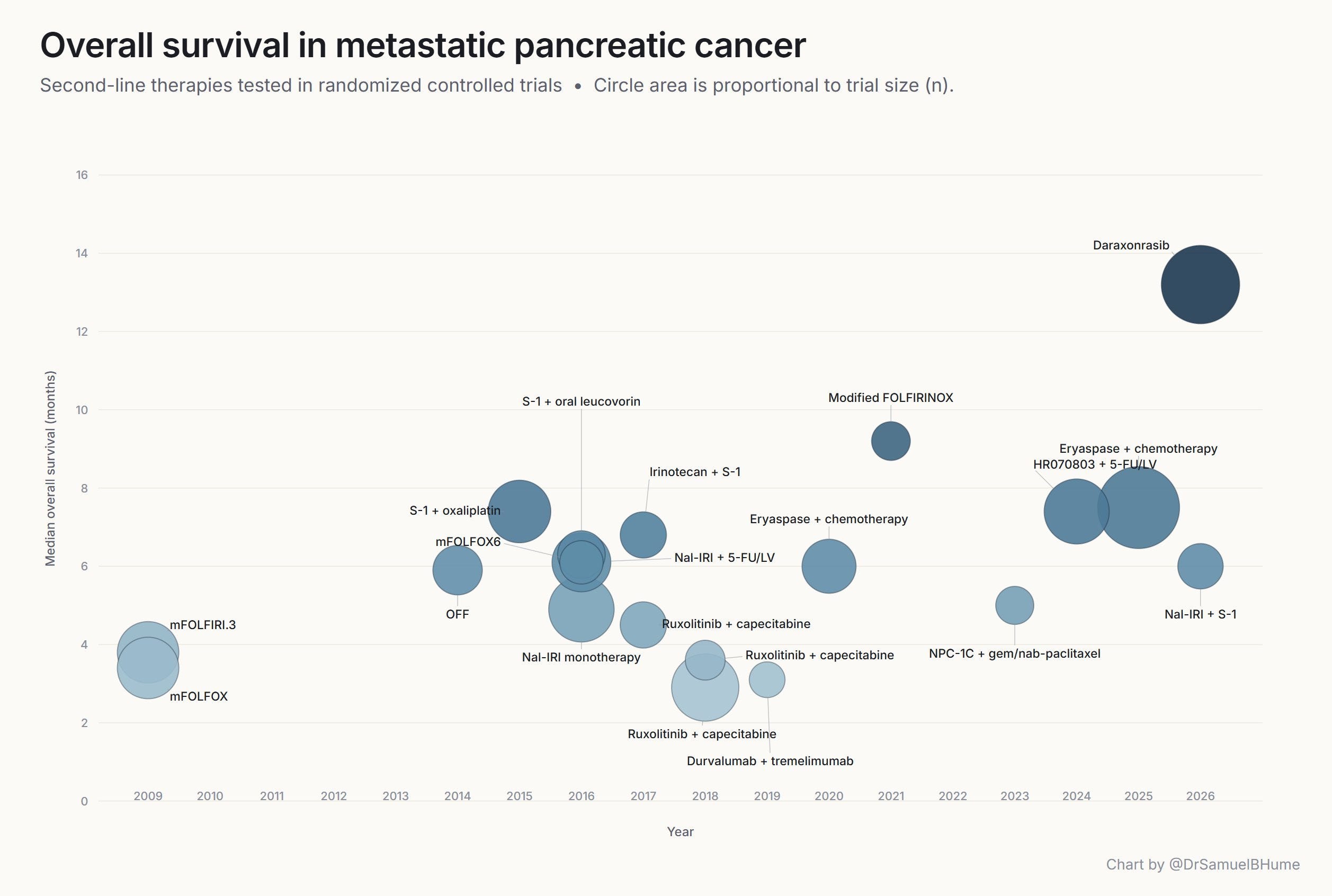
The story of the meeting was Revolution Medicines’ full phase 3 dataset, for Daraxonrasib vs. chemotherapy in metastatic pancreatic cancer. This was greeted by a standing ovation (in the middle of the talk!) which I recorded here:
Here’s the full Kaplan-Meier curve:
There are two reasons this is so important. First, many trials have been done in this setting, all of which failed to improve (or only incrementally improved) the standard of care. Daraxonrasib inhibits the oncogenic driver in pancreatic cancer, RAS, producing this step change in survival and laying the new foundation of therapy:
Second, RAS was king of the undruggable, and it took some serious creativity to inhibit it. Daraxonrasib is a 'molecular glue' that locks RAS into an inactive trimer with a third molecule, Cyclophilin A. This works for many species of RAS — both wildtype and mutant forms — and Daraxonrasib binds RAS in its ON state (which produces more potent inhibition than OFF state inhibition). This also gives rise to the name: Darax-ON-RAS-IB.
As well as doubling average survival, Daraxonrasib improved quality of life and reduced pain associated with pancreatic cancer:
What's next for Daraxonrasib? More trials! 1st line in metastatic pancreatic cancer, and after surgery in resectable disease. RAS is also a major driver in lung cancer and in other solid cancers, like colorectal, so Revolution Medicines are running trials there, too:
Daraxonrasib is far from the only RAS inhibitor moving through trials — these are some of the other ongoing phase 3 trials. There are many others in earlier phases, too – the more the merrier!
There were trials presented for new, innovative therapies — antibody-drug conjugates (ADCs), vaccines, bispecific and even trispecific(!) antibodies.
One that caught my eye was this trial in cancer cachexia (weight and muscle loss in advanced cancer). There are no targeted therapies approved for this condition, but it’s become pretty well-established that a stress-induced cytokine, GDF15, drives it, and recently were recently positive phase 2 data on a GDF15-blocker from Pfizer.
This approach from ASCO builds on that idea with a bispecific antibody that inhibits both GDF15 and IL6 — blocking the driver of cachexia (anti-GDF15) and suppressing inflammation (anti-IL6).
In patients with advanced cancer and cachexia, the antibody increased bodyweight (up to 25% for high dose vs. low dose), increased muscle mass, and increased appetite. The presenter of the poster told me that patients’ main complaint was... gaining too much weight.
These new, final, 5-year phase 2b data were presented for Moderna/Merck’s personalised cancer vaccine (plus the standard of care, Pembrolizumab, a PD1-blocking antibody) in resected melanoma. Melanomas were removed by surgery, personalised vaccines built based on specific cancers’ mutations, with the aim to prevent recurrence — and it worked: there was less recurrence and less metastasis.
Based on a similar idea, these data, from a Chinese biotech, dropped in esophageal squamous cell carcinoma. This condition has huge unmet need, with average disease-free survival of about 22.4 months with the best standard-of-care (PD1 blockade). This personalised neoantigen vaccine looks like it might extend disease-free survival, when used after surgery:
Beyond this, there were new data on a trispecific anti-PD1/CTLA4/VEGF antibody in lung cancer, new data on CEACAM5-targeted CAR-T cells in colorectal cancer, and data on a neoantigen vaccine in glioblastoma, where there’s been minimal progress for decades.
Comments
Nothing yet. Say the first thing.
Sign in to join the conversation.