
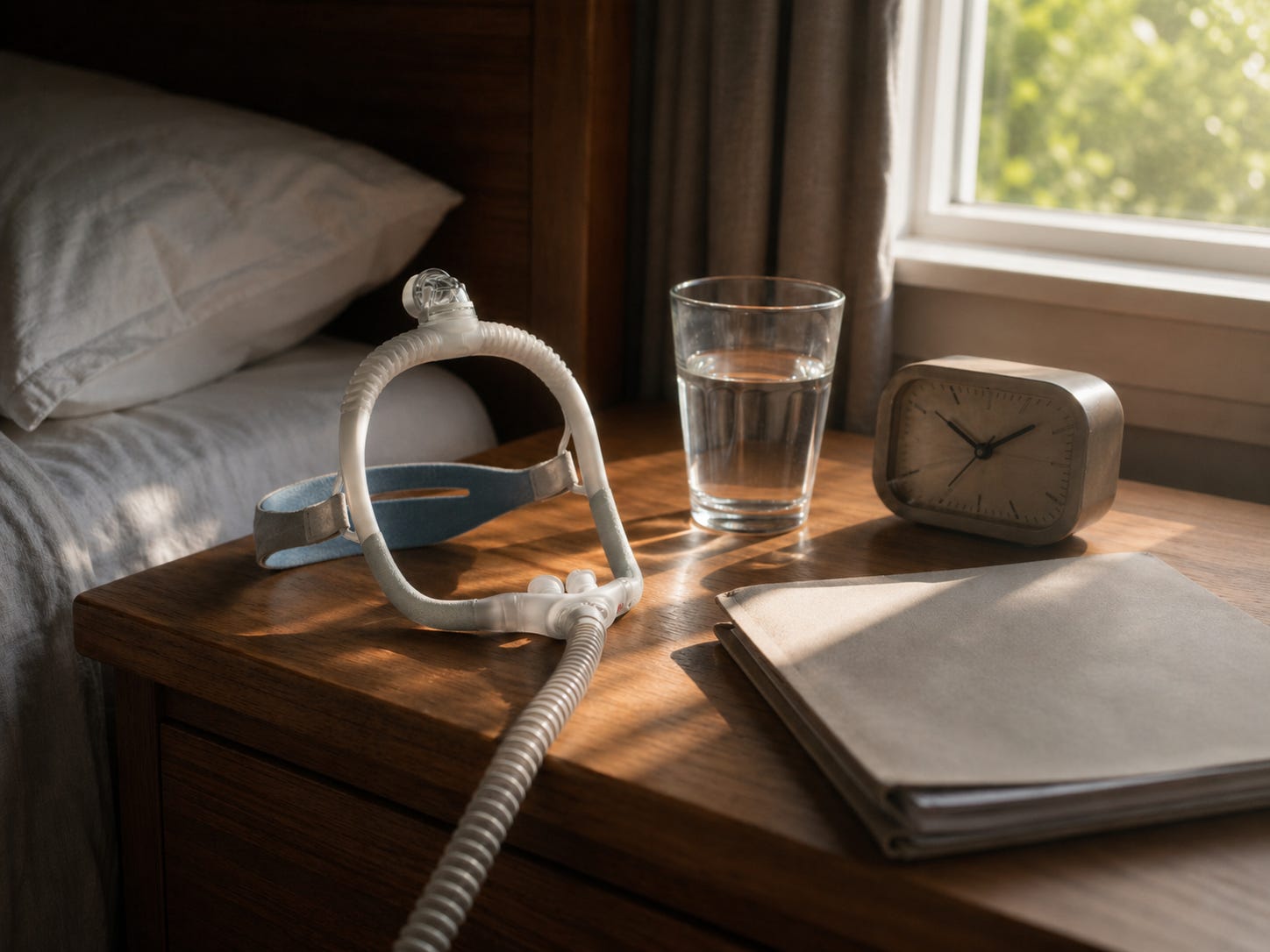
Through medical school and residency, I saw sleep apnea all the time.
I reviewed sleep studies. I explained AHIs. I counseled patients on CPAP.
I just never thought to apply it to myself.
I was exhausted for years and blamed training, call shifts, and stress. My wife told me I snored loudly. My mother has severe sleep apnea. I still brushed it off.
Doctors really are the worst patients.
Eventually, I got tested. The result: mild OSA overall, but strongly REM-predominant.
At first, some people might think: “Great, now I have to treat this too”.
But I saw it differently: “I get to treat this”.
Sleep is one of the biggest levers for energy, mood, health, and performance. This gave me something measurable I could optimize.
Most people know sleep apnea matters. But here’s why I treated mine seriously, even though the overall result was only “mild.”
The strongest evidence is the MERGE trial (2020). Over 300 patients with mild OSA were randomized to CPAP or standard care for 3 months (Wimms et al., 2020).
More energy: CPAP improved a measure of vitality by 10/100 points, a meaningful boost in day-to-day energy.
Less daytime sleepiness: Patients felt more awake and alert during the day.
Less fatigue: CPAP helped reduce that drained, low-energy feeling.
Better mood: Depression symptoms improved.
Better sleep quality: Insomnia symptoms also improved.
The takeaway: even in mild OSA, CPAP can meaningfully improve how people feel, especially energy, sleepiness, fatigue, mood, and sleep quality.
It should be noted that this study was funded by ResMed (a CPAP manufacturer).
A meta-analysis pooling 51 randomized trials on sleep apnea found:
CPAP reduced systolic BP by about 2.5 mmHg and diastolic by about 2.0 mmHg
Each extra hour of nightly use → about 1.5 mmHg more systolic reduction
Oral appliances showed comparable BP effects (Bratton et al., 2015)
Modest, real, dose-dependent.
And while a 2 to 3 mmHg drop may sound small, blood pressure is one of those variables where small changes can compound over time. Lower BP means less chronic strain on the heart, brain, kidneys, and blood vessels and preventing high blood pressure reduces risk of heart attack and stroke.
I wrote a full evidence-based protocol on how I’d lower blood pressure without medication here:
Some people see “mild” on a sleep study and shrug it off. The number that caught my attention was my REM-specific AHI, and it changed how I interpreted the result.
The problem: REM is only about 20-25% of total sleep. If your apneas cluster there, your overall AHI averages them out across the whole night and makes the picture look milder than it actually is.
The associations from observational studies are highly concerning:
Higher REM-AHI independently predicts morning hypertensive blood pressure, even after accounting for non-REM events, BMI, and age (Falla et al., 2023)
Higher REM-AHI was linked to roughly a 7-fold increase in odds of metabolic syndrome (Koo et al., 2020)
REM-OSA is associated with worse insomnia symptoms, with a stronger signal in women (Hoshino et al., 2020)
Higher REM-AHI may matter for the brain too: in older adults at higher Alzheimer’s risk, REM sleep apnea severity was linked to worse verbal memory (Lui et al., 2024)
REM is one of the most important stages of sleep. It’s where memory consolidates, where mood gets regulated, where the brain does some of its most important recovery work.
That’s exactly where my events clustered.
Even with a “mild” overall label, choking or obstructing every few minutes during the stage of sleep that mattered most was not something I could shrug off. That’s what made me personally keen to treat.
Here were my options:
CPAP: best evidence base. My choice.
Oral appliance therapy: May provide comparable symptom improvement in mild OSA for some patients, but it is expensive and did not seem ideal for me given my history of TMJ issues.
Surgery: can be effective for the right anatomy, but I avoided it.
Medications: there is emerging evidence for certain pharmacologic approaches in select patients with OSA. But I am not overweight, and for me personally, I would prefer to avoid exposing myself to potential long-term medication side effects when an effective non-pharmacologic option existed.
In medical school, I saw a previously very healthy young person nearly die from a post-tonsillectomy bleed. What should have been a routine recovery turned into a bedside emergency. They survived, but it shook me. I’m not anti-surgery, but after that experience, my own bar for surgical options, especially for something I could manage non-invasively, is very high.
Before CPAP, I was sleeping a solid 8 hours most nights and still waking up tired. I didn’t actually realize how tired I was, because it had become my baseline. My body was getting the time. It just wasn’t getting the recovery.
After about a week on CPAP, I started noticing something strange: I could go to bed an hour later, sleep for 7 hours, and wake up more refreshed than I had on 8.
I also started using it for naps when I could fit them in. A nap with the mask on left me feeling sharper than longer naps without it. Same input, much better output.
However, it didn’t fix everything. I still get the typical afternoon dip in energy, which is a normal circadian phenomenon, not a sleep apnea problem. CPAP is not going to upend your day. But my mornings and evenings are dramatically better, and that’s where most of my fatigue used to hit.
The label was mild. The fatigue was not.
Most sleep apnea is undiagnosed. Don’t wait for it to become obvious.
Classic symptoms (any of these is worth raising):
Loud habitual snoring
Witnessed apneas, gasping, or choking during sleep
Unexplained daytime sleepiness (the symptom most responsive to treatment)
Unrefreshing sleep or fatigue not explained by anything else
Frequent nighttime awakenings
Nocturia (waking repeatedly to pee)
Morning headaches
Sleep apnea also travels with conditions that often quietly coexist with it: high blood pressure, atrial fibrillation, heart failure, pulmonary hypertension, diabetes, metabolic syndrome, or excess weight. Having one of these doesn’t mean you have OSA. But if you also snore, wake gasping, feel unrefreshed, or struggle with daytime sleepiness, it’s a conversation worth having with your doctor about a sleep study.
I could have dismissed my own diagnosis and kept going at the same pace. I didn’t realize how tired I’d been until I wasn’t anymore.
I’m glad I didn’t.
If something about your sleep feels off, the snoring, the fatigue, the morning fog that won’t lift, take it seriously enough to ask. The cost of getting tested is small. The upside, if you’re anything like me, is an extra hour of more productive life every day.
The downside of ignoring it is also real: higher long-term risks of hypertension, atrial fibrillation, stroke, and cardiovascular disease. You feel the fatigue today. The rest accumulates quietly.
Don’t be the patient (or doctor) who waits.
Thanks for reading. If you found this helpful, a like or restack means a lot and helps others discover it.
This newsletter is for educational purposes only. It is not personal medical advice. Opinions are my own. Always consult your own health-care provider for medical guidance.
No posts
Comments
Nothing yet. Say the first thing.
Sign in to join the conversation.