
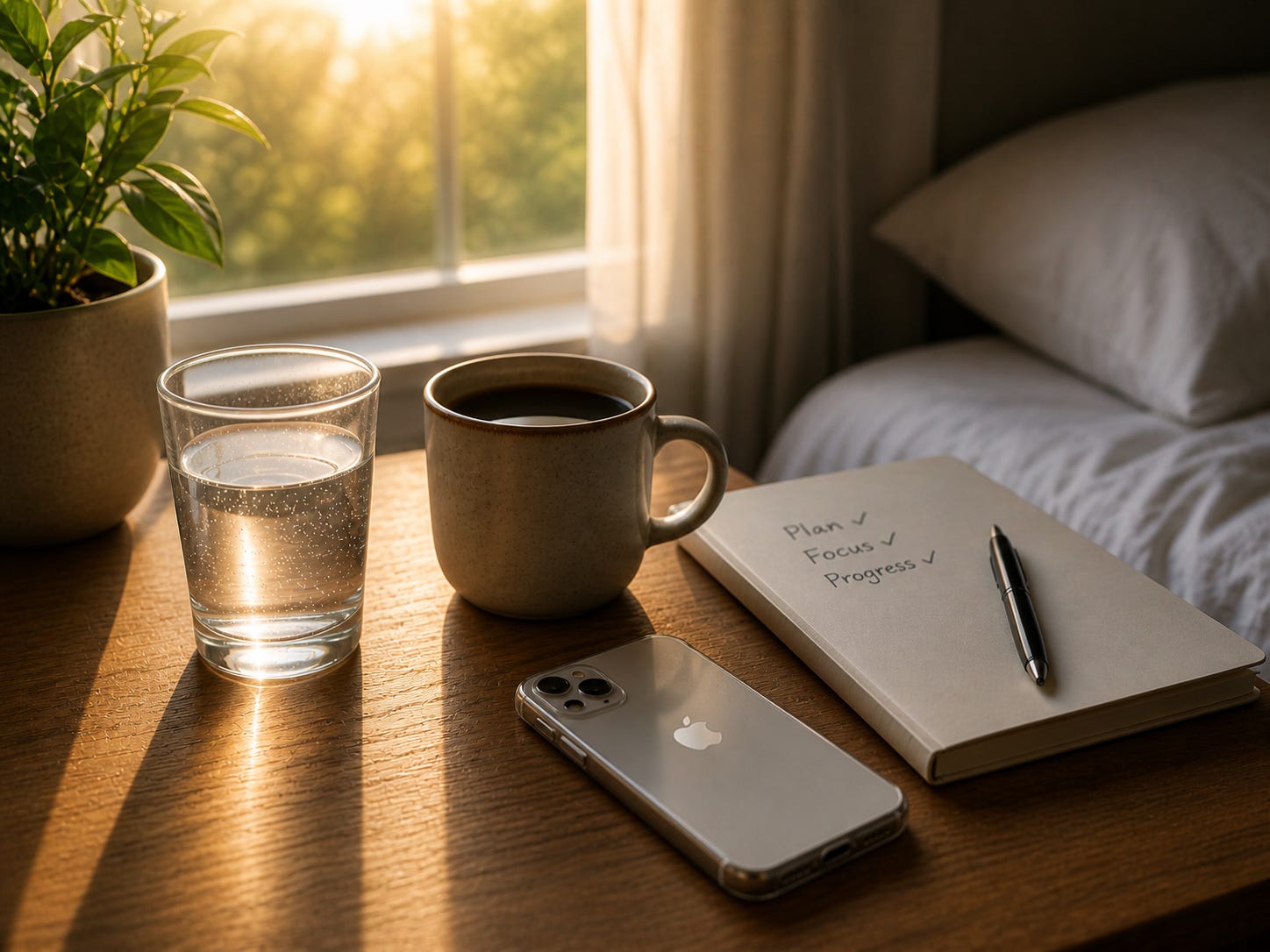
For most of my teenage years and early twenties, my mornings followed the same script: alarm, snooze, snooze, phone, and 30 minutes disappearing into a half-awake scroll before I had even left bed.
Then coffee.
Then out the door without daylight, movement, or anything resembling a real breakfast.
I told myself I was a night person. The truth was simpler: I was letting my morning routine set the state of my brain before the day had even started.
When I finally needed to pull myself in medical school, I rebuilt the first hour from scratch — and the gap between a good morning and a bad one is not subtle.
Here are the habits that worked wonders for me:
My old morning routine was not “waking up.” It was, like many others, handing the first 30 minutes of my attention to an algorithm.
Dopamine helps the brain decide what is worth paying attention to. The problem with checking your phone first thing is that it gives you rapid, effortless rewards before you have done anything difficult: a notification, a message, a headline, a funny clip, another scroll.
That teaches the morning brain to expect stimulation without effort.
A 2025 RCT used an app to block all mobile internet on participants’ smartphones for 2 weeks. The intervention improved mental health, subjective well-being, and objectively measured sustained attention. 91% of participants improved on at least one of these outcomes (Castelo et al., 2025). They also spent more time socializing in person, exercising, and being in nature.
I keep my phone in another room. I don’t check it until I have had light, water, movement, and coffee. For a deeper dive into how phones hijack attention and what to do about it, I wrote more about building a healthier relationship with your phone here.
This is the habit where I noticed the biggest immediate difference: I feel more awake in the morning, less foggy through the day, and more ready to sleep that night.
Light hitting the back of your eye suppresses melatonin and tells your master clock the day has started.
In a randomised trial in night owls, a morning routine built around earlier sleep-wake timing, morning bright light, fixed meals, caffeine timing, and exercise timing produced a ~2-hour phase advance in sleep timing, reduced self-reported depression and stress, lowered morning sleepiness, and improved simple measures of cognitive and physical performance, including reaction time and grip strength (Facer-Childs et al., 2019). It was bundled, so we can’t isolate light alone, but morning light is one of the strongest signals telling your body that the day has started, helping suppress melatonin and reinforce the natural cortisol rise that makes you feel awake.
Outdoor light beats any indoor light, even on a cloudy day. If you can’t get outside, or it is still dark when you wake up, a 10,000-lux lamp helps. More on the optimal morning light strategies here.
Your wake time is the foundation everything else stacks on. Drift it by 90 minutes on the weekend and you spend Monday morning paying for it.
In a 30-day study of college students, more regular sleep-wake patterns were associated with higher GPA. The irregular sleepers also had delayed melatonin timing and a delayed sleep-propensity rhythm, roughly equivalent to shifting their biology 2 to 3 time zones later. The effect was not simply because they slept less; sleep duration was not significantly correlated with GPA (Phillips et al., 2017).
In another study of college students, simply regularizing sleep-wake schedules reduced daytime sleepiness and produced greater, longer-lasting improvements in alertness than giving students a sleep-duration target alone, even when both groups were told to sleep at least 7.5 hours (Manber et al., 1996).
Protocol: Pick a wake time you can keep. Hold it within 30 to 60 minutes, including weekends.
You have just spent 7 to 9 hours fasting and losing water through breath and skin. Dehydration can quietly affect how you feel in the morning.
In an RCT of 64 young adults, after 12 hours of water restriction, 500 mL of water improved working memory, while 200 mL was enough to reduce anger, fatigue, and total mood disturbance (Zhang et al., 2020). Cheapest cognitive intervention on this list.
In healthy young women, losing just 1.36% of body mass from dehydration was enough to make concentration feel 45% worse, tasks feel 58% harder, fatigue rise 17%, and headaches become about twice as common (Armstrong et al., 2012).
I drink a glass of water every morning after my coffee.
Comments
Nothing yet. Say the first thing.
Sign in to join the conversation.