
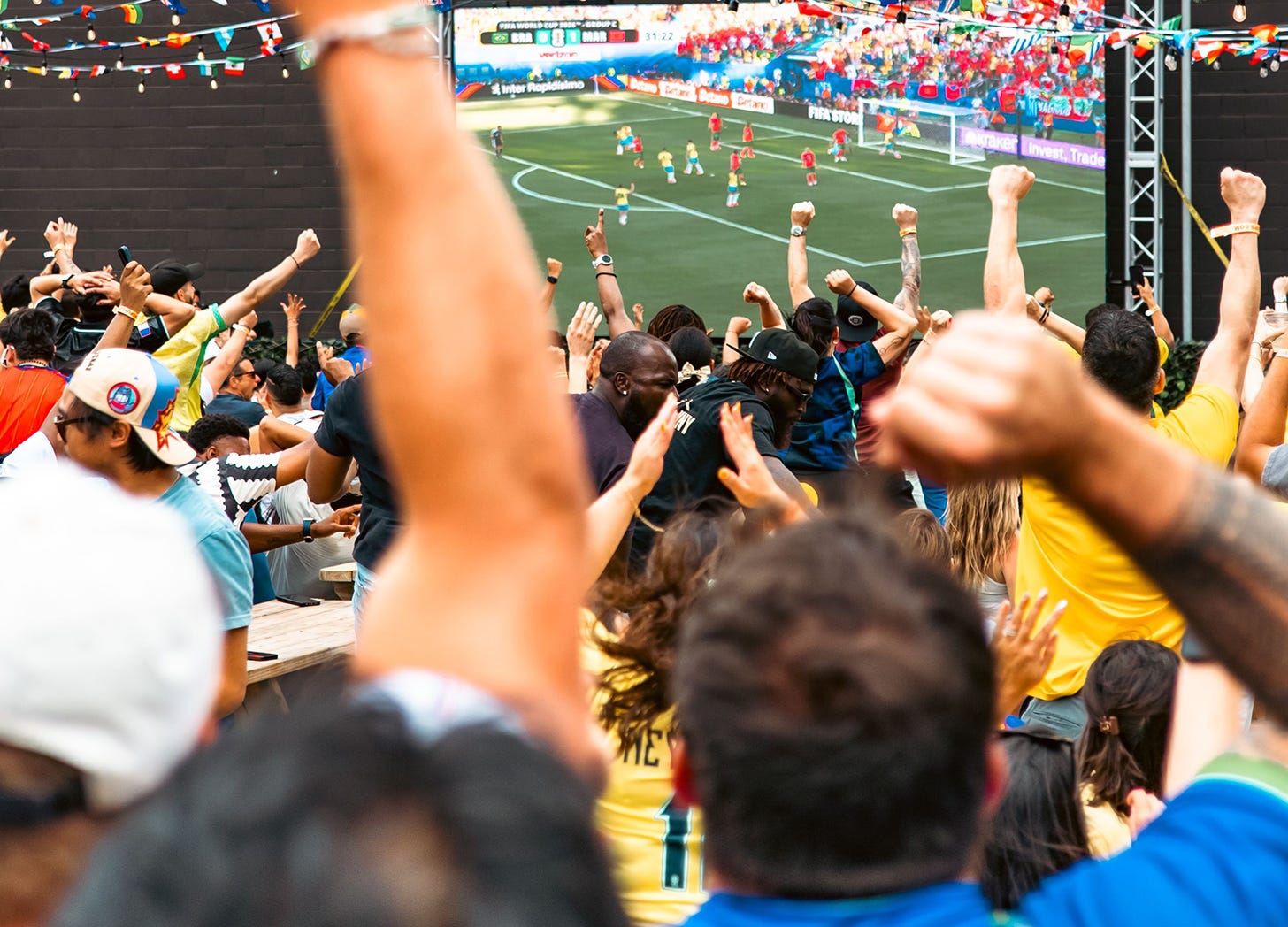
I’ll admit that I have never really understood soccer. So it makes what happened to me this summer even stranger.
For most of my life the World Cup came and went without me. This time I watched anyway. So did plenty of Americans who had never followed the sport before. Mostly I watched with family, and somewhere in the middle of it I stopped being a bystander. I remember asking, during one match, which of the players I was supposed to be watching. The answer came back from everyone at once: All of them. Watch all of them. Watch what they do as a team!!
You might be tired of hearing about the World Cup by now. It has been weeks, and the coverage has already moved on. But that pull to move on, or not, is part of what I want to talk about.
What I felt watching with my family was happening in a lot of places. For a few weeks this summer, a good part of the country reached for the same thing at the same time, on a schedule, and then that schedule ended. I have spent my career studying how human beings grow and what they need in order to do it, so I could not leave the question alone.
What happens to a community that spends a month like that together, cheering for their country and their teams?
The first thing worth noticing is how long it went on. One big night would have been easy to explain. This was many weeks of them, an unofficial calendar laid over ordinary life, a reason to gather together on a weeknight. People took up a common subject with neighbors they barely knew. Some wore the colors of countries they had never once set foot in. For a stretch of weeks, strangers had something to say to one another, and for once it was not about the headlines we usually argue over.
In 2023 the Surgeon General reported that roughly half of American adults were living with loneliness, and he placed weak social connection in the same category of health risk as smoking. That is the ground the tournament fell on. Half of us going without, and then, for a few weeks, we gathered around the same thing without anyone telling us to.
More than a century ago the sociologist Émile Durkheim gave this feeling a name. He called it collective effervescence: the current that runs through a group of people gathered around something they all care about. Durkheim believed communities had to come back to that gathering, again and again, on a rhythm, or they would slowly unravel.
The psychologist Shira Gabriel has spent years studying what that state does to a person. She finds it is two feelings woven together: a sense of connection to the people right around you, and a sense of belonging to something larger than any of you. You do not need to know the strangers beside you, and you may never see them again.
This makes sense given what connection does to a brain that is at rest. The neuroscientist James Coan and his colleagues ran a now well-known set of studies in which people faced the threat of a mild shock inside a brain scanner. Alone, the brain’s threat response ran high. Holding the hand of someone they trusted, it came down. Coan’s account, which he calls social baseline theory, is that the human brain evolved expecting other people to be nearby, and that their presence lets it do less of the work of watching for danger.
A brain that is not braced for threat has room to do other things. Research from psychologist Barbara Fredrickson describes how shared, positive feeling opens us up. When we feel it — through a shared, positive experience — we tend to notice more, and we find it easier to try something or to talk to a stranger. And it leaves something behind. The friendships it sparks and the sense of possibility it creates can stay with us long after the feeling itself is gone.
A single night of that feeling can stir something in you, and then it passes. What the month gave us instead was repetition, and anticipation. That is what turns a feeling into something that lingers and even sticks. Watch the same thing with the same people long enough and the strangers stop being strangers. That kind of familiarity is the soil connection grows from, and for a few weeks it was forming in living rooms and cities and pubs all over the country. For a short while, a lot of us were more open, and more ourselves, more connected than usual.
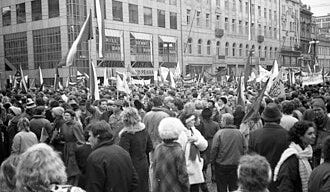
People behave in a crowd in ways they would not dare alone. Durkheim understood how much can follow from that. He was clearly not a sportswriter; he was writing about how a society holds together, and how it sometimes changes. The moments we remember as major turning points were, before anything else, enormous numbers of people standing in one place. A quarter of a million of them gathered on the Mall in Washington in 1963 for the march where King described his dream. In Prague in 1989, a square filled night after night until a government that clung to power for four decades let go of it. Václav Havel — the dissident playwright who emerged as his country’s president that winter — had spent years making the argument underlying all of it: that this kind of power belongs to ordinary people, and that it begins when enough of them stop pretending to believe a lie and take up cause together. Those crowds kept coming back, night after night. The rhythm mattered there too.
Nobody should confuse a tournament with a movement. But those stadiums held a mass of humanity caring deeply about one thing. I kept thinking about what people have done when they gather like that. So much of the drama came down to belief: that something nobody thought was possible might actually happen. Paraguay knocked four-time champions Germany out on penalties. Cape Verde, an island nation of half a million playing in its first World Cup, held the eventual champions to a scoreless draw. None of this changed the world. But for a few weeks, millions of us were feeling the same thing at the same time and witnessed human possibility on a grand stage.
Then it was all over, and it would be easy to think that the feeling ended with it. I do not think that is true. Gabriel’s research finds that the lift from a gathering like this outlasts the gathering itself; the feeling did not leave you when the tournament did. What left instead was the predictable rhythm. For a month we had a shared schedule that pulled us toward each other whether or not we made the effort. The schedule is gone, and without it we slide back to the American default, which often results in each of us alone in front of a different screen.
Part of what drew people in, I think, is how little the game of soccer asks of you. You do not have to be rich to learn or play it. In much of the world a child needs a ball and some open space, and that is the cost of entry. I heard someone make this point after the tournament, that soccer is a working-class game in a way most of our sports are not. And that resonated with me, because the same thing that makes the game open makes the watching of it open. You did not have to be a real fan to feel welcome in that room or that pub. That, maybe even more than the soccer, is the part worth hanging onto.
And the good news is that we do not need a World Cup, or any big sports tournament, to get this. We can make a different choice. By Gabriel’s account, this kind of experience is common rather than rare, and people meet it in ordinary places: a choir, a packed exercise class, a dinner where no one immediately reaches for a phone.
Underneath all of it, many of us were showing up for the same thing, with some of the same people, often enough that it began to matter. That is something you can build on purpose, and it takes less than you might think.
I keep going back to my family telling me to watch all of them, to pay attention to every player and not just one. To pay attention to how they played together as a team, sensed each other’s location. They were not ranking anyone. They were pointing at what it had taken each of those players to get there, which is another way of saying that nobody becomes who they are alone or gets to a level like this by themselves. After studying this for decades, it was strange to hear my family say it to me during a soccer match.
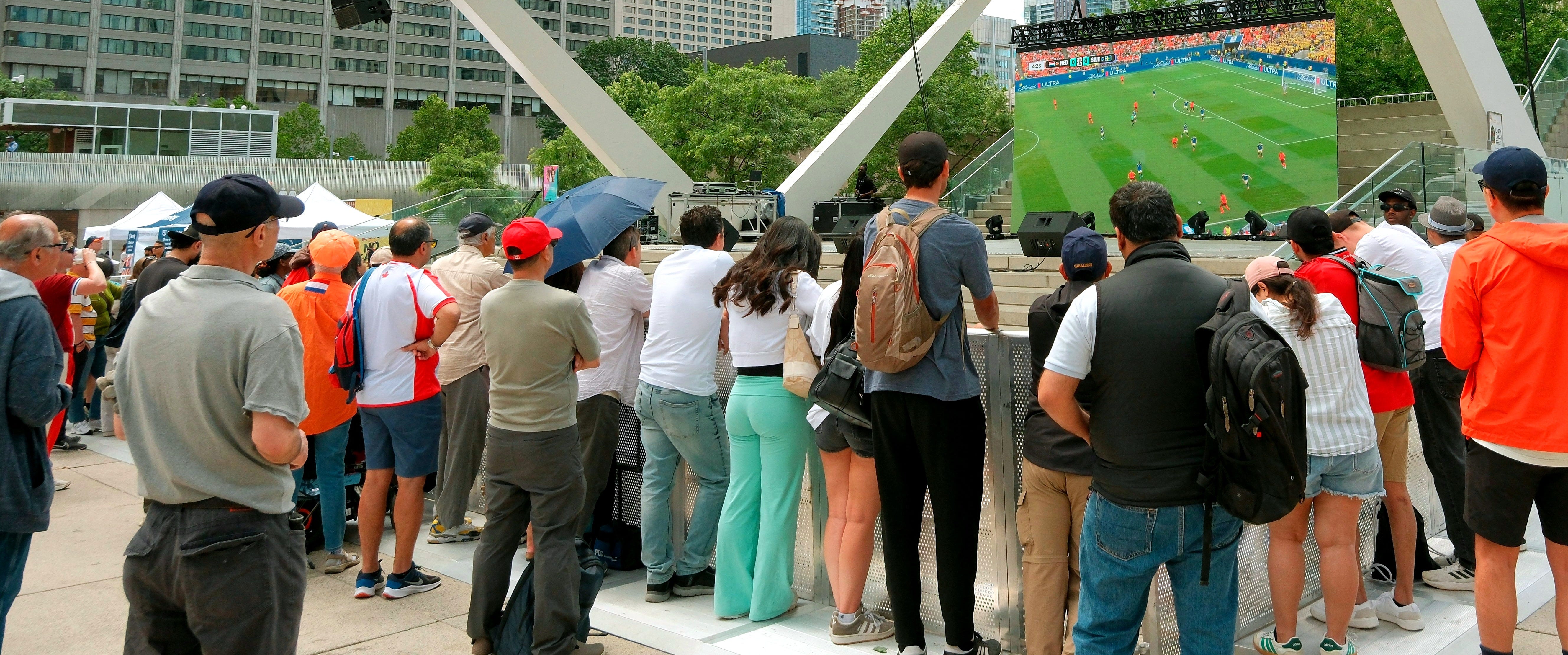
The World Cup is over and most of us have moved on. So many of the games were exhilarating and worth watching on their own, but they also gave us a standing reason to be in the same place, with other people, attuned to the same thing, believing, if only briefly, that the unthinkable was possible.
And that is the part you can make happen yourself. Pick one thing that repeats — maybe a standing dinner or a class at the same hour every week — and commit to showing up for it. Then try to leave the door open wide enough for someone else to come along with you. I cannot promise the heart-pounding thrill of a penalty shootout. What I can promise is that you will not be doing it alone, and I do not think we should wait around for another tournament to arrange that for us. Or watch it by ourselves on a screen. This is something each of us can do in community with others.
If this sparks something, I hope you will send it to someone who needs it. Tell me your own version in the comments. I read them. And if you want to keep going with me on the science of how we become who we become, subscribe.
Thank you for being here.
— Pam
Comments
Nothing yet. Say the first thing.
Sign in to join the conversation.