
A few weeks ago, during a consulting session, I was talking with a client about emerging trends in hospital operations when the conversation took an unexpected turn. He told me the next big problem in hospitals was going to be a space problem.
Space? I asked. Hospitals are already large. He smiled. Not space to grow, he corrected me. Space to reorganize.
Of course. Now there’s more free space in the pathology area. Before, you needed one or two pathologists per office. But now with digital pathology, everyone is diagnosing from home. The offices are empty. We need to figure out what to do with all that room.
He said it with the ease of someone describing a storage reorganization. No alarm. As if it were the natural consequence of a sound technology investment.
And technically, it is. Digital pathology works. Scanners are precise, viewers are fast, pathologists can work from anywhere. The hospital bought technology to solve a problem, and the technology solved it. The issue is that no one had asked whether that was the only problem that needed solving.
We built software to eliminate distance. What we didn’t see is that in doing so, we created a different kind.
The Invisible Infrastructure of Diagnosis
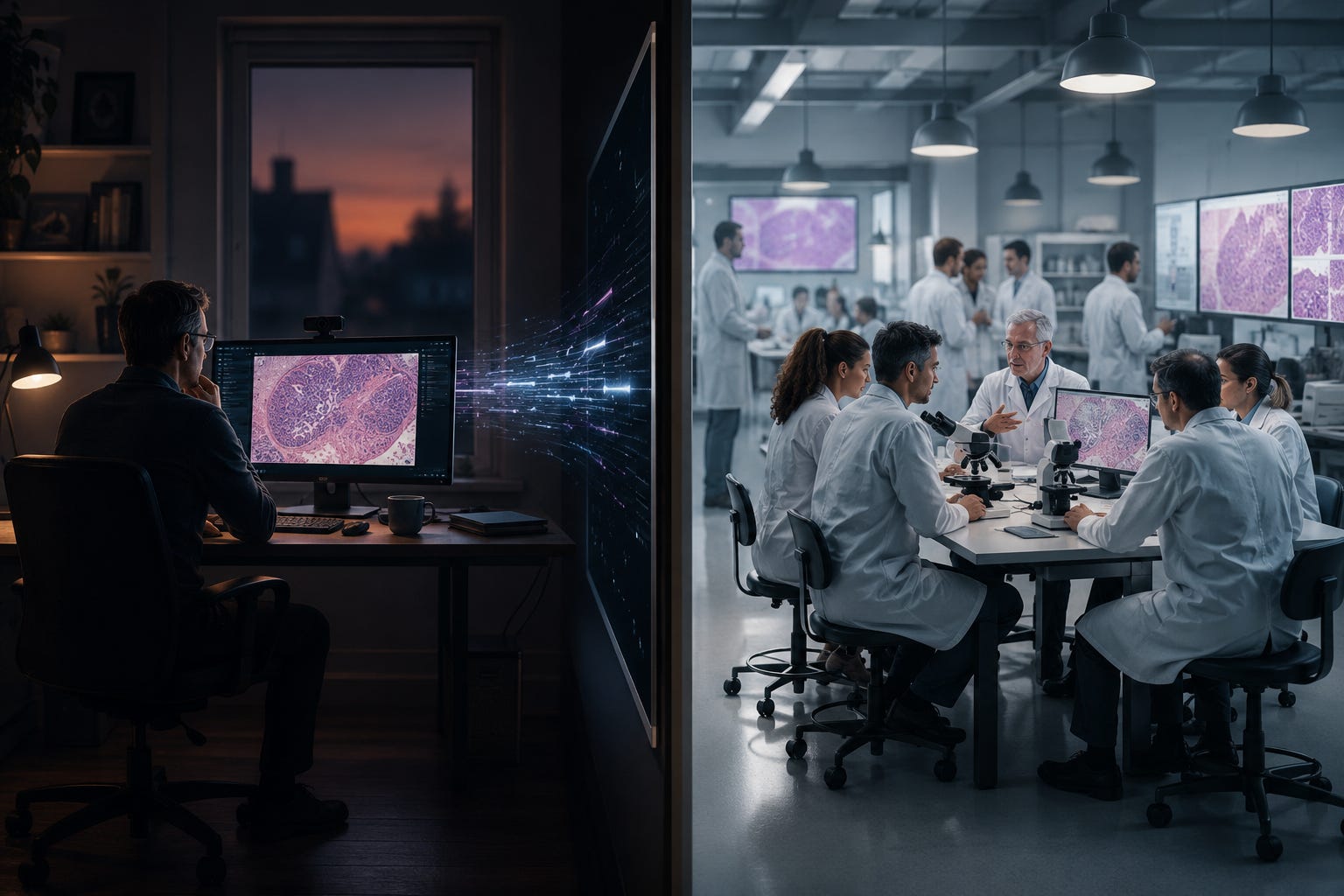
I remember being a pathology resident in Peru. Telepathology didn’t exist yet (if you wanted to be precise, we had barely discovered the word) but what did exist were hallways and the five-headed microscope.
Every time I had a doubt about a case (and I had many) I picked up my slide, stood up from my microscope, and walked down to the office of the senior pathologist responsible for that area. I knocked. I said: “Do you have a couple of minutes? Can you look at this?”
He would look. Sometimes he asked: what’s your diagnosis? I answered. He confirmed, or didn’t, and thirty seconds later I was back at my microscope with something I hadn’t had before: certainty. Other times, what started as a simple question turned into twenty or thirty minutes at the double-headed microscope, or the five-headed one, if other residents were rotating through, or if the case was too good not to share.
That walk was not in any protocol. It did not appear in any procedure manual. Nobody had designed it.
But it was, simultaneously:
Real-time quality control
Implicit knowledge transfer
Diagnostic calibration across generations
Mentorship without a name
Departmental culture building
All at once. And nobody was measuring it.
When Microsoft researchers analyzed the behavior of more than 61,000 knowledge workers during the shift to remote work, they found that collaboration networks became more static and fragmented. Communication did not disappear. It simply stopped crossing organizational boundaries.
Messages increased.
Spontaneous conversations declined.
This is not a pathology problem. It is what happens to any knowledge industry when informal proximity disappears.
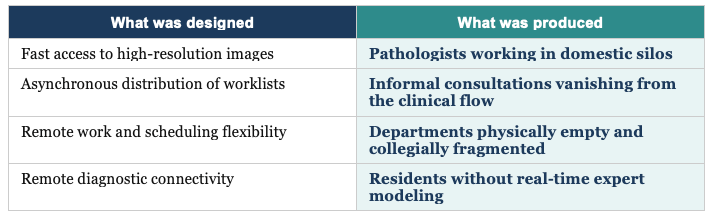
Today, that conversation requires opening a formal consultation ticket in the system. Or sending a message on Teams. Or waiting for the next tumor board.
What used to take three minutes and happen spontaneously now requires planning, credentials, and aligned calendars.
The Right Solution for the Wrong Problem
Digital pathology was built with a clear objective: eliminate geographic distance. And on that objective, it delivered with precision.
I think about the time I received a set of tissue blocks from Puno nearly six weeks late. Andean geography is not a metaphor: it is a biopsy that takes weeks to reach a specialist, or never does. In that context, digital pathology is the exact answer to the exact problem it was designed to solve.
The error was not in the technology, the error was in applying that same solution (generic and transactional), to contexts where the problem was radically different. A pathologist in a European hospital does not need the geographic distance of the Andes eliminated. They need the informal proximity to the colleague three doors down preserved.
That is where the generic solution became the problem.
The evidence is beginning to show that what looked like generational nostalgia may be something more substantive. When researchers studied how departments changed after digitization, they found a consistent pattern: residents, technicians, and support staff described a progressive fragmentation of the interactions that had structured their daily learning.
What disappeared was not an office. It was an invisible network of micro-consultations, corrections, and spontaneous conversations.
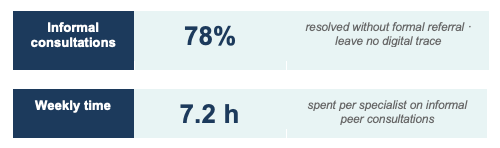
The paradox: we solved geographic distance and created collegial, institutional, and mentorship distance
The first generation of platforms was built on a transactional logic:
Radiology Has Been Here Before
Pathology is not the first diagnostic field to live through this transition. Radiology did it two decades earlier. And the scars are documented.
At Brown University, radiologists tracked how their daily face-to-face interactions with clinical colleagues fell from roughly 500 to 600 per day in the early 1980s to near zero by the mid-1990s. The department shifted from a vibrant social hub to a dark, isolated reading room.
The consequences were not only cultural. They were economic, legal, and clinical. Burnout rates among radiologists reached between 54% and 72%. Malpractice claims involving teleradiology show patient mortality rates of 36%, compared to 20% in traditional in-person radiology. The commoditization of reading, professional isolation, and disconnection from the hospital transformed a medical specialty into a transactional, outsourced service.

Radiology didn’t have time to design its transition. Pathology still does.
Not Everything Can Be Digital
The argument is not to return to glass slides. The argument is more precise: there are activities where physical co-presence creates value that no screen has managed to replicate without degrading clinical or educational quality.
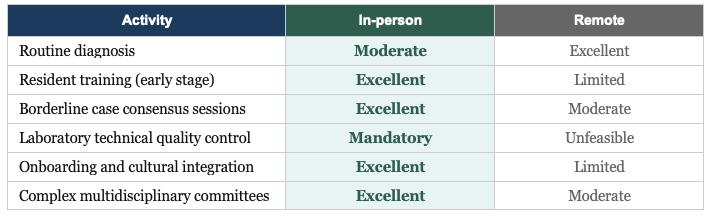
Digital pathology does not have to choose between efficiency and culture. It has to design when each applies.
The Incomplete Diagnosis
We need to do a complete macroscopy of the problem. We had a distance, we had technology, we added them up and found an answer. That was the dominant framework. But it cannot remain so, because the moment has come to add a layer where we solve not only the logistics but also the human dimension, which is the fundamental pillar of medicine.
Industry played a decisive role: they heard about our problem and solved it. But we were never in the same room looking at the full picture together. If we had been, we would have realized the problem was incompletely framed from the start.
Hospitals bought technology to eliminate geographic distance. They did not buy technology to preserve collegiality, because nobody told them that also needed to be bought. And industry did not include it in the solution because nobody asked.
That is the incomplete diagnosis. And it is precisely where hospitals and industry need to sit down together, before signing the next contract.
There are questions that do not appear in any digital pathology procurement process today:
How does this platform support urgent informal consultations without requiring a formal consultation ticket in the LIS?
Is there a real-time synchronous viewing environment that allows a faculty member and a resident to interact on the same image from different locations?
How does the system preserve departmental culture when its professionals stop sharing physical space?
What contingency architecture ensures diagnostic continuity during a network outage?
These questions do not have a single answer. They have a contextual one. And that is precisely the conversation that is not yet happening systematically between those who buy the technology and those who design it.
There are emerging models pointing in the right direction: synchronous co-navigation platforms, hybrid affinity spaces, task-oriented presence policies. But they are isolated initiatives, not systems.
Building that system requires a real partnership. Not a sale. Not an implementation. A co-construction that begins by asking the right question: what problem are we actually solving?
The future of digital pathology is not a choice between the physical and the digital. It is the deliberate design of systems that preserve the benefits of both.
Empty offices are not just a space problem. They are the symptom of an incomplete diagnosis. And getting the diagnosis right is, precisely, what we are supposed to do.
A closing question:
If you were designing a pathology department from scratch today, what would you decide to keep in person?
Beyond the Slide is a reader-supported publication. To receive new posts and support my work, consider becoming a free or paid subscriber.
References:
Hanna, M. G. & Ardon, O. Digital pathology systems enabling quality patient care. Genes Chromosomes Cancer 62, 685–697 (2023).
Debating digital pathology? Consider the risk of not doing it. https://resources.ironmountain.com/whitepapers/d/debating-digital-pathology-consider-the-risk-of-not-doing-it.
News and press releases. Sectra Group https://sectra.com/news-and-press-releases/.
Bringing digital pathology to the hospital environment. https://healthcare-in-europe.com/en/news/bringing-digital-pathology-to-the-hospital-environment.html.
Pearson, S. D., Moreno, R. & Trnka, Y. Informal Consultations Provided to General Internists by the Gastroenterology Department of an HMO. J Gen Intern Med 13, 435–438 (1998).
Krupinski, E. A. Virtual slide telepathology workstation of the future: lessons learned from teleradiology. Hum Pathol 40, 10.1016/j.humpath.2009.04.011 (2009).
Ashraf, N. et al. Incidence and factors associated with burnout in radiologists: A systematic review. Eur J Radiol Open 11, 100530 (2023).
Fratt, L. Hot Topic! Has PACS Ignited an Epidemic of Burnout? https://radiologybusiness.com/topics/healthcare-management/medical-practice-management/hot-topic-has-pacs-ignited-epidemic-burnout (2013).
A Digital Pathology Platform Trusted by Hospital Worldwide. https://www.tribun.health/a-digital-pathology-platform-trusted-by-hospital-worldwide.
Browning, L. et al. Impact of the transition to digital pathology in a clinical setting on histopathologists in training: experiences and perceived challenges within a UK training region. J Clin Pathol 76, 712–718 (2023).
Sebastian, M. et al. Applications and challenges of utilizing digital pathology and AI-enabled workflows in clinical trials. J Pathol Inform 20, 100542 (2026).
From Glass to Cloud: The Next Leap for Pathology. The Pathologisthttps://thepathologist.com/issues/2025/articles/september/from-glass-to-cloud-the-next-leap-for-pathology.
Jahn, S. W., Plass, M. & Moinfar, F. Digital Pathology: Advantages, Limitations and Emerging Perspectives. J Clin Med 9, 3697 (2020).
Work & well-being. Microsoft Research https://www.microsoft.com/en-us/research/project/work-well-being/.
Microsoft has found we’re working longer and collaborating less during COVID-19. World Economic Forumhttps://www.weforum.org/stories/2021/10/microsoft-study-covid19-work-hours/ (2021).
Larsen, E. P. et al. Optimizing Radiology Reading Room Design: The Eudaimonia Radiology Machine. J Am Coll Radiol 18, 108–120 (2021).
Comments
Nothing yet. Say the first thing.
Sign in to join the conversation.