

Picture the moment you receive the results.
Eight months have passed. The budget ran out weeks ago, but the team kept going because the science justified it. The platform performed flawlessly, no incidents, no contamination, no sample loss. Controls passed. The bioinformatics pipeline ran without errors. The heatmaps are spectacular. The clusters appear exactly where they should.
The team is satisfied. Legitimately satisfied.
Then someone in the meeting asks the question nobody expected:
What decision changes if this cluster exists?
Nobody answers.
Not because the answer is complicated. Not because the team is incompetent. But because nobody asked that question when the study began.
The data is real. The biology is interesting. And yet, the study cannot support a single concrete program decision, not a go/no-go, not a patient stratification criterion, not a threshold for the next clinical trial.
Eight months. Hundreds of thousands of euros. What remains is a paper.
> 6 months
the average time committed to a spatial omics program before a team discovers its data cannot support any concrete R&D decision
The villain is not the technology. It is a way of thinking
This scenario is not exceptional. It is the most recurring, and most costly, failure mode in spatial transcriptomics and proteomics programs across pharma and biotech.
And when it happens, the instinct is to look for a technical fault. Review the pipeline. Question the platform. Ask whether the gene panel was right.
But the failure is not there.
It lies in a premise that teams rarely articulate out loud, but that implicitly drives study design:
We have access to a powerful new technology.
Let’s generate data.
We’ll see what we find.
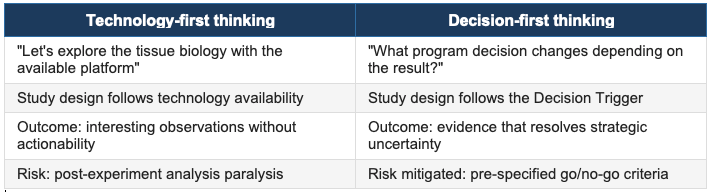
That is technology-first thinking. And it is not a spatial omics problem, it is an organizational pathology that appears in AI, in foundation models, in single-cell sequencing, in high-dimensional proteomics, in any technology impressive enough to substitute for the question.
The technology is often more powerful than the questions teams ask it.
Spatial omics simply makes this especially visible because the investment is large, the timeline is long, and the data is so rich that it is easy to confuse its abundance with its utility.
The tissue architecture nobody saw before the clinical trial
Technology-first thinking does not only produce data without decisions. In oncology, it can produce clinical failures that a well-designed study would have prevented.
Two cases illustrate the problem precisely:
Roche developed a bispecific antibody that required the simultaneous physical co-presence of tumor cells (DR5+) and stromal fibroblasts to trigger apoptosis. Selected patients expressed both targets abundantly on global biopsy. Selection criterion: met.
The clinical trial was halted for lack of efficacy.
Post-hoc spatial analysis revealed that the tissue had a dense tumor core surrounded by fibroblasts strictly segregated to the stromal periphery. Both targets existed. They were never in contact. The tissue architecture made the drug’s mechanism of action impossible, a finding that early spatial transcriptomic profiling would have detected before the clinical investment.
Pfizer designed a bispecific anti-CD3/anti-P-Cadherin antibody to force an immunological synapse between circulating T cells and tumor cells overexpressing P-Cadherin. The target was present. The mechanism was sound on paper.
Resistance did not come from the target. It came from stromal collagen barriers that physically excluded T cells from the tumor compartment, and from niches enriched with suppressive granulocytes that nullified the drug’s lytic activity.
A drug can be biochemically optimized, possess high target affinity, and still fail clinically if the tissue microenvironment's architecture prevents the necessary cellular encounter.
In both cases, the correct question was not “does this tissue express the target?” It was “in which cell, in which compartment, at what distance from the relevant effector cells?” That question distinguishes an actionable study from one that generates impressive heatmaps.
The conversation that should happen before the machine is turned on
Before getting into the framework, it is worth naming something explicitly.
These questions are not really questions about spatial omics. They are questions about how organizations learn. Spatial omics simply makes the problem visible because it is expensive, slow, and produces enormous quantities of information. But the same pattern appears in artificial intelligence, in single-cell sequencing, and in any technology capable of generating more data than an organization knows how to convert into decisions.
The bottleneck is no longer technological capacity. It is the organizational capacity to formulate questions that the technology can answer usefully.
If the problem is pre-experimental, the solution is too. Not a pipeline problem. A design problem, and a governance problem.
The central principle is straightforward: any spatial omics study should begin by defining what concrete decision, about a candidate, a target, patient stratification, a trial design, will change depending on what the data shows.
In practice, this means establishing a Decision Trigger before the experiment begins: an explicit criterion that defines what course of action is taken based on the profiles obtained. Without that trigger, the study does not support decisions, it accumulates exploratory evidence that never integrates into governance processes.
The five questions a spatial omics study must answer before the first sample
This principle can be operationalized into five questions, plus a question zero that is the prerequisite for all the others. These are not a technical post-hoc checklist. They are questions that must be answered unanimously before processing the first sample.
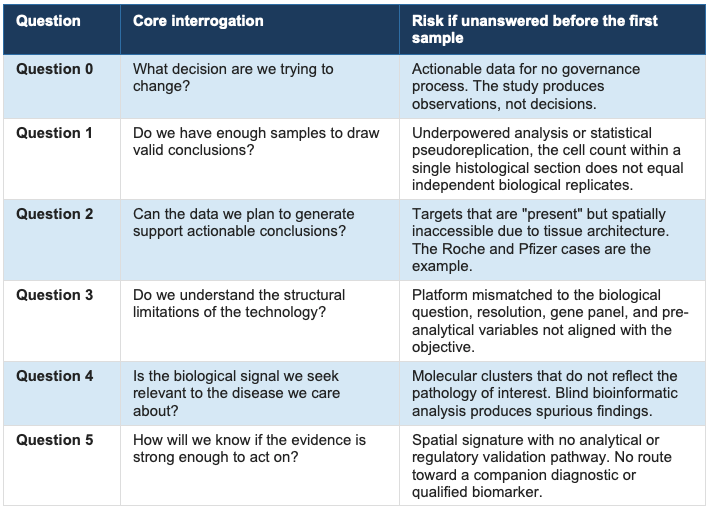
Building an interdepartmental governance committee, with pathologist, translational scientist, bioinformatician, and program coordinator, that does not allow the first sample to be processed until these questions are answered is not bureaucracy. It is the only way to transform a high-dimensional technology into a predictable tool for translational medicine.
The bottleneck is no longer the technology
Spatial omics is not overhyped. Its analytical capacity is genuinely extraordinary. What is underdeveloped is the organizational discipline that should precede it.
And this is not a spatial omics problem. It is the pattern that emerges every time a sufficiently powerful technology reaches an R&D team before that team has developed the muscle to formulate the right questions.
We see it in clinical AI. In single-cell. In foundation models applied to pathology. In multimodal proteomics. The constant is always the same:
The bottleneck is no longer technological capability. It is our capacity to formulate questions that technology can answer in a useful way.
Teams that develop that capacity do not only avoid wasting resources. They design studies that yield pharmacodynamic Decision Triggers, biomarkers with regulatory pathways, patient stratification criteria for Phase II trials.
Teams that don’t generate interesting papers.
If this pattern feels familiar, the experiment that generated magnificent data that nobody knew how to bring to a portfolio review meeting, there is a conversation to be had, feel free to contact me.
Beyond the Slide is a reader-supported publication. To receive new posts and support my work, consider becoming a free or paid subscriber.
Suggeested lectures:
Kathryn. How spatial biology improves clinical trial success in oncology. BioLizard https://lizard.bio/how-spatial-biology-improves-clinical-trial-success-in-oncology/ (2026).
Comments
Nothing yet. Say the first thing.
Sign in to join the conversation.