
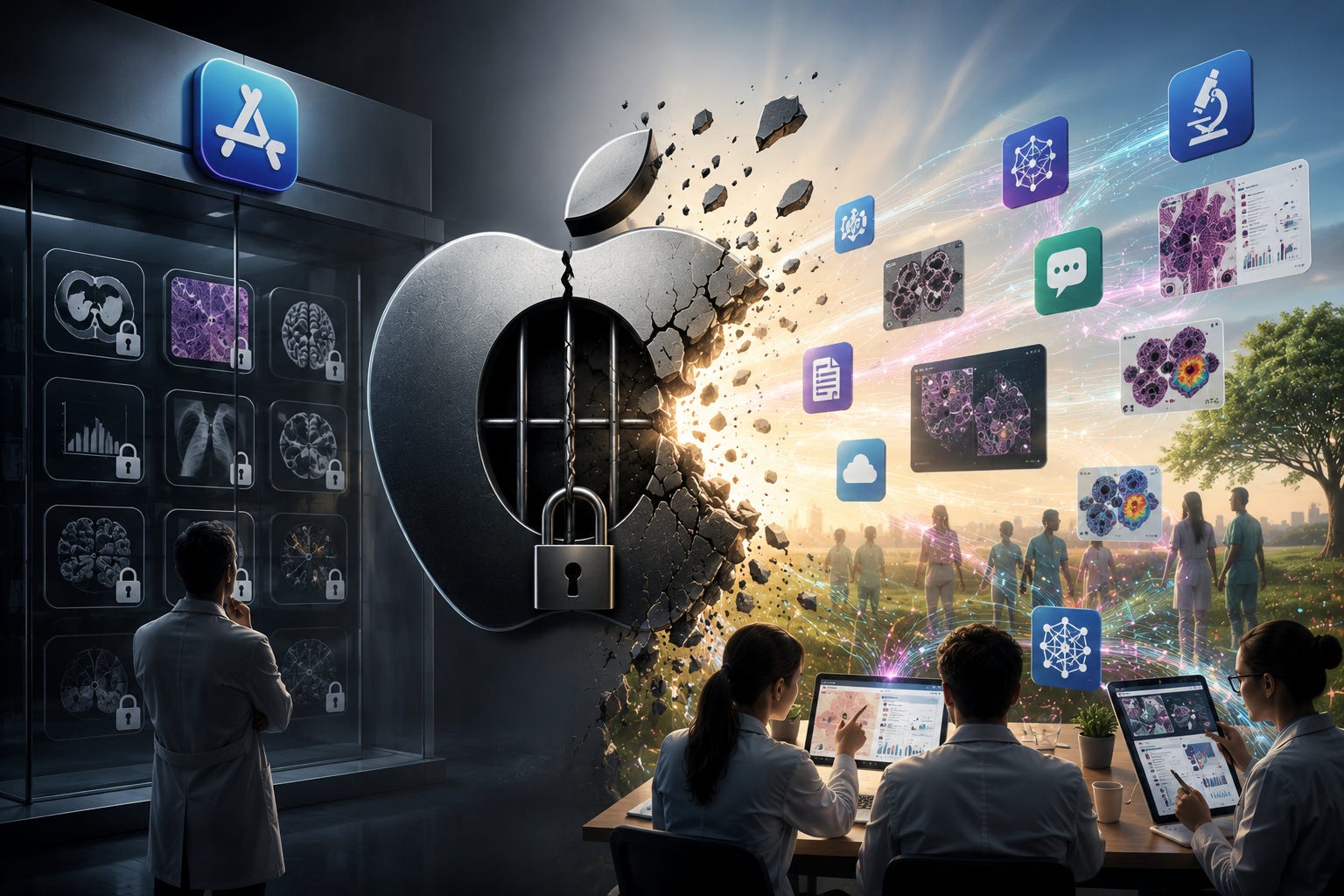
I remember the first iPhone I bought. It was 2014. The novelty wasn’t just the hardware, it was what lived inside it: applications, connectivity, the feeling of holding a computer in your hand. I started learning Swift, Apple’s programming language, convinced that everything could eventually fit inside that device.
I also remember something else from those years: the jailbreak. Apple had its official developers, but there was a whole community of enthusiasts who knew how to break the code and build their own software. Ringtones. Games. System customization. Small technical transgressions, full of enthusiasm and irreverence. The official ecosystem said this far. The user said we’ll see.
That moment matters because it captures something fundamental about closed systems: when a platform solves the wrong problem, users build parallel solutions. Always. Not out of malice. Out of necessity.
Now imagine that dream reaching medicine. Apps arriving in the clinic. Heart rate. Respiratory pattern. Fundoscopy. Dermoscopy. Histological analysis. An App Store for physicians where every diagnostic problem has a downloadable solution.
The question isn’t whether there would be a jailbreak. The question is how many. And what each one reveals about the problem the industry chose not to see.
Medicine adopted the model, and it made sense
The “Appleification” of diagnostic medicine wasn’t an accident or an arbitrary imposition. It was a logical response to a real problem.
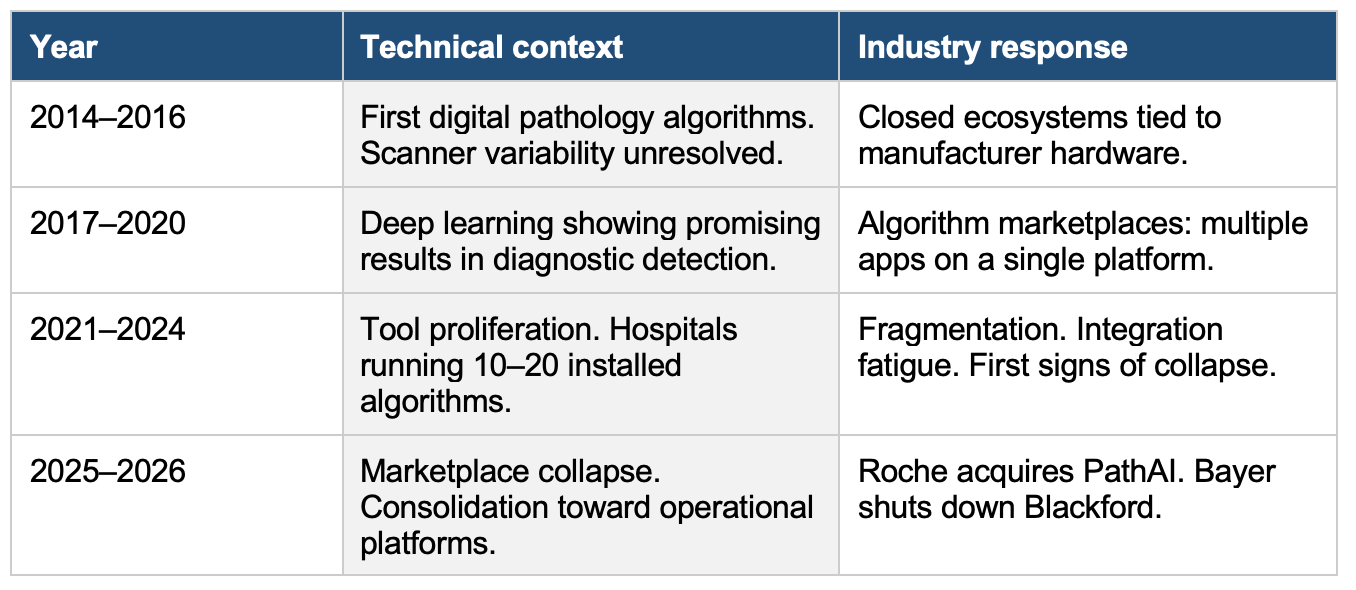
When AI began showing promising results in medical image analysis (detecting pulmonary nodules, classifying biopsies, quantifying biomarkers) the industry hit an immediate technical wall: variability. An algorithm trained on Hamamatsu scanner images doesn’t necessarily perform the same on Aperio images. Hematoxylin-eosin staining varies between labs. Image compression, scanning parameters, color calibration: all of it introduces noise that degrades model performance.
The only practical way to control that variability, in 2016 or 2018, was to control the hardware. It was the right answer to the problem of the moment.
That’s how closed ecosystems were born. The scanner manufacturer also provided algorithms validated on its own images. Buy the machine, get the models. Give us your data, we control the variability. The hospital gets reproducible results. The manufacturer gets lock-in. It was (and in certain contexts still is) the only technically viable architecture.
The medical App Store wasn’t born from greed. It was born from engineering. And that is precisely the hardest kind of error to correct: the one backed by good reasons.
What if the problem was never detecting more tumors?
There is an assumption the medical AI industry adopted so early and so naturally that it never had to be stated as one. It became invisible. And invisible assumptions are the most dangerous kind.
The assumption was this: the bottleneck in diagnostic medicine is the diagnosis.
If physicians miss tumors, catch them too late, or classify them with too much inter-observer variability, then the solution is an algorithm that detects, classifies, and quantifies more accurately. The logic is sound. The premise is the problem.
THE PARADOX : The more accurate diagnostic AI became, the less clear it was that diagnosis was medicine’s main problem.
A radiologist in a high-pressure hospital environment reads approximately 34 CT scans per day. Each CT generates an average of 679 reconstructed images. With 5.5 net hours of reading time available, that leaves roughly 0.86 seconds per image. In that context, adding one more window the radiologist has to open, confirm, and reconcile with the PACS isn’t an improvement. It’s additional friction on a system already running at its limit.
And while the industry was building detection algorithms, radiologists were spending up to 20% of their working day preparing for and attending multidisciplinary tumor boards. Pathologists were using 2.4 hours of preparation time for every hour of scheduled meeting. Nobody had an algorithm for that. Nobody was building one.
The real bottleneck
20% of radiologists’ and pathologists’ working day at high-complexity centers goes to preparing and attending multidisciplinary meetings, with zero AI support.
The question the industry never asked out loud is the simplest one: what does the physician do with their time when they’re not interpreting images? And could AI help with that?
The answer was already written. In the jailbreaks clinicians had built for themselves.
150 algorithms, 60 developers and silence
September 2025. Bayer announces it is discontinuing Calantic Digital Solutions and winding down operations at Blackford Analysis, its radiology AI subsidiary.
It wasn’t a surprise to those who knew how to read the signals. It was, like the García Márquez novel, a death everyone saw coming and nobody could (or chose to) prevent.
The scale of the collapse
~10% of global radiology AI platform spending eliminated overnight.
The numbers are concrete. Blackford had built one of the most ambitious ecosystems in the sector: over 150 third-party applications, over 60 developers, a promise of being the neutral App Store that no hardware manufacturer could be. Bayer had acquired it in 2023 (barely two years earlier) convinced the future ran through there.
The official statement spoke of “strategic reprioritization” and “reinvestment in growth areas.” The real translation is more direct: the model wasn’t working. Hospitals were buying. Hospitals were piloting. Hospitals weren’t using.
The immediate fallout was dramatic. The 60 developers who had built their products on the platform suddenly had no distribution channel. Hospitals that had begun integrating those workflows had to evaluate emergency replacement paths. CIOs who were already notoriously cautious about long-term AI commitments now had one more reason to be.
And the market kept moving. Because markets always keep moving. Signify Research documented that in the same month Bayer exited, three additional acquisitions were announced in the sector adding to the seven already registered that year. Consolidation didn’t wait for the body to be buried.
The sector’s confession
41% of radiologists feel that AI tools developed within their organization don’t adequately address their real-world needs.
Four out of ten radiologists. Involved in the development of those apps. Saying the result doesn’t serve what they actually need. The assumption the industry never questioned (that the bottleneck was diagnosis) had been written in that number since May. Nobody wanted to read it.
The dead: 60 developers without a platform. The wounded: hospitals locked into ecosystem contracts they can’t exit because switching costs are structurally prohibitive. The survivors: those who understood early enough that the value wasn’t in the algorithm catalog. It was in removing friction.
Three jailbreaks. One law…
When a system solves the wrong problem, users build parallel solutions, always. And the solutions they build are the most honest evidence of the problem the system ignored.
What remained after the marketplace collapse wasn’t a vacuum. It was a parallel ecosystem that filled the spaces the official model left uncovered. Three jailbreaks. Three manifestations of the same phenomenon. Three diagnoses of the same error.
JAILBREAK I (the simple fix) : WhatsApp, ChatGPT, and the workaround everyone uses
The first jailbreak required no specialized technical knowledge. Everyone did it. Everyone still does.
Digital imaging systems were extraordinarily good at one thing: seeing. High-resolution viewers. Instant zoom. Stain synchronization. From the standpoint of pure diagnostic visualization, digital pathology and radiology PACS represent decades of sophisticated engineering. Sharing was a different story.
Sharing a biopsy image with a colleague at another hospital. Sending a complex case to an expert in another country at 10pm. Discussing an ambiguous finding with the oncologist before Monday’s tumor board. Those communication flows weren’t in the original system design.
So physicians did what people always do when the system doesn’t solve their problem: they broke it with whatever they had at hand. WhatsApp became the de facto teleconsultation channel in dozens of countries. ChatGPT started appearing in radiology report drafting workflows. Excel continued managing worklists where the PACS couldn’t reach.
Here is the insight that changes everything: none of those workarounds is a diagnostic hack. WhatsApp doesn’t detect tumors. ChatGPT doesn’t classify biopsies. Excel doesn’t perform cell segmentation. They are all productivity hacks. Communication hacks. Coordination hacks.
Physicians didn’t jailbreak the system to get better diagnoses. They jailbroke it to save time. That is exactly the opposite of what the industry had assumed they needed.
JAILBREAK II (the sophisticated fix) : Open-source platforms, Ki-67, and the medical Cydia
The second jailbreak required more, technical knowledge, time, and some audacity. Few people did it. But what they built has consequences that extend well beyond those who use it.
While major manufacturers were constructing validated, certified, regulated diagnostic algorithm ecosystems, a parallel market was taking shape at the margins of the official system. In open-source histological image analysis platforms (developed in academic environments and distributed at no cost) biomarker quantification algorithms began circulating. Ki-67, estrogen and progesterone receptors, cell segmentation tools published as scientific papers with available code, ready to deploy.
Who was using them? Private clinics without enterprise system budgets, Anatomical pathology labs with limited resources. Physicians with their own practices who needed to quantify a biomarker to make a treatment decision and couldn’t wait months for the official system to provide that capability. Each one under their own responsibility. Without formal regulatory validation, without institutional traceability, but working.
This is medical Cydia. The alternative repository that emerged when the official App Store didn’t offer what the user needed.
This jailbreak is also evidence of the same phenomenon, but with a nuance that cannot be romanticized.
An incorrect Ki-67 quantification can influence a chemotherapy decision. An algorithm without formal validation can produce systematically biased results across certain patient populations or staining protocols. The risk is not hypothetical. It is structural.
Initiatives have also emerged proposing that specialists themselves (without data scientists on the team) develop and distribute image analysis models. The intention is noble. The execution misses something fundamental: the difference between an algorithm that works on the training dataset and one that works in real clinical practice requires exactly the expertise being proposed for elimination. The Cydia jailbreak on iPhone could leave your phone unusable. The medical equivalent is worse. Here the operating system that can break is not the iPhone.
Comments
Nothing yet. Say the first thing.
Sign in to join the conversation.