
Somewhere between 2020 and 2026, the pharmaceutical industry made a collective decision: artificial intelligence wasn’t optional anymore. It was existential. What followed was a technology arms race without precedent in the sector’s history.
Eli Lilly built LillyPod, a supercomputer with over 1,000 NVIDIA Blackwell Ultra GPUs and more than 9,000 petaflops of computing power, dedicated exclusively to genomic R&D and molecular simulations. Roche added 2,176 GPUs to its global hybrid cloud infrastructure. GSK was running Cambridge-1 in the UK. In a single year (2025) 168 new strategic alliances were recorded between biopharma multinationals and specialized AI startups.
The numbers were almost too large to say out loud. Pharma’s AI spending within R&D was projected to go from $4 billion in 2025 to $25.7 billion by 2030. Top consulting firms estimated that full industrialization of AI could generate up to $254 billion in additional annual operating profit for the sector. Generative AI alone would contribute between $60 and $110 billion a year.
The message was unambiguous: whoever didn’t invest in AI would be left behind in the next era of medicine. The competitive pressure was real. Corporate FOMO was palpable. And the capital flowed.
The race wasn’t just technological. It was existential. You either got on

In 2026, ZS Associates published a survey of pharmaceutical technology leaders. The question was direct: are your AI investments generating measurable returns? The answer should have echoed through every boardroom in the industry.
17% of technology leaders report measurable ROI from their AI investments in research and discovery
29% report tangible returns in the clinical development phase
Read that again. With $4 billion invested in a single year, fewer than one in five leaders can document that the investment produced measurable value in R&D. In clinical development, barely one in three. And yet, 50% of those same leaders expect results within a year. Which reveals something important: investment decisions are being driven by technological faith and competitive pressure, not by evidence of return.
The industry bought the most sophisticated instrument ever built. And then discovered it didn’t know how to play it.
A related symptom: in organizations where data quality diagnostics have been conducted, the picture is consistently troubling. The vast majority of historical pharma data (accumulated across decades of research) does not meet the minimum quality standards required to train AI models reliably. As a direct consequence, data scientists in pharma report spending the majority of their working time cleaning and curating data before they can do anything else.
A company can own the most powerful supercomputer in the world. If its data is poor, the model produces poor outputs faster.
The industry bought the most sophisticated instrument ever built. And then discovered it didn’t know how to play it.
Before pointing to failures, something needs to be named that industry conversations habitually skip: no organization in history has had to learn to operate a technology with these three characteristics simultaneously.
Speed of evolution without parallel: AI models don’t update on yearly cycles, they transform in months. Organizations designed to absorb gradual technological change don’t have the mechanisms to process this cadence.
Opacity of mechanism: unlike a microscope or a sequencer, a deep learning model cannot explain its reasoning in terms a scientific committee can audit. The output exists. The internal logic doesn’t.
Probabilistic outputs without human authorship: AI doesn’t deliver truths. It delivers probability distributions. And organizations built around human expert judgment (where someone assumes responsibility for their interpretation) have no protocols for managing decisions based on algorithmic scores with no assignable author.
That specific combination has no clean historical precedent. It’s not like industrial electrification, where the change was gradual and the mechanism was comprehensible. It’s not like the internet, where the output was text and images that anyone could evaluate. This is something genuinely new. And expecting organizations to have resolved it in five years would be naïve.
That said, and here is the real diagnosis, the problem isn’t the speed of the technology. The problem is that the industry has responded to that speed by measuring the wrong things.
Every complex narrative has a villain. In this case it’s not the AI. It’s not the pharma leaders. The villain is the measurement system the industry built to track its AI progress, one that measures precisely the things that don’t predict real success.
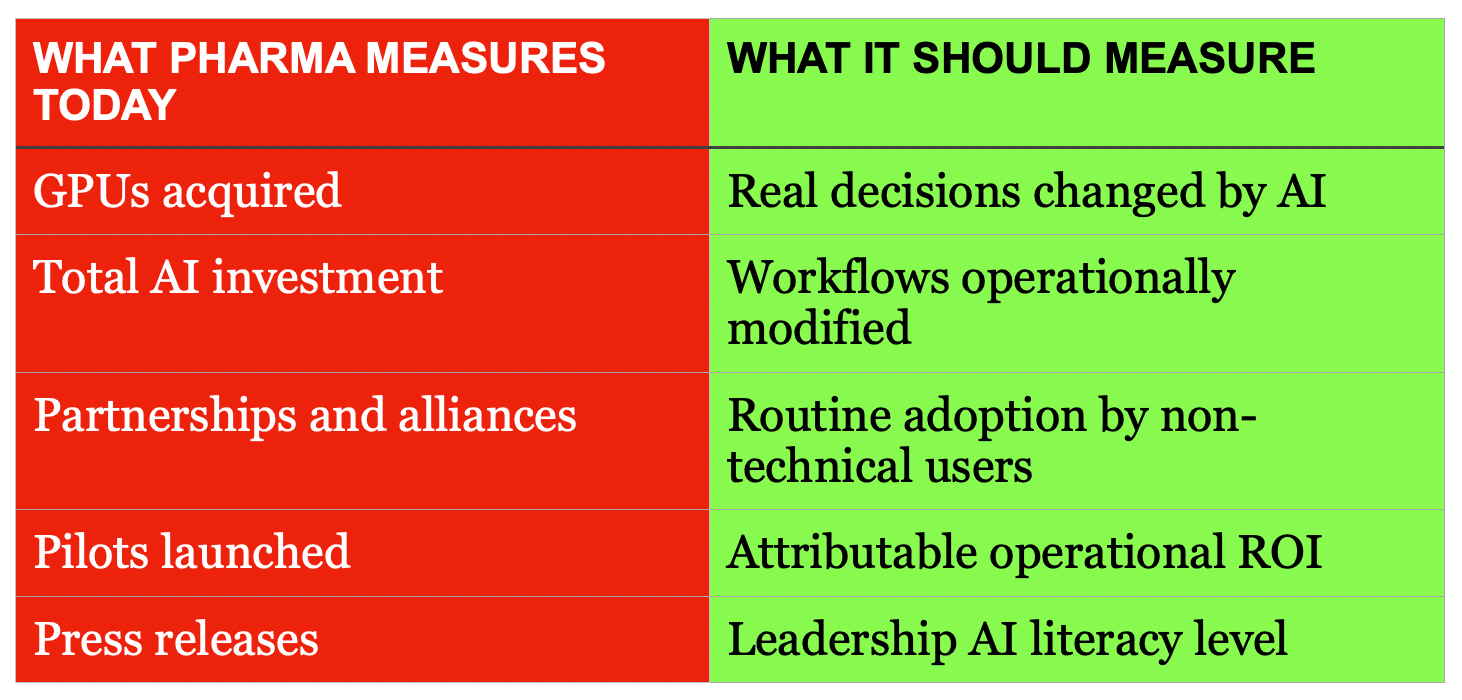
The left column is easy to measure, easy to communicate to investors, and easy to put in a press release. The right column is hard to quantify, uncomfortable to report, and requires admitting that the pilots haven’t produced real adoption.
As long as the industry keeps rewarding GPUs and partnerships instead of changed decisions and modified workflows, the gap between investment and capability won’t close. Not because organizations are incompetent. But because the incentive system doesn’t reward real capability, it rewards its appearance.
There is a fundamental difference between two things the industry treats as synonyms:
AI investment: acquiring platforms, hiring data scientists, signing partnerships, launching pilots, building supercomputers.
AI capability: the real organizational ability to understand what a model does, operate critically with its outputs, calibrate trust correctly, and convert predictions into sustainable institutional decisions.
The first is a purely financial challenge. The second is slow, complex, deeply human, and cannot be purchased with a purchase order. The Digital Medicine Society formalized this distinction in the Health AI Maturity Model:
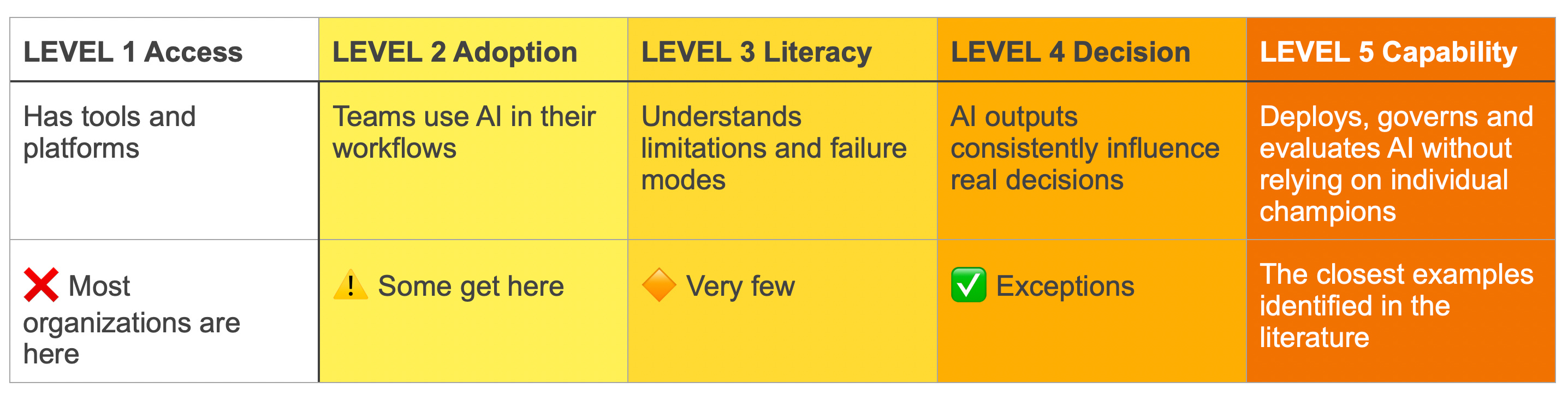
The uncomfortable diagnosis: most pharmaceutical organizations are stuck between Level 1 and Level 2. They have world-class infrastructure. They lack the operational capability to use it.
This isn’t a problem of incompetence. It’s a problem of measuring the wrong things for too long.
This is not a theoretical problem. It has victims. It has documented consequences. And it’s happening right now in laboratories, boardrooms and clinical committees across the industry.
In 2026, a team of researchers published “Stuck on Suggestions” on arXiv, a controlled experiment with 28 expert pathologists evaluating tumor cell percentages in histological preparations, with and without AI assistance.
The result was striking. 7% of the pathologists’ own correct, independent professional judgments were overridden by the pathologists themselves after receiving an incorrect AI suggestion. Highly qualified professionals cancelled their own correct judgment to follow a mistaken algorithm. A parallel study in endoscopy documented even more concerning figures: 16.39% erroneous changes induced by incorrect AI, and 15.95% of correct AI suggestions ignored due to the expert’s overconfidence in their own judgment.
What these studies demonstrate is that the precision of an AI system in the lab does not equal the precision of the human-machine pair in real practice. Miscalibrated trust destroys value in both directions. The performance of a model is not an abstract attribute of the algorithm, it is conditioned by the cognitive capability of the human operator.
While some laboratories were struggling with invisible cognitive biases, others were building something equally dangerous: a facade of AI capability without actual capability. AI washing describes the tendency of corporations to publicly promote the use of sophisticated algorithms when their real implementations are limited to superficial integrations or isolated proof-of-concept projects with no operational scalability.
The mechanism is understandable given the incentive system described: announcing capabilities that don’t yet exist is easier than admitting that pilots haven’t scaled. But the cost is real: feeding models with biased or incomplete data introduces critical errors in clinical simulation environments at rates that would be unacceptable in any regulated setting.
Perhaps the most costly conceptual error has been the uncritical import of AI success assumptions from consumer platforms. Three structural differences make Netflix or Amazon frameworks inapplicable in biomedicine:
Error tolerance: if Netflix recommends an irrelevant film, the consequence is trivial. An incorrect prediction in oncology biomarker selection can compromise the validity of a Phase III trial.
Data quality: consumer platforms feed on billions of standardized digital interactions. Biological AI models operate on noisy experimental data, small samples, and intrinsic biological heterogeneity.
Causality vs correlation: Meta and Google thrive by detecting surface correlations. Precision medicine requires elucidating causal mechanisms at the molecular level. Optimizing a clinical trial like a digital advertising campaign isn’t just inefficient, it’s scientifically incorrect.
The pharma industry imported the success frameworks of Netflix and Amazon. And then seemed surprised when they didn’t work in a Phase III trial.
The failure of the consumer tech analogy doesn’t mean AI doesn’t work in pharma. It means it works differently depending on the nature of the task. And confusing the two categories is one of the most common sources of broken expectations.
The biggest successes cluster around tasks with clear rules, high structure and objective success criteria. Exscientia designed a TOC drug candidate ready for Phase I in under 12 months, compressing a standard 4-5 year preclinical cycle. Insilico Medicine identified a therapeutic target and developed a preclinical candidate in approximately 18 months for a cost of around $150,000. Model Medicines achieved a 46% hit rate in compound screening, versus the industry standard of under 2%.
Histological image classification with well-defined criteria, structured data extraction from clinical records, routine regulatory documentation automation, clinical trial recruitment optimization. These are the areas where AI delivers what it promises.
At the opposite end sit tasks of high ambiguity and intrinsic biological uncertainty. Biomarker selection strategy requires determining whether a marker detected in wet lab will translate into a real clinical correlate of patient survival, a question that AI statistical extrapolation cannot reliably answer without the evolutionary context of human pathology.
Go/no-go decisions in drug development portfolios require simultaneously weighing patent life, competitive dynamics, the board’s risk tolerance and the ethical profile of the treatment. Those are holistic judgments that are not modelable through elementary computational optimization.
Stanford researchers formalized at ICML 2025 the concept of Centaur Evaluations: a framework where AI systems are not measured by their autonomous performance on isolated datasets, but by the effectiveness of the human-machine pair solving complex tasks cooperatively. The empirical evidence is consistent: in drug development, the centaur approach systematically outperforms any purely computational or purely human approach.
The question isn’t whether AI can replace the translational scientist. The question is what the right human-machine pair can produce that neither can produce alone.
Amid the sector’s general paradox, there are documented exceptions, organizations that transitioned to higher levels of maturity. And the pattern connecting them is more revealing than any of their individual cases.
What differentiates organizations that extracted real value from AI was not the power of their models or the size of their technology budget. It was an organizational decision that almost nobody makes: investing in human infrastructure with the same seriousness and rigor applied to technological infrastructure.
In practice, this means four concrete things. First, treating data quality as a strategic priority investment, not a technical problem for the data science team to solve in the background. Second, designing adoption from the executive committee downward, not from technical teams upward, because the ownership of the decision to act on model outputs needs to sit with those who have the authority to do so. Third, implementing role-based AI literacy: not a one-off awareness session, but a structured curriculum that allows scientific and commercial leaders to correctly calibrate their trust in algorithmic outputs. And fourth, measuring success in terms of decisions changed and workflows modified, not pilots launched or partnerships signed.
That pattern is the transferable insight. Not the implementation details of any specific company, but the underlying logic: technology without human infrastructure is inert hardware. And human infrastructure isn’t built in a quarter.
Sanofi deployed plai, an integrated AI platform that unifies clinical, scientific and logistics data across the entire corporation, used daily by between 15,000 and 20,000 employees including 95% of the executive leadership. Documented results: a 20-30% reduction in target identification times, discovery of 7 new therapeutic targets in a single year, $300 million saved in logistics costs. What set Sanofi apart wasn’t the platform, others have similar ones. It was prioritizing the cleaning and validation of historical data over buying generic software, and designing adoption from the top down.
Novartis dismantled data silos between R&D, clinical and commercial development, consolidated its molecular databases into a common repository, and implemented mandatory role-based training so medical and commercial directors could use algorithmic proxies in critical allocation decisions. The clinical insights analysis cycle dropped from 21 days to 2. Trial recruitment speed multiplied by 3.4.
Vas Narasimhan publicly estimated a seven-to-ten year horizon before documenting widespread benefits in the pipeline. Eli Lilly’s team projected that LillyPod’s real benefits would materialize from 2030 onward. That capacity to moderate investor expectations and coordinate multi-year investments focused on human capital (not hardware) is the hallmark of an organization with real AI maturity.
The competitive advantage of these organizations isn’t technological. It’s organizational. And that’s the only advantage that can’t be bought with a purchase order.
Before discussing implementation strategies or data architectures, there is a diagnostic question every pharmaceutical organization should be able to answer honestly:
Not where you think you are. Not where the last consulting report says you should be. Where you actually are.
The honest answer determines everything that follows. The critical dimensions for the diagnosis:
Leadership alignment: does the organization have an AI strategy approved by the executive committee, tied to R&D objectives and real budget? Or does a strategy document exist that nobody has converted into operational KPIs?
Literacy of key personnel: can the translational scientists and committee leaders articulate what an ROC curve measures, what model drift is, and when an AI alert should be ignored? Or are they operating on outputs they don’t understand?
Data quality: does the organization know what percentage of its historical data meets training standards? Is there an active curation program? Or are models being trained on data that doesn’t meet minimum requirements?
Decisional ownership: is there someone with an explicit mandate to act on model outputs? Or are results presented in meetings where nobody has the authority to convert them into decisions?
That last question connects directly to the previous post in this series. And it may be the most important one of all.
Last week we described the meeting after the model: all the data there, the right analysis, the model working, and nobody able to answer “so what do we do now?” because the question has no owner.
This post answers why. And the answer isn’t that the industry is incompetent. It’s that the industry has been answering the wrong question.
The question pharma has been answering for five years is: are we investing enough in AI? The answer, measured in GPUs, partnerships and budgets, is unambiguous: yes.
The question pharma should be answering is different: Do we have the organizational capability to act on what AI tells us?
That question measures different things: real decisions changed, workflows modified, leaders who understand the margin of error in their algorithms. And there the answer, for most organizations, is far more uncomfortable.
Not every company that jumped in the pool knew how to swim. But the problem wasn’t jumping. It was assuming that buying the biggest pool on the market was the same as knowing how to swim in it.
The organizations winning this race aren’t necessarily the ones investing the most. They’re the ones that made a transition most of the industry hasn’t yet completed: from measuring technological possession to measuring real decisional capability.
The winners in pharma AI will not necessarily be the companies that build the best models.
They will be the ones that build the best decision-making systems around those models.
I work with translational medicine teams and scientific leadership in biotech and pharma to diagnose real AI maturity and design the decisional structures that turn technical outputs into real clinical actions.
References:
IntuitionLabs [Internet]. [cited 2026 Jun 5]. Pharma AI Infrastructure: 2026 Deals and Investments. Available from: https://intuitionlabs.ai/articles/pharma-ai-infrastructure-investments
Yokoi T, Wade MR. AI trends in pharma: How leaders gain competitive advantage - I by IMD [Internet]. 2026 [cited 2026 Jun 5]. Available from: https://www.imd.org/ibyimd/artificial-intelligence/ai-trends-in-pharma-from-rd-to-operational-efficiency-and-accuracy-for-competitive-advantage/
IntuitionLabs [Internet]. [cited 2026 Jun 5]. Measuring AI ROI in Drug Discovery: Key Metrics & Outcomes. Available from: https://intuitionlabs.ai/articles/measuring-ai-roi-drug-discovery
Scientific Infrastructure or Expensive Theatre? AI Discovery’s Reckoning in Asia [Internet]. [cited 2026 Jun 5]. Available from: https://biopharmaapac.com/analysis/73/8008/scientific-infrastructure-or-expensive-theatre-ai-discoverys-reckoning-in-asia.html
Administrator. To avoid “AI washing,” pharma companies must reinvest in data quality. PharmaLive [Internet]. 2025 Jan 3 [cited 2026 Jun 5]. Available from: https://www.pharmalive.com/to-avoid-ai-washing-pharma-companies-must-reinvest-in-data-quality/
Health AI Maturity Model. Digital Medicine Society (DiMe) [Internet]. [cited 2026 Jun 5]. Available from: https://dimesociety.org/ai-implementation-in-healthcare-playbook/ai-evaluation-readiness/health-ai-maturity-model/
Roser D, Meinikheim M, Muzalyova A, Mendel R, Palm C, Probst A, et al. Artificial Intelligence‐assisted Endoscopy and Examiner Confidence: A Study on Human–Artificial Intelligence Interaction in Barrett’s Esophagus (With Video). DEN Open. 2025 Jun 19;6(1):e70150. doi:10.1002/deo2.70150 PubMed PMID: 40548292; PubMed Central PMCID: PMC12178752.
Reis M, Reis F, Kunde W. Influence of believed AI involvement on the perception of digital medical advice. Nat Med. 2024;30(11):3098–100. doi:10.1038/s41591-024-03180-7 PubMed PMID: 39054373; PubMed Central PMCID: PMC11564086.
Conti L, Capetti B, Battaglia O, Grasso R, Pesapane F, Monzani D, et al. Viewpoint on the Consequences and Mitigation of Cognitive Bias in the Radiological Interpretation of Breast Cancer Imaging Using Artificial Intelligence. JMIR Medical Informatics. 2026 Mar 30;14(1):e78955. doi:10.2196/78955
AI agents and the next leap toward proactive, personalized health care | Medical Economics [Internet]. [cited 2026 Jun 5]. Available from: https://www.medicaleconomics.com/view/ai-agents-and-the-next-leap-toward-proactive-personalized-health-care
Howard S. LillyPod Drug Discovery: Lilly’s NVIDIA Supercomputer Explained. Life Science Daily News [Internet]. 2026 May 22 [cited 2026 Jun 5]. Available from: https://lifesciencedaily.news/lillypod-drug-discovery-lillys-nvidia-supercomputer-explained/
Acelerar la adopción de la IA en la biofarmacia y la atención médica - Sociedad Europea de Medicina [Internet]. 2026 Feb 4 [cited 2026 Jun 5]. Available from: https://esmed.org/accelerating-ai-adoption-in-biopharma-and-healthcare/
Augusta Hitech [Internet]. [cited 2026 Jun 5]. Augusta Hitech - Bridging the Gap Between Technology and Business. Available from: https://www.augustahitech.com/blog/navigating-industry-4-0-and-beyond
Haupt A, Brynjolfsson E. Position: AI Should Not Be An Imitation Game: Centaur Evaluations.
IntuitionLabs [Internet]. [cited 2026 Jun 5]. Pharma AI Strategy: Scaling Digital Transformation. Available from: https://intuitionlabs.ai/articles/pharma-digital-transformation-ai-strategy
Healthcare AI Maturity Assessment | Kaufman Hall [Internet]. 2026 [cited 2026 Jun 5]. Available from: https://www.kaufmanhall.com/healthcare-consulting/strategy-business-transformation/healthcare-ai-maturity-assessment
Rosbach E, Ammeling J, Ganz J, Bertram CA, Conrad T, Riener A, et al. Stuck on Suggestions: Automation Bias, the Anchoring Effect, and the Factors That Shape Them in Computational Pathology. Melba. 2026 Mar 13;2026(MELBA–BVM 2025 Special Issue):126–47. doi:10.59275/j.melba.2026-87b1
Comments
Nothing yet. Say the first thing.
Sign in to join the conversation.