
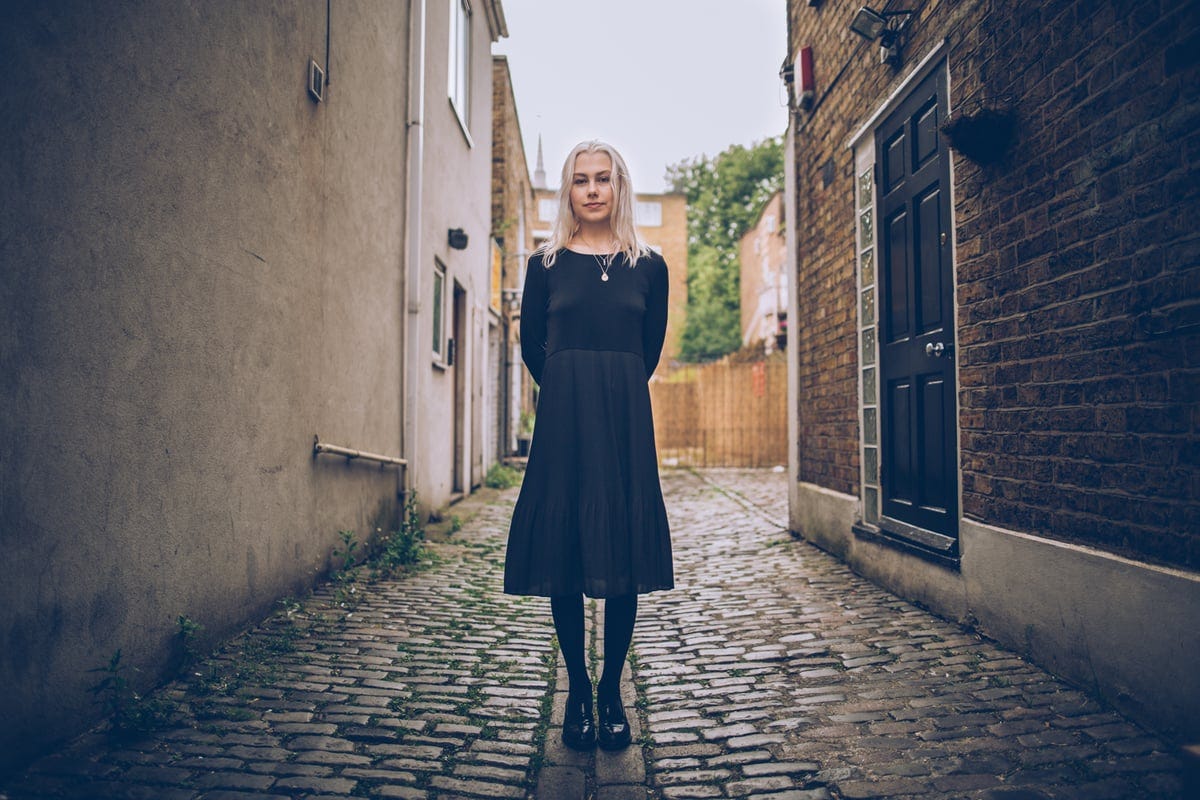
Phoebe Bridgers 3 came out and nothing has been quite the same for me since. I’m okay to be that girl. I am that girl. I have always been that girl. Sue me!
Little surprise, the record, to me, was a knockout. But it was also incredibly refreshing. It feels as though for the last 6 years — since Punisher came out — we have lived in a musical minefield of Phoebe Bridgers dupes. But none of them are actually the real Phoebe Bridgers. Lost Weekend was a jolting reminder of that fact, as if Phoebe came out from the shadows just to say: “You losers can try, but you’ll never be me.”
I was mulling this over on the weekend — amidst my genuinely obscene replays of the album — and realized what’s been missing all this time is that many of these Phoebe wannabes seem to fundamentally misunderstand the art of the “confession” and the art of “confessional songwriting.”
Confessional songwriting as a practice actually has a long and storied tradition. Dating back to the 60s, it found its roots in the confessional poetry of people like Sylvia Plath and Robert Lowell, who spoke openly about trauma and mental health in ways few had before. Their poetry was bare and raw, not shrouded in mystery or obscured by overly elevated language. It was an everyman kind of poetry that spoke to the struggle and splendour of, well, everyday living. It made the mundane something worth examining.
Songwriters soon coopted this language, most notably Joni Mitchell, James Taylor, and Bob Dylan. The speakers of these songs were the artists themselves, who wrote in plain terms about the trials and tribulations of their personal lives. Records like Blue and The Freewheelin’ Bob Dylan have withstood rapid churn of pop culture and remained as seminal blueprints of how to speak openly and honestly about the work of living an emotionally examined life. Songs like “Free Man in Paris” — a spectacular meditation on the perils of stardom and the desire to live totally unburdened lifted from her musings on the life of her friend David Geffen — read as modern parables, serving to enlighten and interrogate beyond just entertaining and transporting. Make what you will of the term itself — understandably, some songwriters, particularly women, occasionally find it diminishing — the sentiment remains. The best artists working in this genre find ways to make you pause and think twice about the small slices of life we often rush by or skip over, the way David Sedaris can make you roar with laughter simply by describing an evening walk or a family dinner.
Phoebe understands this art. What made her so refreshing when she first came on the scene was that exact directness. In the late 2010s, popular music was very much about churning out hits. The charts were, frankly, littered with pop slop, and even indie was still slouching out of that awkward stomp-clap-hey phase that felt far more performed than it did grounded and real.

The precision with which Phoebe writes is undeniably near-unparalleled. She became famous for lyrics like “You gave me fifteen hundred / to see your hypnotherapist” and “Call me when you land / I’ll drive around again / One hand on the wheel / One in your mouth.” There were shower beers, there were nautical themed birthday parties. The arrangements themselves were sparse but powerful, a long-awaited reminder of how moving stripped-back guitar music can be. It was all weird and wonderful but felt ultimately in service of Phoebe’s outsider/insider exploration of her lived experience, like she was freezing time and walking around the scenes of her life to move around the little details and see if it made any difference. She pulled for inspiration from 90s/00s grunge icons like Elliott Smith and Conor Oberst (her collaborator on the Better Oblivion Community Center project), both confessional poets in their own right. Those influences, on Lost Weekend, remain.
It’s also undeniable that Stranger in the Alps and Punisher launched lyrical movements. Phoebe became the artist’s reference for her commitment to uncanny specificity. But what happened in her wake felt like a fundamental misunderstanding of what made her work so great to begin with. It felt like scores of artists assumed that by infusing the most specific references possible in their songs (Gum on your shoe! A dusty fish hook! A PBR!) and set those references to mumbling guitars and near-whisper vocals that they too would end up with the piercing emotional resonance of a Phoebe track. What often ended up happening were songs that read more like whining laundry lists rather than carefully woven vignettes of lives interestingly, complicatedly lived. For all their curated specificity, a lot of these records have ended up feeling confusing, incoherent, and vague. There’s a few particular offenders I could point to here, but I won’t.

At best, some of these post-Phoebe up-and-comers added to the burgeoning class of folk that she helped kickstart. Jake Minch — who Phoebe cites as an influence on Lost Weekend’s “Panorama” and who works with Tony Berg, Phoebe’s longtime production partner — is a particularly notable example here, as, in my opinion, are others like Samia Finnerty, Alec Duckart (Searows), and Jensen McRae. So too are those in Phoebe’s more direct circle, including, of course, Lucy Dacus and Julien Baker, as well as Christian Lee Hutson (a frequent Phoebe collaborator).
But at worst, we had strings of copycat albums — some even chart toppers — that felt like hollow shells of their parent references. What I think a lot of these records got wrong was that they fundamentally misunderstood the art of the confession. They forgot that the reason Phoebe’s specificity has worked so well is that all of it — nearly every turn of phrase and every detail — works in service of some broader parable or message. More than that, those musings are nothing without the genuine willingness to examine oneself and unearth things that aren’t always that neat and clean. In the case of Lost Weekend, we see this tactic again. She writes skillfully about the experience of recognising yourself as flawed but, despite that, remaining deeply open to the possibilities of love and joy. That’s complex emotional terrain, the kind of thing that requires a lot of up-front inner knowing and exploration. But Phoebe seems willing to go there — at least in song, if not in interviews… though it’s the songs that really count — in a way that many other so-called “confessional writers” these days aren’t.
Phoebe certainly glamourised writing about suffering and inner turmoil, but what many of the copycat records seemed to forget was that writing about inner turmoil actually required having inner turmoil and coming to some kind of peace with it, or at least conclusions about it. Many records these days that claim to be “confessional” seem to want to confess more than they actually engage in any real confessing. They feel like the type of records someone might write if they were imagining what it might be like to examine yourself, not the type of thing someone who had actually examined themselves would write. The “authenticity” we see churned out by many TikTok-adjacent songwriters these days reads more like the performance of authenticity rather than the actual exploration of messy humanity. We want things to be “authentic,” but then we make them “authentic” in this delicate, quirky way that’s so performatively quaint it ceases to be actually authentic at all. Lost Weekend reminded me just what we’ve been missing, and how emotionally satisfying this genre can be when done so right.
Across the album, the tension behind messiness is explored satisfyingly. It’s no secret that Phoebe’s various personal ups and downs have been blasted across the Internet, a seemingly large reason behind her retreat from public life as of late, or at least the music industry press cycle. Whatever ridicule may have once come her way, on Lost Weekend she pulls back the curtain, calling critics’ bluff on songs like “Kill Me” and “The Governor’s Waltz”, in which she offers a knowing shrug at these highly-scrutinized events. Real life isn’t so cut and dry, these songs recognise, and they present us with works that force us to consider scenarios where the protagonist we so want to root for isn’t always in the right. And, the songs also suggest, maybe that’s okay. More than that, maybe it’s natural.
On Lost Weekend, the central topic at hand is grief. Grief over the loss of a parent — Phoebe’s father died in 2023 — grief over the loss of a relationship, grief over the loss of a life she once knew and ambivalence about the start of a new one. “Never Going Back!” alludes to this transition, as does “The Governor’s Waltz,” both songs that position Phoebe not as the person driving her own experiences but rather a curious outside observer who is trying to figure out both what the fuck is going on and what the fuck to do in equal measure. Even more interestingly, she wades through the complication of experiencing deep sadness in the same stretch of life as pure elation. “Bobby”, for example is one of those run-through-a-cornfield songs that feels like flying. The song opens to screams, the instrumentals are as expansive as Phoebe has ever gone (miles bigger than “ICU” for example, or even boygenius’s “Not Strong Enough”) but still paired with the weird twists only a Phoebe Bridgers song could provide.

While occasionally cutting, the words are never snarky. Instead, they exude a sense of radical acceptance. On “Haunted”, for example: “It’s not this house that’s haunted / But I don’t want it either way / I’ve been daydreaming about sleeping / But by the evening, I’m wide awake.” Later on in the song, she continues: “I have no secrets, only feelings / And I know those go away / There is a difference / Between lying, and deciding what not to say.” She accepts her position as an unreliable narrator, argues that’s what makes her human, and thumbs her nose at a music landscape that’s taken her serious art of confession far, far out of context.
What Phoebe gets right that so many aspiring confessional writers get wrong is that the success of highly specific lyricism isn’t really won in the documentarian accuracy of every detail. Rather, the success of this genre is rooted in the purity of the feelings and the lessons its best songs work to unearth, often feelings and lessons that go otherwise undiscussed. The details should be in service of those lessons, not the other way around. Too many writers these days get that wrong, jumping in on the specifics and the “world building” and the “imagery” without having much to say with those images at all. It’s like everyone forgot that the premise of songwriting is actually having something to get off your chest. But by God, Phoebe didn’t.
Anyway. I’m thanking my lucky stars for Lost Weekend. What a gift it is to get to listen to music this good.
A few other bits for you this week:
I loved Spencer Kornhaber’s take on Lost Weekend that was in The Atlantic.
To mark Lost Weekend’s release, we’ve also published some archival features we’ve done with Phoebe over the years: check out our very first profile almost a decade ago to mark the release of Stranger in the Alps and an essay from the same year on why her own brand of melancholy is so apealling.
In 2018 she took our Nine Songs interview, choosing the music that changed her life; we caught up with her again in 2020 ahead of Punisher’s release and then again at the end of the year where she dive a deep-dive dissection of “Kyoto” with us. And then there was the morning we spent with Phoebe and Conor Oberst for their 2019 collab record.
Pigeons & Planes did a cool piece a little while back on the piracy era and why it was kind of a fun Wild West while it lasted.
Ok, yeah, more Phoebe. She’s been on a college radio mini-tour, popping into stations to relay the meaning of Lost Weekend tracks. Watch it unfold on Reddit.
No posts
Comments
Nothing yet. Say the first thing.
Sign in to join the conversation.