
很多學過 Schema Therapy 的治療師都會說,Chairwork 和 Imagery Rescripting 是最有力量的介入方法之一。
然而,當個案的困難牽涉到父母時,我們卻常常開始猶豫。
「如果我鼓勵個案設立界線,是否等於鼓勵他反抗父母?」
「如果個案來自重視孝道和家庭責任的文化,我是否正在挑戰他的價值觀?」
「究竟我應該處理的是內化父母模式(Internalised Parent Mode),還是真實父母之間的互動?」
「什麼時候應該支持個案接受限制?什麼時候又應該推動改變?」
我發現,真正困難的,從來都不是 Chairwork 或 Imagery Rescripting 本身。
真正困難的是,治療師如何在自主(autonomy)與忠誠(loyalty)之間取得平衡。
不少個案並不是單純害怕父母。
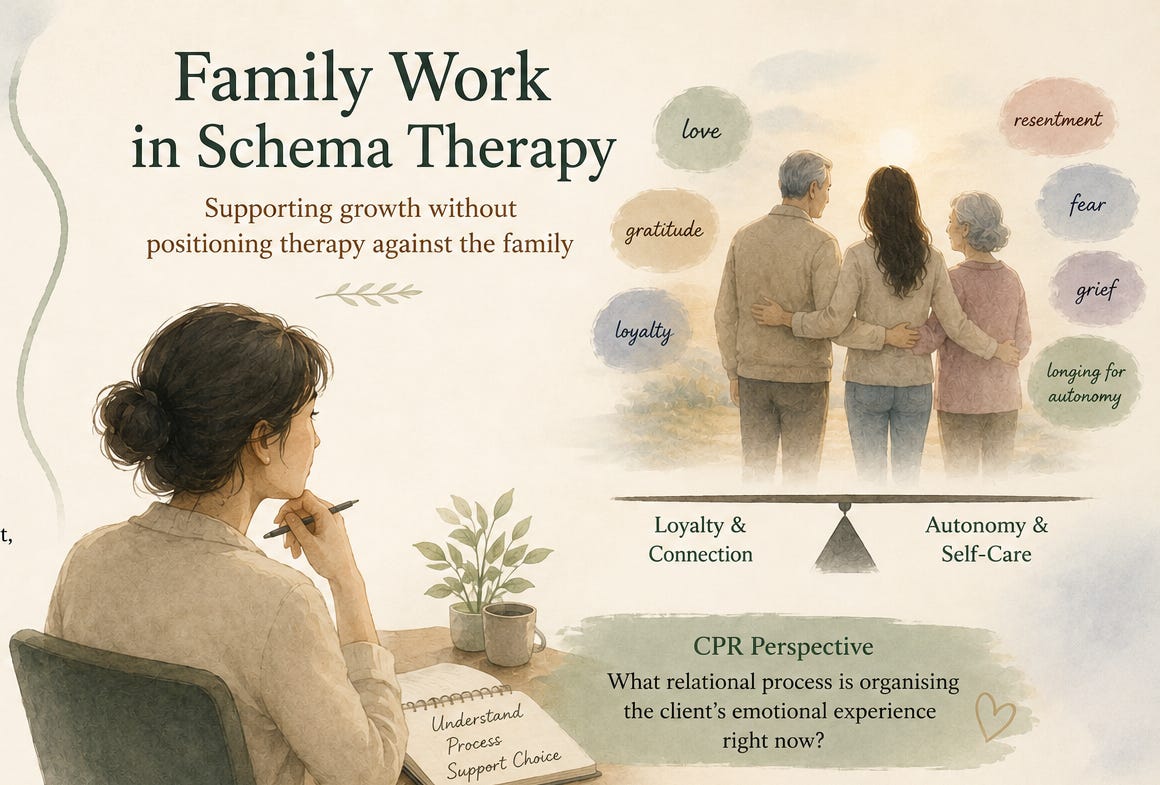
他們同時愛父母、感激父母、心疼父母,希望父母幸福;同時又感到委屈、憤怒、失望,甚至窒息。
如果治療師未能通透地看見, 眼前的個案這兩面的模樣,治療便很容易觸礁。
Schema Therapy 的目的,不是說服個案離開父母,也不是要求個案一味接納父母,而是協助他們逐漸建立一個更成熟、更有自主能力的 Healthy Adult,讓他們能夠自由地決定,自己希望如何與父母相處。
從 Content-Process-Relationship 的角度,我愈來愈少問:
「治療應不應該鼓勵個案原諒父母?」
反而更常問自己:
「究竟是什麼 relational process,正在組織(organising)個案此刻的情緒經驗?」
很多時候,當這個 relational process 改變了,個案自然便知道自己最希望如何回應父母,而答案不需要由治療師替他決定。
Many Schema Therapists learn chairwork and imagery rescripting as powerful techniques for working with unmet childhood needs.
Yet something often changes when the client’s difficulties centre on their relationship with their parents.
Therapists begin to hesitate.
“Am I encouraging the client to distance themselves from their parents?”
“Am I challenging cultural values such as filial piety?”
“Should I work with the internalised parent, or the real parent?”
“How do I know when to validate loyalty, and when to support differentiation?”
These are not simply technical questions.
They reflect one of the central tensions in psychotherapy:
How do we facilitate psychological growth without positioning therapy against the client’s family?
Over the past few years, this has become one of the central questions in my clinical work, supervision, and research.
Many clients do not simply carry punitive or demanding parent modes. They also carry love, gratitude, responsibility, loyalty, and hope. These often coexist with resentment, fear, grief, and a longing for greater autonomy.
When therapists cannot see both sides of the same coin, interventions can unintentionally become polarising.
The goal of Schema Therapy is not to persuade clients to reject their parents, nor to encourage unquestioning acceptance. Rather, it is to help clients develop sufficient emotional freedom to relate to their parents from a healthier Adult mode.
From a (CPR) perspective, I have become less interested in asking,
“Should the therapy encourage the client forgive their parent?”
and more interested in asking,
“What relational process is organising the client’s emotional experience at THIS moment?”
The answer to that question often determines whether chairwork or imagery rescripting deepens emotional integration—or inadvertently reinforces guilt, compliance, or emotional distance.
除了介紹 Chairwork 和 Imagery Rescripting 的技巧外,我更希望和大家一起探討治療背後的臨床思考,包括:
如何處理內化父母模式(Internalised Parent Modes)
如何在複雜家庭關係中運用 Chairwork 與 Imagery Rescripting
如何支持自主,而不把個案推向與家庭對立: 再撫育個案的父母 (Reparenting the client’s parents)
如何在孝道與家庭排序下進行體驗式治療
如何避免過度順從或過早對抗
如何提升體驗式治療中的即時臨床判斷能力
These questions have shaped a new one-day Cantonese workshop that I will be teaching in Hong Kong.
Rather than focusing only on techniques, we will explore the clinical reasoning behind experiential work with complex family relationships.
Topics include:
Working with Internalised Parent Modes
Chairwork and Imagery Rescripting in complex family dynamics
Supporting autonomy without positioning clients against their families
Working with filial piety and family hierarchy
Avoiding both over-compliance and premature confrontation
Developing moment-to-moment clinical decision-making during experiential work
I will also provide an English version of this workshop in some in-house training in Hong Kong, UK and Singapore. Interested parties, please email: info@chinese-schema-therapy.com
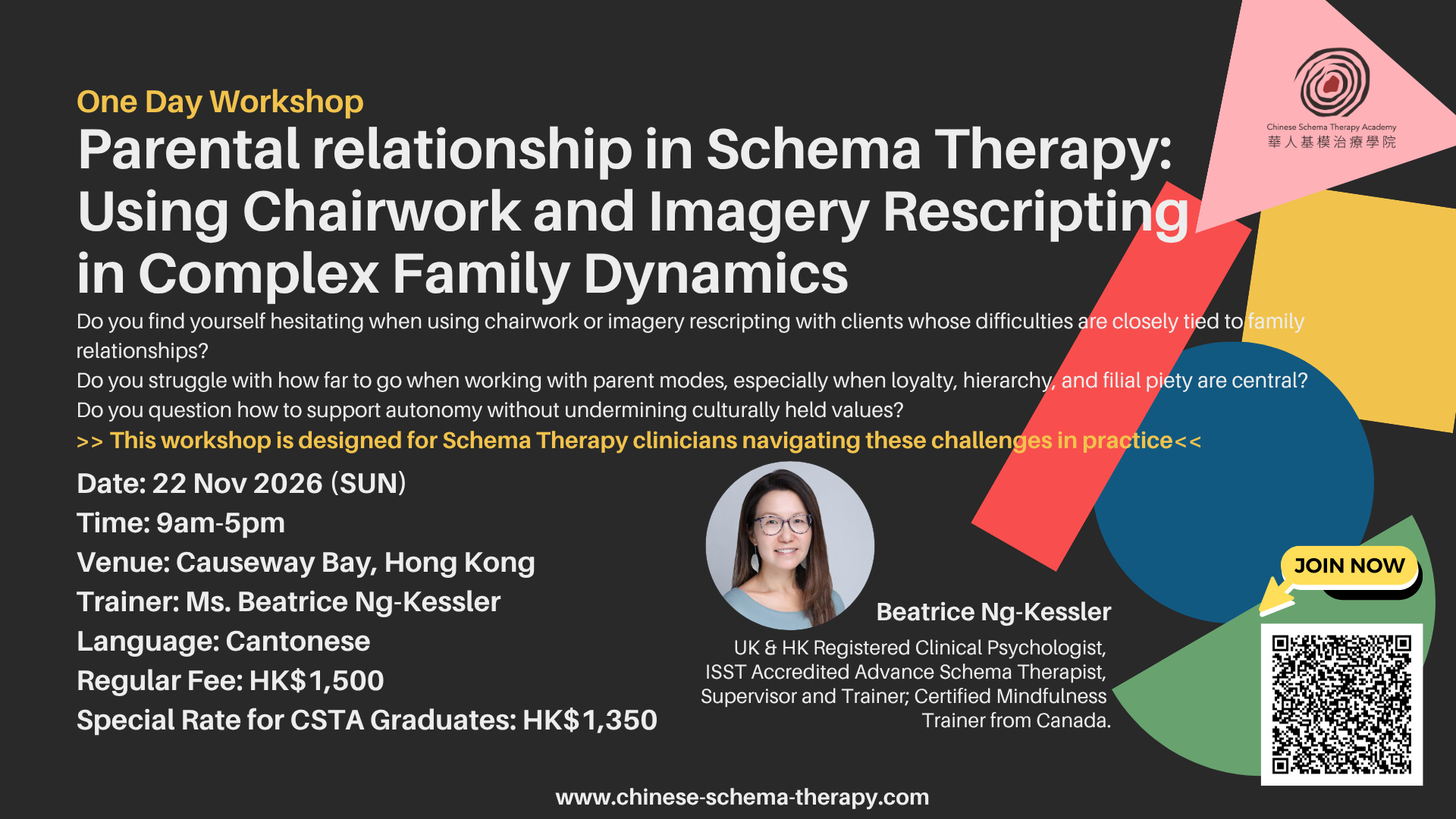
Parental Relationship in Schema Therapy: Using Chairwork and Imagery Rescripting in Complex Family Dynamics
Schema Therapy 中的親子關係:在複雜家庭關係中運用 Chairwork 與 Imagery Rescripting
📅 22 November 2026 (Sunday)|2026 年 11 月 22 日(星期日)
📍 Causeway Bay, Hong Kong|香港銅鑼灣
🗣 Language|語言:廣東話
👥 For clinicians who have completed Schema Therapy Level I (or equivalent basic training).
適合已完成 Schema Therapy Level I(或具備基本 Schema Therapy 訓練)的臨床工作者。
I would be delighted to meet colleagues who are interested in exploring one of the most nuanced areas of Schema Therapy practice.
Application Link: Parental relationship in Schema Therapy:Using Chairwork and Imagery Rescripting in Complex Family Dynamics | Chinese Schema Therapy Academy
期待在香港與大家一起深入探討 Schema Therapy 中最細緻、也最富挑戰性的臨床工作。
Comments
Nothing yet. Say the first thing.
Sign in to join the conversation.