
Hello Friend,
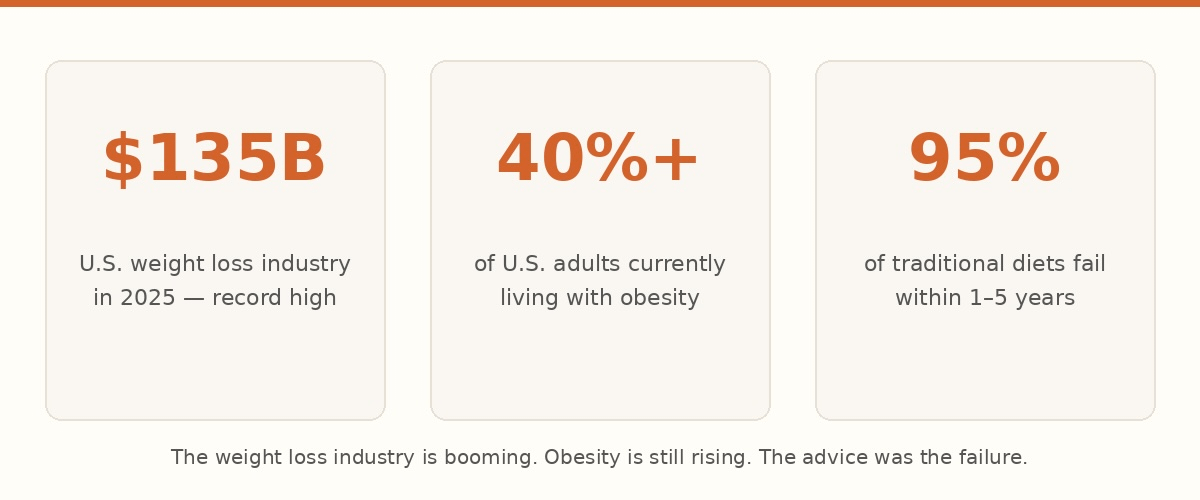
Think about this for a moment. The U.S. weight loss industry hit a record $135 billion in 2025. That’s billion ,with a B. And yet, more than 40% of American adults are still classified as obese. The global weight management market is projected to nearly double to over $890 billion by 2035.

The $135 Billion Lie You’ve Been Sold
We are spending more money than ever on diets, shakes, meal plans, calorie-counting apps, gym memberships, supplements, and “fat-burning” teas and the problem is getting worse, not better.
Most people get wrong about weight loss: they think it's about eating less and moving more. That formula sounds logical. But if it worked, the billions spent on diet products every year would have solved the problem by now. The truth is that weight loss is not primarily a calorie problem. It is a hormonal problem. And until you address the hormonal environment inside your body, no amount of restriction or cardio will produce lasting results.
If you’ve ever lost weight only to gain it all back , maybe more than once, maybe three or four or ten times ,you are not the failure. The advice was the failure. “Eat less, move more” was sold to you as science. But it was never the full picture. It ignored the single most important factor in whether your body stores fat or burns it: your hormones.
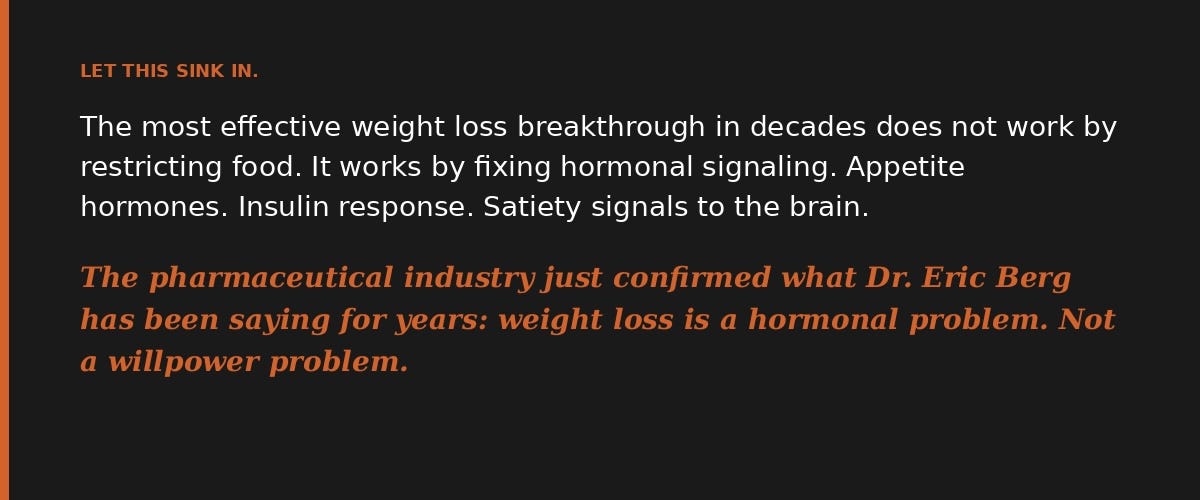
And here’s the irony that proves it. Look at the most successful weight-loss drugs in modern history ,the GLP-1 medications like Ozempic, Wegovy, Mounjaro, and Zepbound.
And what do they do?
This post breaks down exactly what’s happening inside your body when fat loss stalls, why the conventional advice keeps you stuck, and the specific, actionable steps you can take starting today to shift your metabolism into fat-burning mode.
The master switch behind fat storage and fat burning is insulin "fat-storing hormone," and for good reason. Every time you eat ,especially carbohydrates your blood sugar rises and your pancreas releases insulin. Insulin's job is to shuttle that sugar out of the bloodstream and into cells for energy.
But here's the problem: when there's more sugar than your cells need, insulin signals your body to store the excess as fat. And it does something even worse ,while insulin is elevated, it blocks your body from accessing stored fat for energy. So you're locked in storage mode.
Now imagine this happening three meals a day, plus snacks, plus sugary drinks. Insulin stays chronically elevated. Over time, your cells start ignoring insulin's signal ,a condition called insulin resistance. Your pancreas compensates by producing even more insulin. The result? You're storing fat constantly and unable to burn it, no matter how little you eat.
Key Insight: Research suggests that over 40% of American adults have some degree of insulin resistance. This means nearly half the population is metabolically set up to store fat, not burn it, regardless of how hard they diet. Addressing insulin is the single most important lever for fat loss.
This is why someone can eat 1,200 calories a day, exercise every morning, and still not lose weight. The calories are low but insulin is high. The body is in storage mode, running on stress hormones, breaking down muscle for energy, and holding onto every ounce of fat.
Why the Way You Lose Weight Matters More Than the Number on the Scale
Most people measure success purely by pounds lost. But not all weight loss is the same. Losing weight through extreme calorie restriction, juice cleanses, or crash diets can actually make your situation worse over time.
Here's what happens when you slash calories drastically: your body interprets it as a famine. It slows your metabolism to conserve energy. It increases cortisol (your stress hormone). It breaks down muscle tissue for fuel instead of fat. And it ramps up hunger hormones to force you to eat.
So yes, you lose weight on the scale. But you've lost muscle, slowed your metabolism, and set yourself up for a massive rebound. This is why 95% of diets fail long-term ,the approach itself creates the conditions for future weight gain.
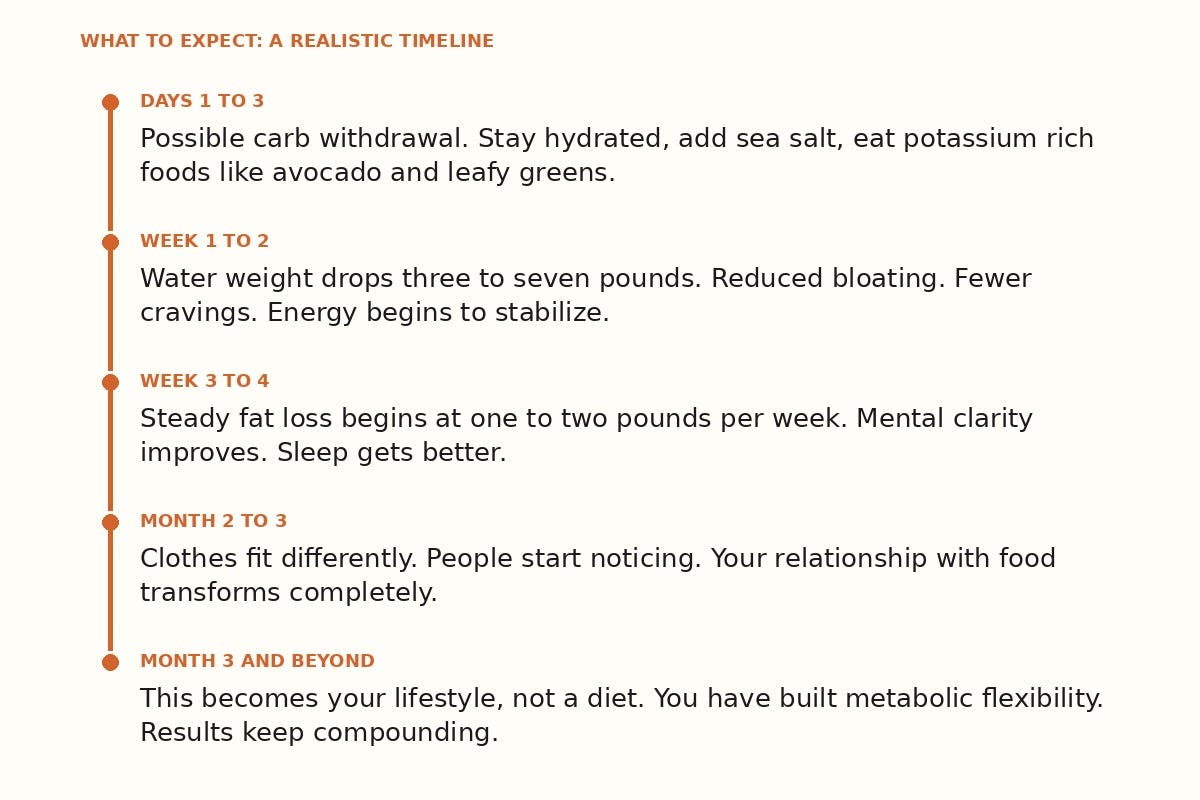
The better is to support the body first. When your body is properly nourished with nutrient-dense whole foods, when insulin is stable, and when stress hormones are managed ,weight loss follows naturally.
These aren't hacks or tricks. They're the foundational habits that create an internal environment where fat loss becomes your body's default setting.
This is the cornerstone. Reducing carbohydrate intake ,especially refined carbs, sugar, and starches, lowers insulin more effectively than any other single dietary change. When insulin drops, your body unlocks stored fat and begins using it as fuel.
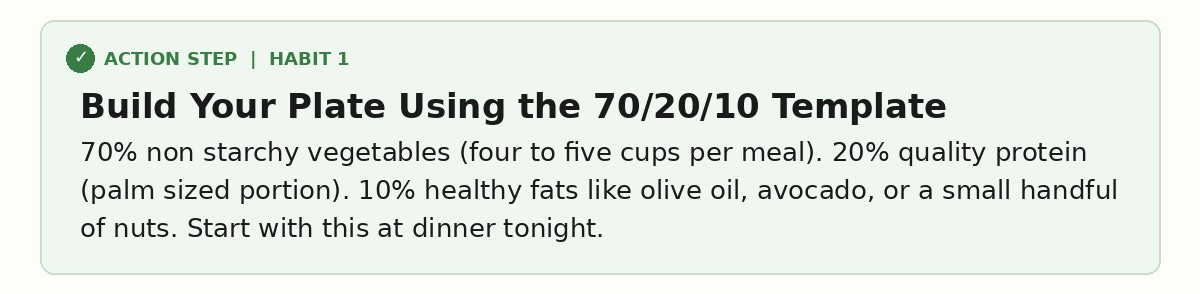
The bulk of your plate should be vegetables aiming for 7 to 10 cups of vegetables per day, primarily leafy greens and cruciferous vegetables like broccoli, and arugula, cabbage.
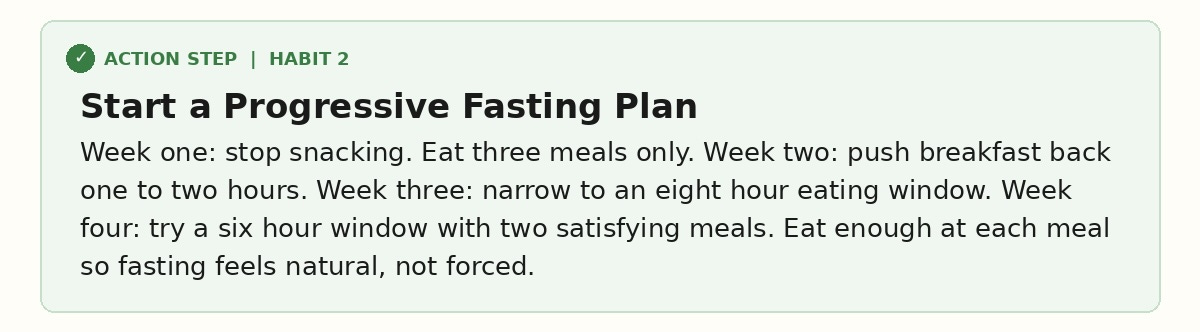
Every time you eat , no matter what you eat ,your body releases insulin. So the frequency of eating matters just as much as the content. Time-restricted eating means compressing your meals into a shorter window each day, giving your body long stretches without food where insulin can drop and fat burning can activate.
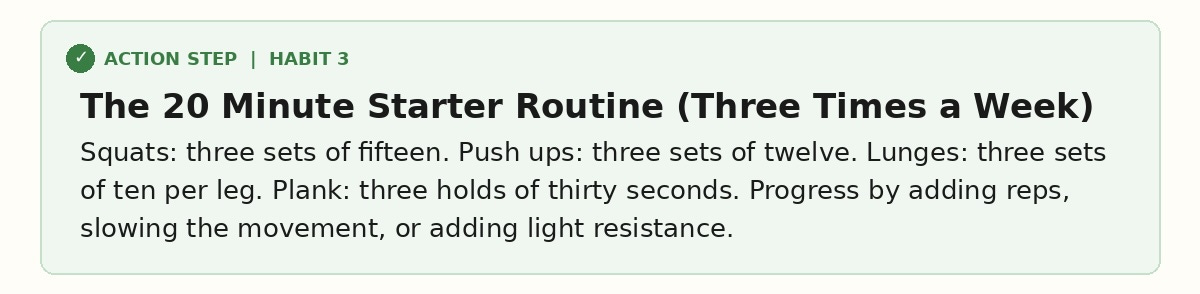
Muscle is the most metabolically active tissue in your body. It burns calories even when you're sitting on the couch. Strength training also directly improves insulin sensitivity ,meaning your cells respond better to insulin, requiring less of it. Less insulin means easier fat burning.
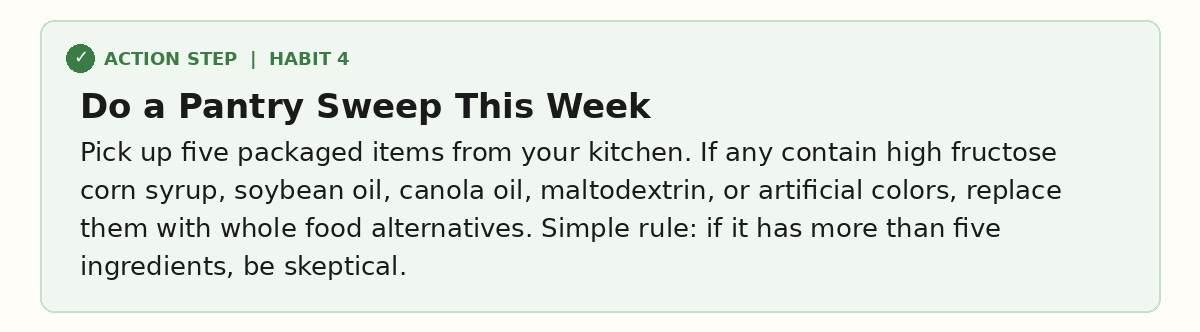
Ultra-processed foods ,those with long ingredient lists full of preservatives, artificial sweeteners, modified starches, and seed oils ,can disrupt your hormones, inflame your gut, and stall fat loss even when your calories and carbs are technically in check
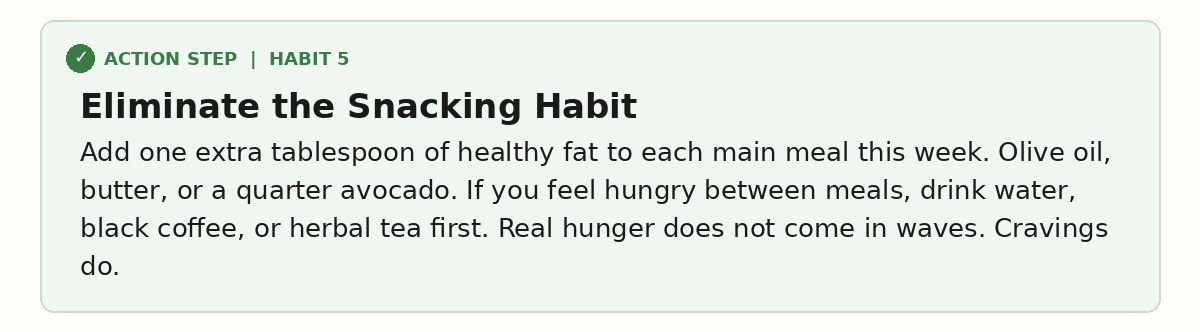
Every time you eat, insulin rises. If you're eating 5–6 times a day, insulin never gets a chance to come down, and your body never switches into fat-burning mode. The fix isn't willpower , it's eating larger, more satisfying meals so that snacking becomes unnecessary.
Stress isn't just a feeling, it's a hormonal event. When you're stressed, your body releases cortisol. Chronically elevated cortisol promotes fat storage (especially around the midsection), raises blood sugar, increases cravings for comfort foods, and disrupts sleep. It directly counteracts everything you're trying to do with diet and fasting.
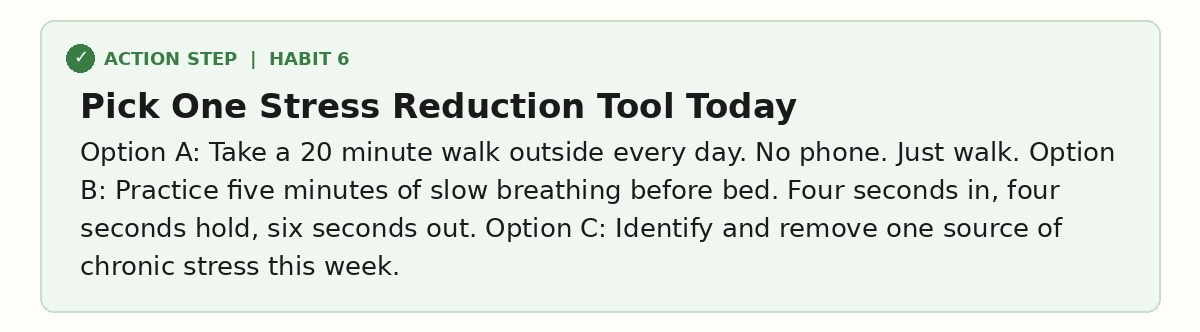
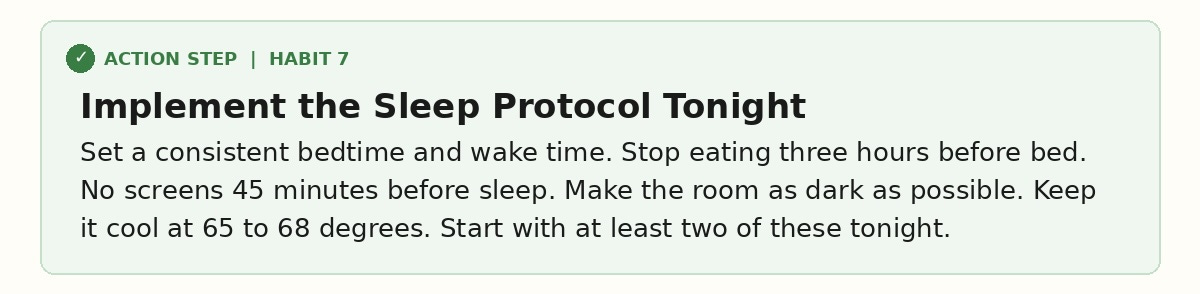
Poor sleep is one of the fastest ways to undo all of your dietary progress. Even one night of bad sleep increases cortisol, raises insulin resistance, spikes hunger hormones, and increases cravings for high-carb foods the next day.
Too much protein. Excess protein can be converted into glucose through gluconeogenesis, which raises insulin. Try moderating protein to 3–6 ounces per meal.
Too much fat. Your body may be getting enough dietary fat that it doesn't need to tap into stored fat. Try reducing added fats slightly.
Hidden carbs. Condiments, sauces, and "keto" snack products can add up. Read labels carefully.
Stress and sleep. These two can single-handedly halt fat loss even when nutrition is dialed in.
If you've plateaued, simplify. For one week, eat only whole foods: eggs, fish, meat, leafy greens, cruciferous vegetables, olive oil, avocado. No packaged products, no protein bars, no nut butters. Just real food, two meals a day, within a 6–8 hour window.
The Daily System: Making This Sustainable
Here's your daily framework:
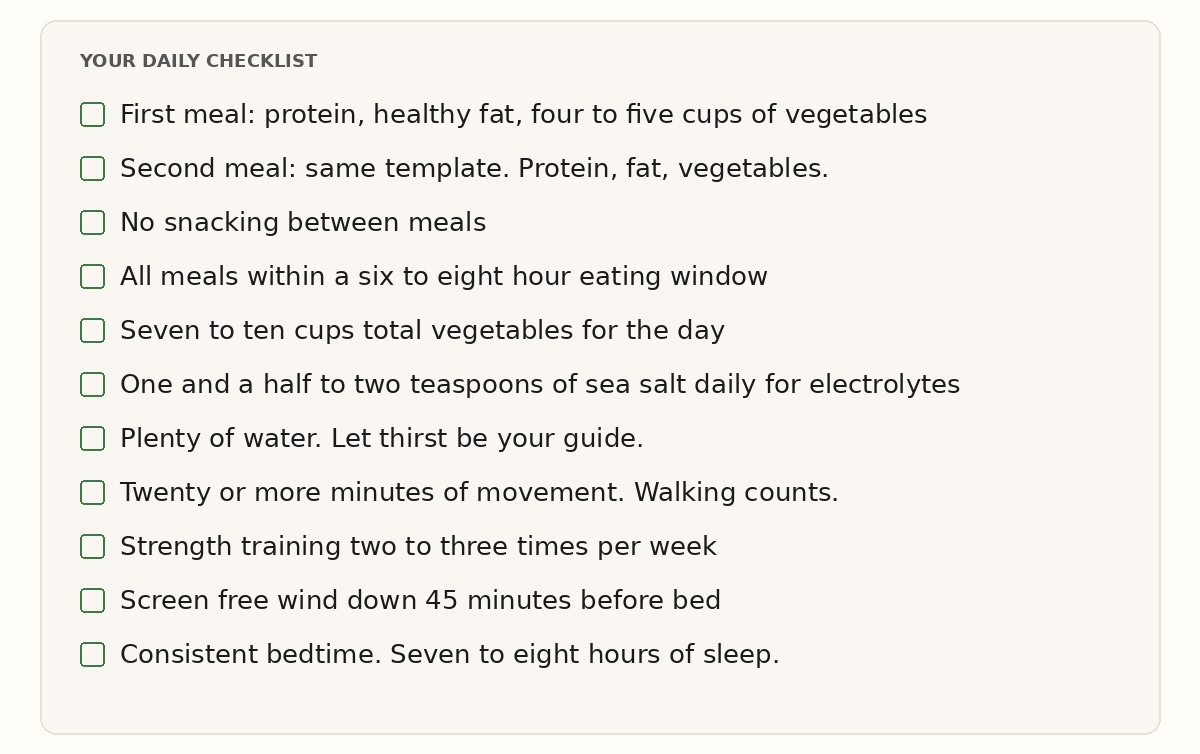
Get healthy to lose weight. Don't lose weight to get healthy.
I built something for people who are done guessing and ready to do this properly.
The 30 Day Metabolic Reset
Everything in this post becomes a daily practice.
You get a clear framework for what to eat, when to eat, and how to structure your days so your body can do what it was designed to do. You get weekly check ins, a community of people going through the same transformation, and direct support when you hit a wall or have a question at 9pm about whether almond butter is stalling your progress.
This is not another course you buy and never open. It is 30 days of showing up, together.
The next cohort is forming now. Spots are limited because the program only works when the group is small enough for real support.
Already know you want to go deeper, faster? I also work with a small number of people 1:1. If you want a personalized plan built around your body, your schedule, and your life, book a free discovery call and we will figure out if it is the right fit. No pitch. Just an honest conversation.
Not ready for either? That is completely fine. Save this post. Try the steps. Come back in two weeks and see how you feel. The door is always open.
with love,
Azadeh
Comments
Nothing yet. Say the first thing.
Sign in to join the conversation.