
Hello Friend,
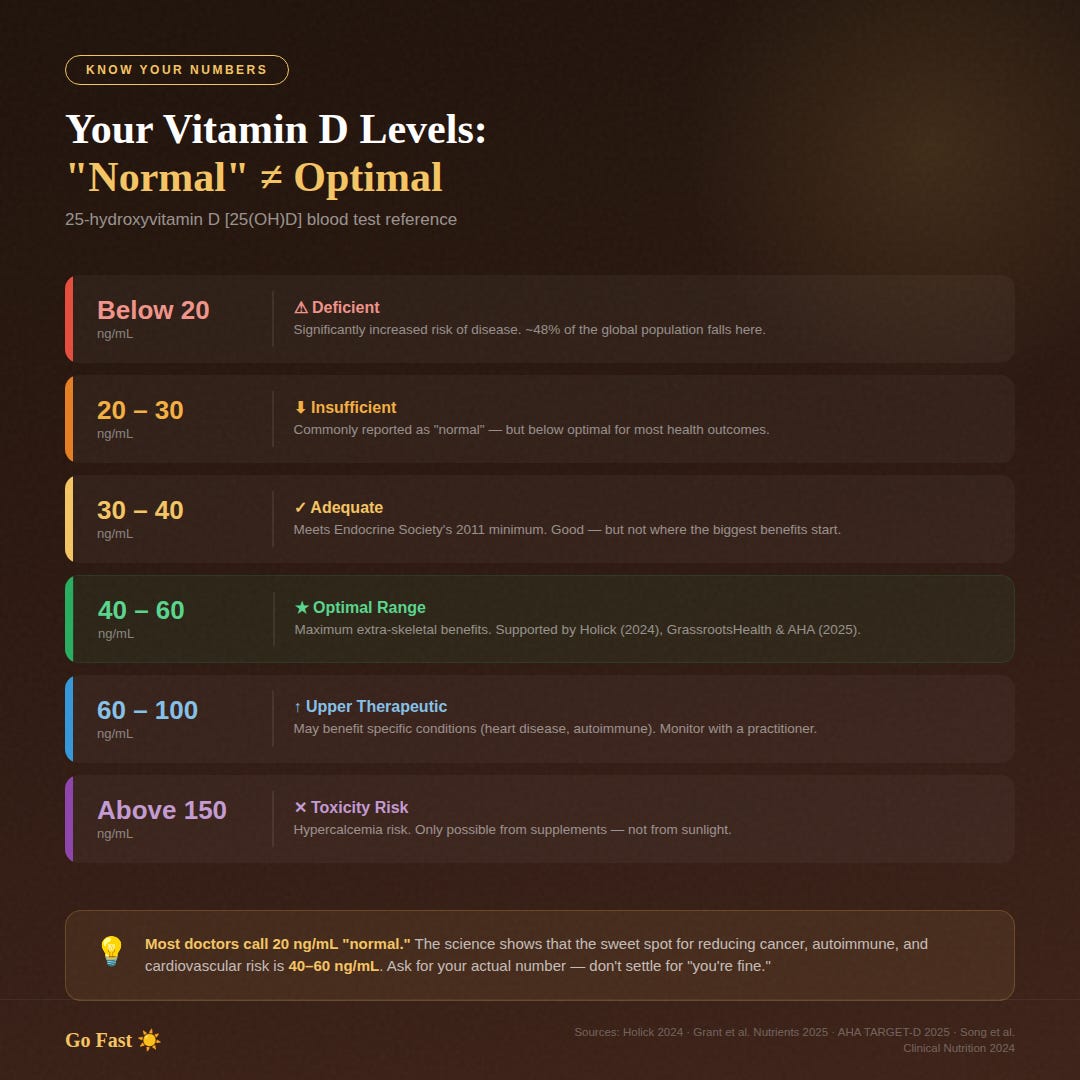
Your doctor checks your vitamin D, sees a 22 on the lab report, and tells you you’re fine.
But what if that number ,the one nearly every doctor in the country uses as the cutoff was based on a math mistake?
This isn’t a fringe theory. It’s a finding from a peer-reviewed journal. And once you understand what it means, you’ll never look at that lab result the same way.
In 2011, the Institute of Medicine set the recommended daily allowance for vitamin D at 600 IU per day, declaring a blood level of 20 ng/mL sufficient for nearly everyone.
But in 2014, researchers Veugelers and Ekwaru reanalyzed the IOM’s own data and discovered a significant statistical error. When corrected, the required daily intake jumped to approximately 8,895 IU ,roughly 15 times higher than the official guideline. A separate study by Heaney and colleagues confirmed that 6,201 IU per day was needed to reach the Endocrine Society’s target of 30 ng/mL.
Fast-forward to 2024: Dr. Michael Holick from Boston University reviewed the Endocrine Society’s latest guidelines and noted that these new recommendations still rely heavily on randomized controlled trials while excluding the larger body of association studies that previously informed targets. He pointed out that for every 100 IU of vitamin D consumed, blood levels rise by only about 0.7 ng/mL ,meaning the standard 600–800 IU dose barely moves the needle for most people.
A 2025 paper published in Nutrients , now the most-cited vitamin D paper of the year ,found that higher blood levels of 25(OH)D are associated with lower risk of death from eight of the ten leading causes of mortality in the U.S., including cancer, diabetes, stroke, Alzheimer’s, and kidney disease.
So for over a decade, reference labs have been setting the “normal” cutoff at 20 ng/mL, and doctors everywhere have been reassuring patients who may actually be significantly deficient.
This is one of the most important things I teach my clients: vitamin D is not a vitamin. It’s a steroid hormone.
Vitamins are nutrients your body can’t manufacture ,you must get them from food. Vitamin D is different. Your body produces it when ultraviolet B light hits the cholesterol in your skin. It then undergoes conversion in the liver and kidneys into its active form — calcitriol — which has the same chemical structure as cortisol, testosterone, and estrogen.
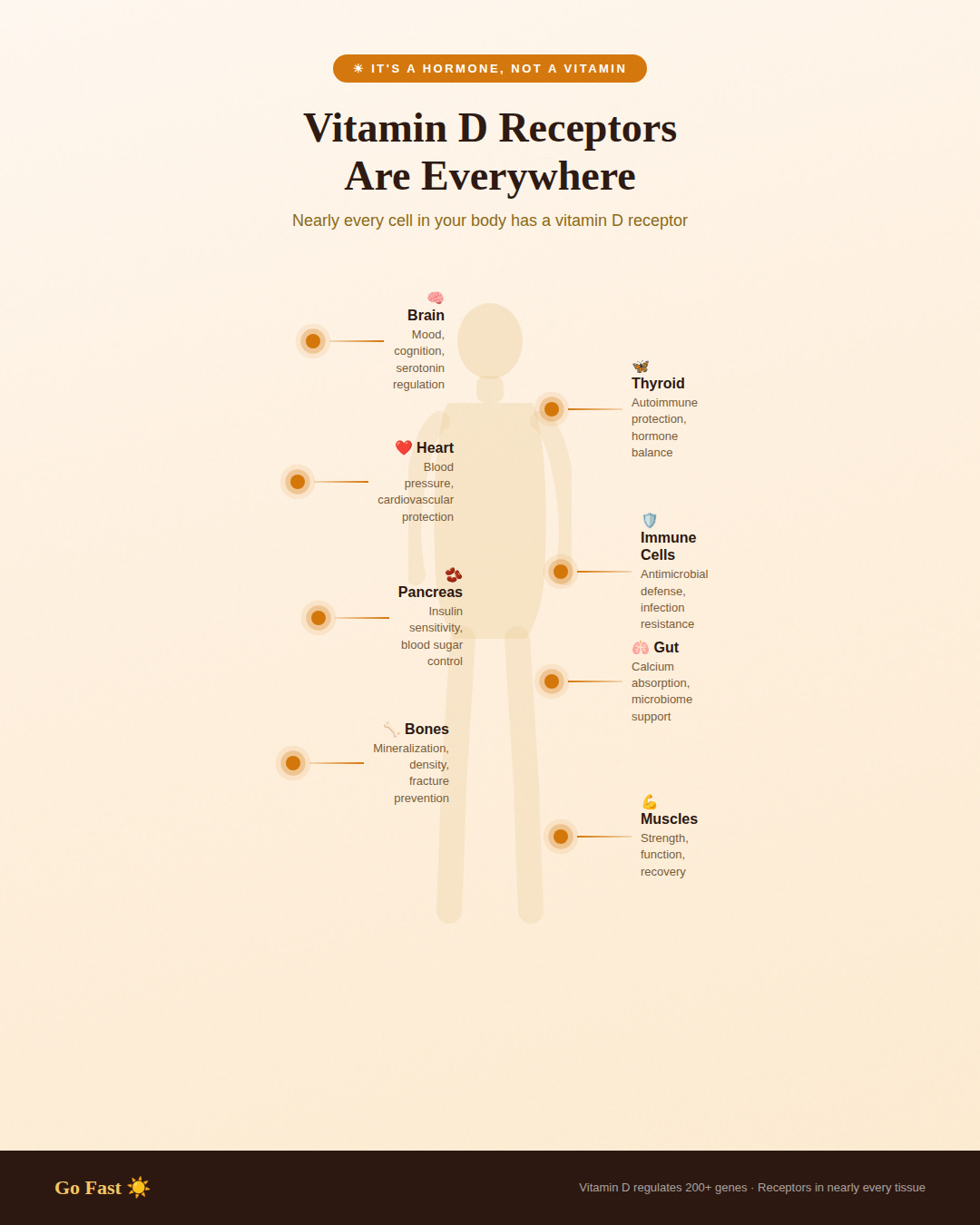
Almost every cell in the human body carries a vitamin D receptor. That alone tells us something important: this molecule isn’t a minor nutrient. It’s a signaling hormone with influence across virtually every system.
Active vitamin D regulates the expression of more than 200 genes. It governs cell growth, modulates both your innate and adaptive immune responses, and influences how your body handles glucose and insulin.
That’s not a vitamin doing vitamin things. That’s a master hormone ,and because we’ve mislabeled it, most of conventional medicine treats it like a checkbox item.
🔎 Think vitamin D might be part of your puzzle?
Download my free Metabolic Health Checklist — 12 warning signs that your metabolism is working against you, with a specific fix for each one. Takes 10 minutes.
Comments
Nothing yet. Say the first thing.
Sign in to join the conversation.