
hello friends,
I want to start this week with something I hear almost every single day from the professionals I work with.
“I eat healthy. I exercise. I drink water. I try to fast. And nothing changes.”
The frustration in those words is real. Because the effort is real. And yet the body seems to be ignoring every good intention.
Here is what I have come to understand after years of studying food science, working with clients and digging into the research on insulin, metabolism, and the gut: the reason your body holds onto weight has almost nothing to do with how hard you are trying. It has everything to do with what is happening hormonally and metabolically beneath the surface, in systems most of us were never taught to pay attention to.
This is the newsletter where I am going to explain exactly why that happens, what the research actually says, and what you can do about it in a very practical and realistic way.
If you are tired of dealing with low energy, poor sleep, stubborn weight, digestive issues, or the stress that comes with modern life, you can book a discovery call with me here. Book your Free Discovery Call
Let’s get into it.
Most people understand that insulin is connected to blood sugar and diabetes. What most people do not understand is that insulin is also the master switch for fat storage.
When insulin is elevated, your body is in storage mode. It is taking glucose from your blood and pushing it into cells or converting it to fat. While insulin stays elevated, your body literally cannot access your stored fat for energy. It does not matter how many miles you walk or how many calories you cut. The hormonal signal says “store,” and your body listens.
Dr. Robert Lustig, pediatric endocrinologist and author of Metabolical, has written extensively about how excess insulin, driven by sugar and processed food, creates a metabolic environment where the body is simultaneously overfed and starving at a cellular level. Your fat cells are full, but your muscles and brain are not getting the energy they need. So what happens? You feel hungry again. You eat again. And the cycle continues.
Research published in Cell Metabolism has shown that chronic hyperinsulinemia (consistently elevated insulin) is not just a consequence of overeating but may actually be a primary driver of metabolic dysfunction, making weight loss progressively harder over time.
This is a hormone problem.
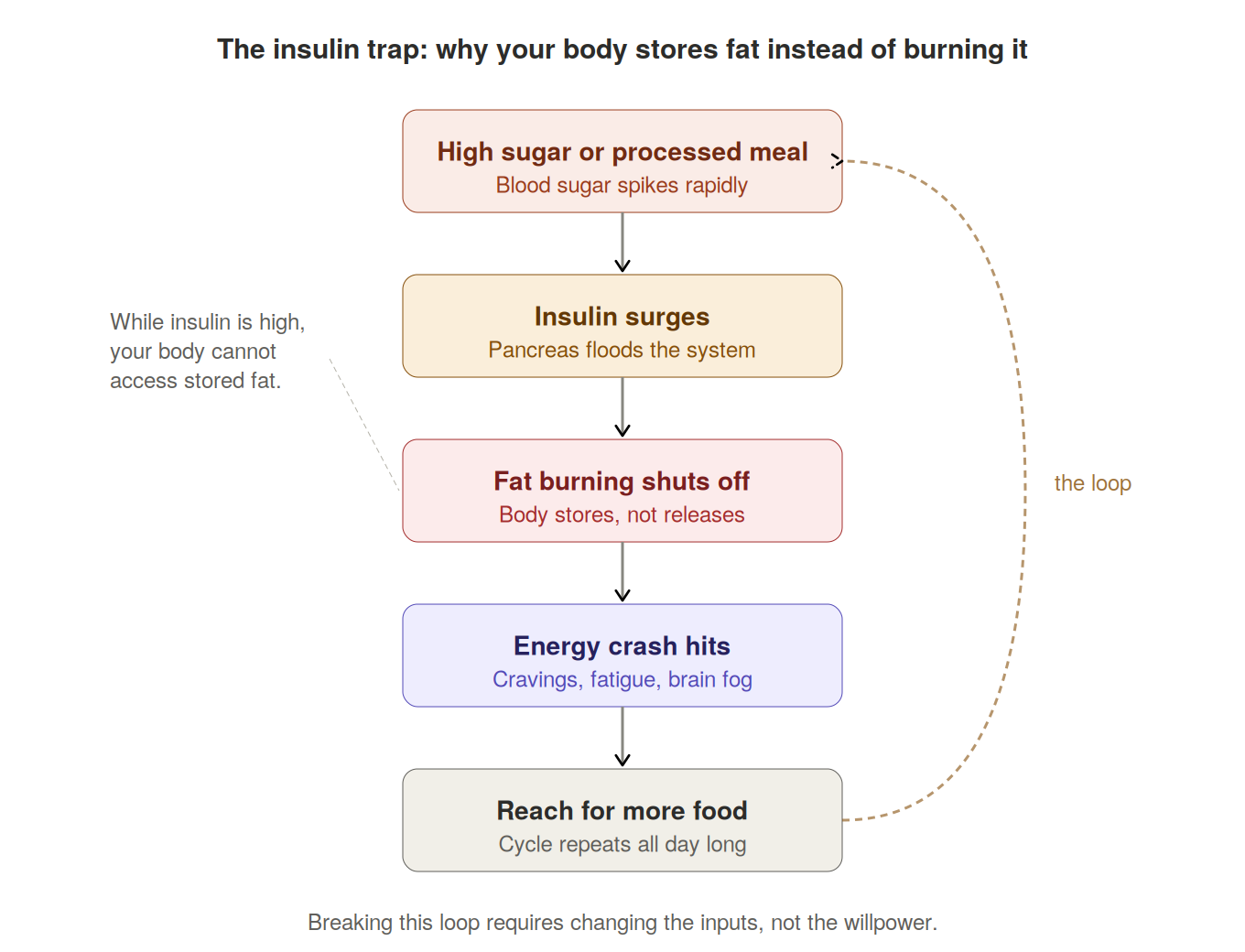
That cycle in the image above is what most people are living through every single day without realizing it. And the foods driving the cycle are not always the ones you would expect.
When I sit down with a new client and we walk through their food diary together, the pattern is almost always the same. They are eating what they believe is healthy food. And yet many of those foods are silently spiking insulin, feeding gut inflammation, or disrupting the hormonal balance that makes fat burning possible.
Here are the five most common metabolic blockers I see in practice, all backed by published research.
Every time you eat, even a handful of almonds or a protein bar, your body releases insulin. When you eat three meals and two or three snacks per day, insulin never gets the chance to come all the way down. And if insulin never comes down, your body never shifts into fat burning mode.
Research in The Journal of Clinical Investigation demonstrated that extending the gap between meals allows insulin to drop low enough for the body to begin mobilizing fat stores. This is one of the foundational principles behind time restricted eating, and it is also why I structure my 7 Day Detox the way I do: meals spaced 4 to 5 hours apart, with zero snacking.
The fix: structure your day around 2 to 3 complete, satisfying meals with no eating in between. Each meal should contain enough protein, healthy fat, and fibre rich vegetables to hold you until the next one. If you are hungry between meals, that is a signal that your meals need more protein or fat, not that you need a snack.
Comments
Nothing yet. Say the first thing.
Sign in to join the conversation.