
Well, hello you.
Yes, you, with the cuff reading you have been quietly worrying about, or the little orange bottle on the kitchen counter you have made peace with. Pull up a chair. This one is for you.
Here is what the next few minutes are going to do. I am going to show you how the definition of high blood pressure was changed, how that turned millions of well people into patients without a single thing happening inside their bodies, and why, for most men, the number on the cuff is not really the problem at all. It is a messenger. And by the end, you will know what it is actually trying to tell you, and the real levers that move it. Let’s go.
The number moved
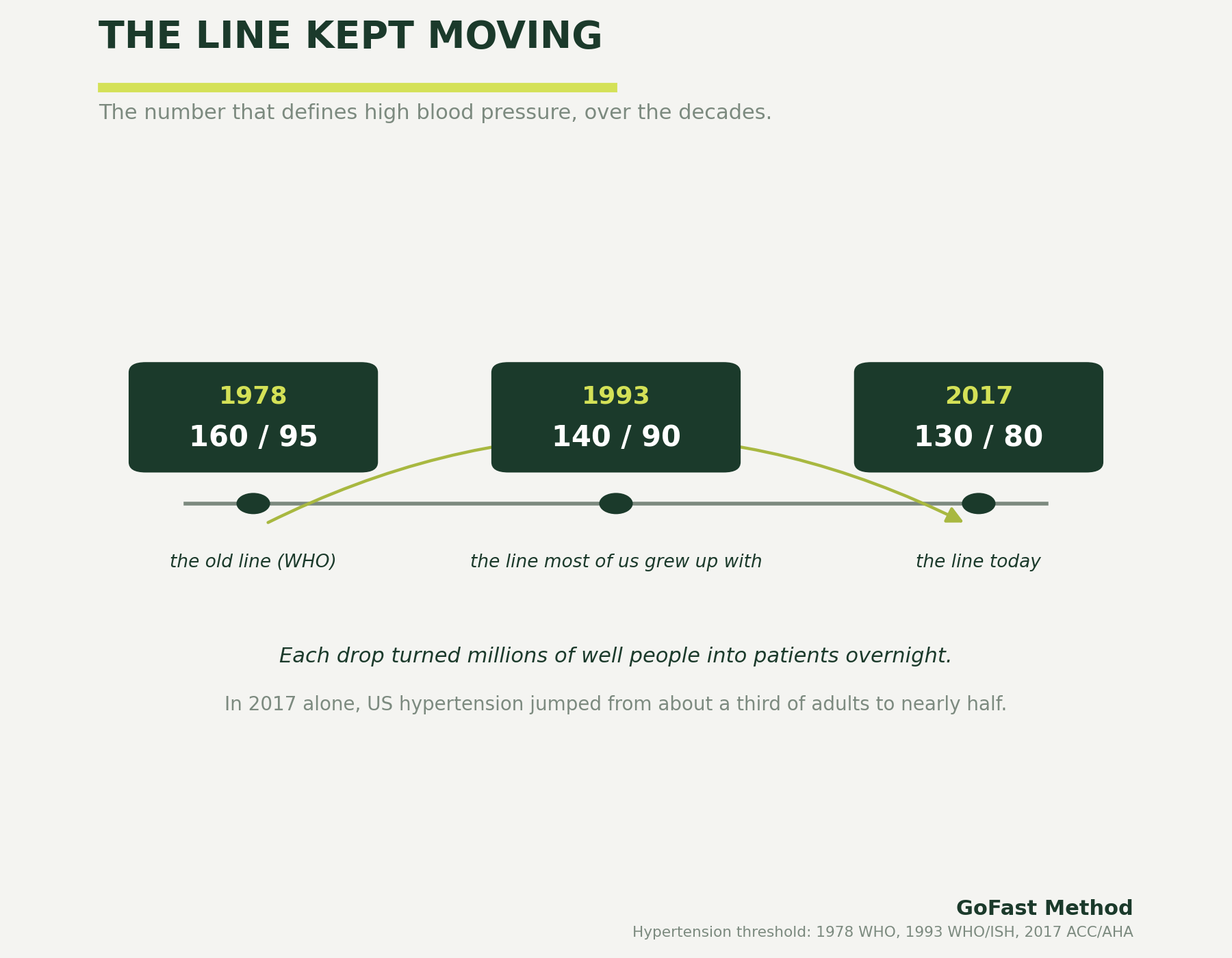
For most of modern medicine, high blood pressure began at 140 over 90. That was the line. Everyone knew it.
Then in 2017, a panel in the United States moved it to 130 over 80.
Nothing changed in a single human body that year. No one’s arteries stiffened overnight. No one felt different. But by the next morning, tens of millions of people who had gone to sleep healthy woke up with a diagnosis. In the space of one document, hypertension went from describing about a third of American adults to nearly half. Roughly thirty-one million people were reclassified as sick, not by anything that happened inside them, but by a decision about where to draw a line.
And the line kept moving. The 2025 update went further still, recommending medication even for lower-risk people whose pressure sits at 130 after a few months of lifestyle change, which moves more of that newly created group toward eventual medication.
Now here is the part that should make you stop and tilt your head.
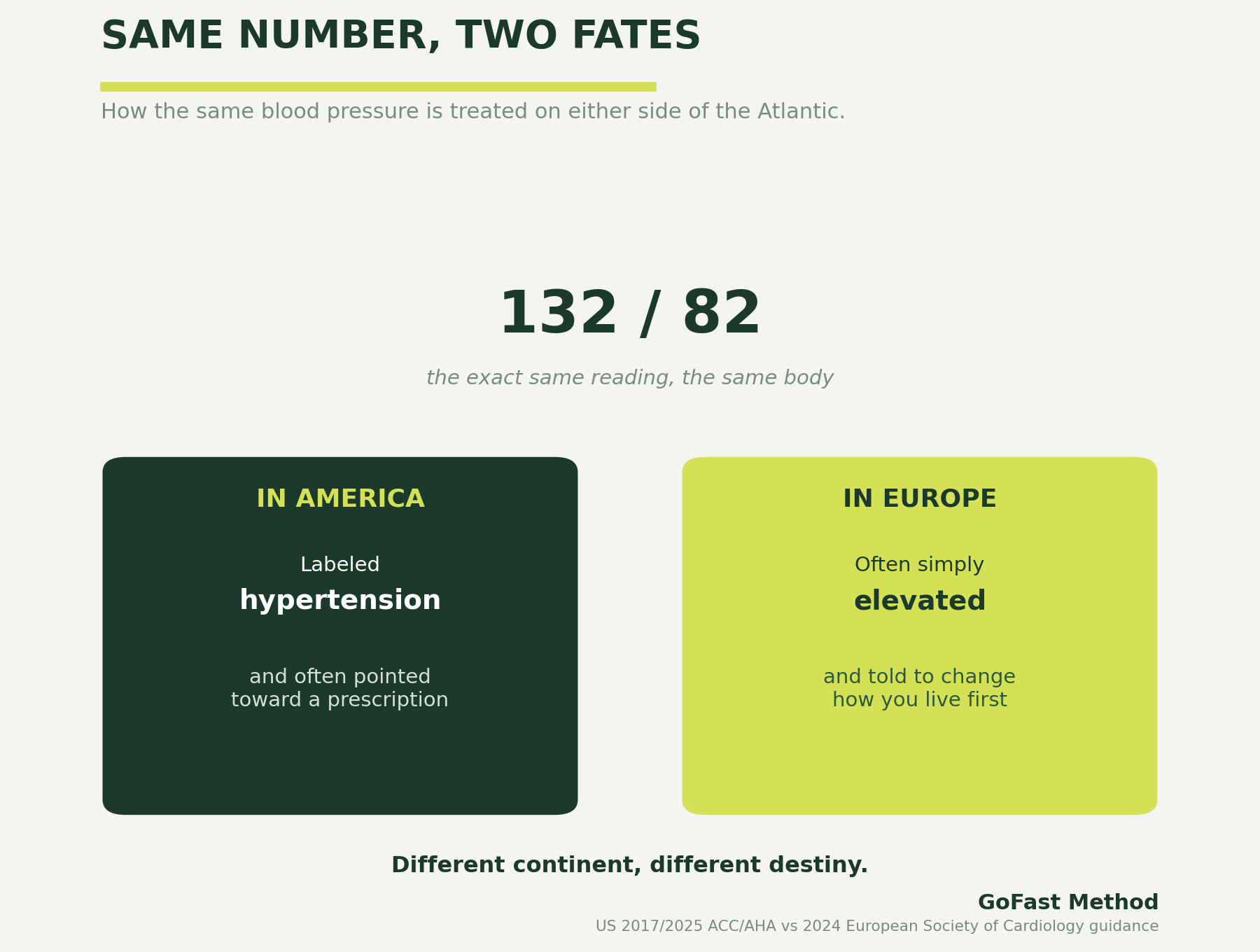
Cross an ocean, and the exact same number means something entirely different. Under the current European guidelines, a person sitting at 132 over 82 is often simply told to change how they live. In the American system, that same person can be labelled hypertensive and steered toward a pill. Same body. Same reading. Different continent, different destiny.
When a condition can be created or erased depending on which committee’s paperwork your doctor happens to follow, it is fair to ask what the number is really measuring. And it is fair to ask who benefits every time the line drifts a little lower and a few million more customers appear.
GoFast With Azadeh is a reader-supported publication. To receive new posts and support my work, consider becoming a free or paid subscriber.
What the number is actually measuring
Blood pressure is not mysterious. It comes down to two things.
How much fluid is moving through your vessels, and how tight or relaxed those vessels are. Squeeze the vessels or add volume, and the pressure climbs. Relax them or drop the volume, it falls. Every blood pressure drug ever made simply pulls one of those two levers.
Which leaves the real question, the one there is never time for in a seven-minute appointment.
What is quietly telling your body to hold onto extra fluid and keep your vessels clamped tight, day after day after day?
For an enormous number of people, the answer is not in the heart at all. It is one floor up, in the metabolism.
The story the cuff is actually telling
When the body becomes resistant to insulin, it compensates by making more of it. And chronically high insulin does two specific things that matter enormously here.
First, it signals the kidneys to hold onto sodium and water. More retained fluid means more volume in the system, and more volume means more pressure. This is well documented. A 2020 review in the Canadian Journal of Cardiology by Hall and colleagues lays out exactly how excess insulin drives the body to retain salt and water and pushes blood pressure up.
Second, that same state keeps the nervous system stuck in a low, constant hum of threat. The stress branch stays switched on. The heart runs a little faster. The vessels stay a little tighter. And the pressure settles into a new, higher normal.
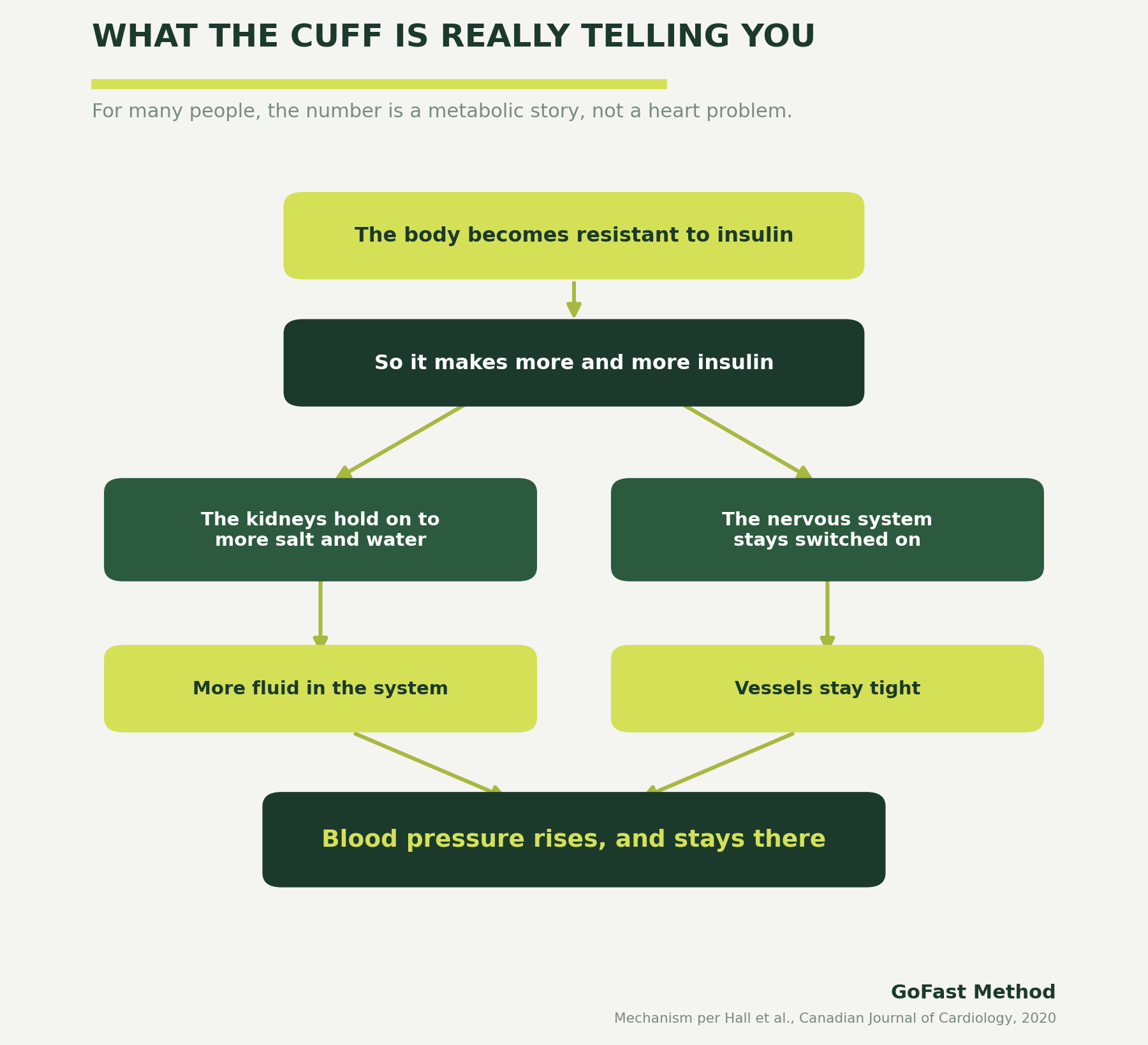
So the reading on the cuff is not the disease. It is the readout. It is a metabolism under strain, showing its work on a monitor. The number is the messenger. Insulin is the story.
This is the heart of everything I teach. The weight is a side effect. The blood pressure is a side effect. They grow from the same root. And it is why, before you change a single thing, it helps to actually see what your metabolism is doing. That is exactly what my metabolic test is for. The metabolic test does exactly that. If you're curious where your metabolism stands,
And now, the salt you were told a half-truth about
For forty years, the message was carved in stone. Salt is the enemy. Put down the shaker and save your heart.
It was half a truth, and the half they left out is the one that actually decides your blood pressure.
Your body was never built to fear salt. It was built to run on a balance between two minerals, sodium and potassium. In the wall of every cell sits a tiny pump whose entire job is to push sodium out and pull potassium in, all day, all night. Running it takes so much work that your body spends close to a fifth of its resting energy just keeping it going. That balance is what lets your heart beat, and your vessels stay relaxed.
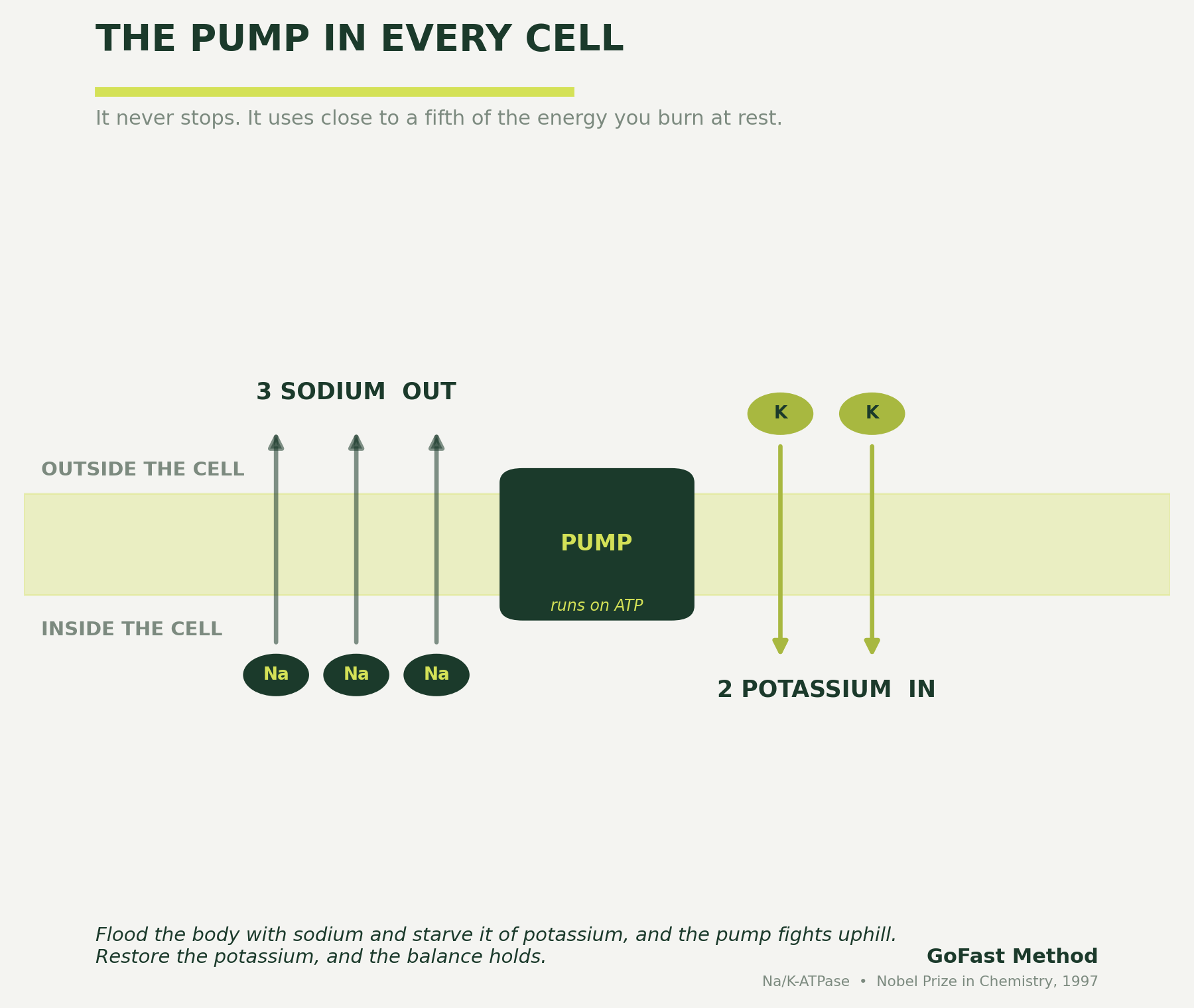
For nearly all of human history, we ate very little sodium and enormous amounts of potassium. Then, in a single lifetime, the modern food system flipped it. Today, the average plate is drowning in sodium and nearly empty of potassium, and it is not the salt on your steak doing it. It is ultra-processed, packaged food, where sodium is poured in, and potassium has been stripped out.
So the fix was rarely to strip all the flavor from your food. It was to stop living on processed foods that are high in sodium and low in potassium, and bring the balance back with real food, leafy greens, avocado, and beans.
The evidence is strong. A 2013 review in the British Medical Journal by Aburto and colleagues found that increasing potassium lowered blood pressure and was linked to lower stroke risk. A landmark 2021 trial in the New England Journal of Medicine found that swapping regular salt for potassium-enriched salt reduced strokes, heart events, and deaths across tens of thousands of people.
This is not a green light to pour on more salt. Many people with high blood pressure are salt sensitive, meaning their pressure genuinely rises when sodium goes up.
And here is the fascinating part that sits at the center of my work. Salt sensitivity is often tied to insulin resistance. In other words, it is not just a salt problem. It is often a metabolic problem showing up in blood pressure.
What actually moves the number
Of every major risk factor for the heart, blood pressure is one of the most responsive to how you live. The evidence is not soft.
The DASH eating pattern, tested by Appel and colleagues in the New England Journal of Medicine in 1997, lowered systolic pressure by more than eleven points in people who already had hypertension, roughly the range of a starting medication, from food alone. It is no accident that DASH is one of the highest potassium-eating patterns ever studied. And it works even in stubborn cases. The TRIUMPH trial, published in Circulation in 2021, took people whose pressure had shrugged off three separate drugs, changed how they ate and moved, and still brought their numbers down.
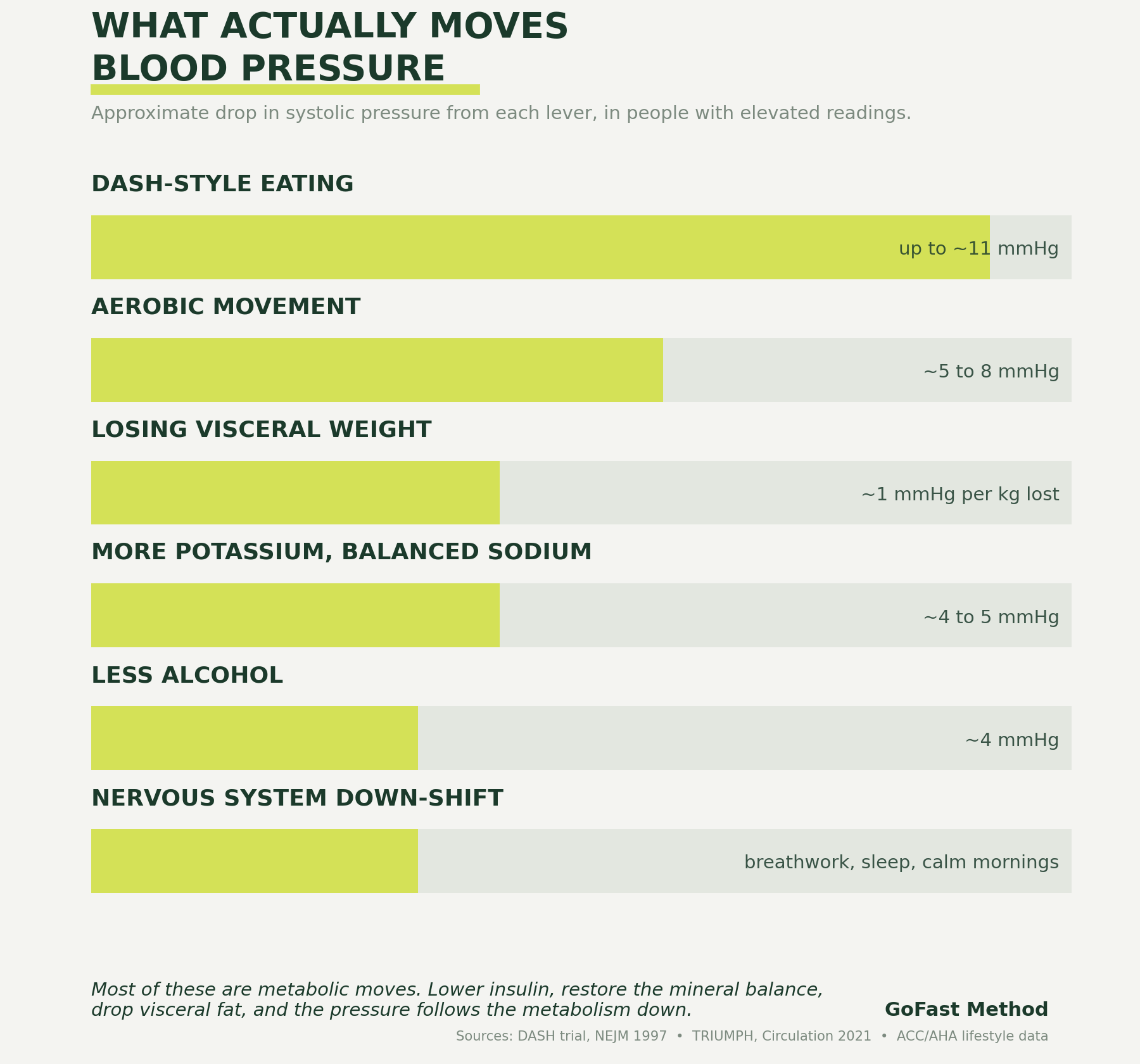
Look closely, and you will see these are all metabolic moves. Lower insulin, restore the mineral balance, calm the nervous system, shed the visceral fat, and the pressure follows the metabolism down. You are not chasing the number. You are removing the reason it was ever high.
A Different Approach, Different Outcome
A client came to me after fifteen years on blood pressure medication, convinced his body had simply betrayed him somewhere in his forties.
When we looked at how he actually ate, the picture was almost a caricature of modern advice done wrong. Low-fat, packaged everything, and terrified of the salt shaker. On paper, he thought he was being careful. In reality, his diet was flooded with hidden sodium from processed food and contained almost no potassium at all. His balance was upside down, and underneath it, his insulin was running high.
We did not touch his medication. That was a conversation for him and his doctor, and I told him so directly. What we changed was the balance. We took out the processed food that had been flooding him with hidden sodium, made sure he was getting enough magnesium, and filled his plate with potassium-rich foods the way the body was designed to receive them. His salt came from real food now, not packets. Alongside that, we worked on his metabolism with consistent eating windows, a short walk after his biggest meals, and a regular sleep routine.
Over several months, his readings came down steadily. And his doctor, not me, was the one who eventually chose to lower his medication. He had spent fifteen years managing a number. He had never once been shown the story underneath it.
The honest part, and the real hope
If you are on blood pressure medication right now, nothing here is permission to stop it tonight. Please do not. Coming off these drugs on your own, especially after years, can send your pressure surging back dangerously. That is not up for debate, and anyone who tells you otherwise is not looking out for you.
But here is the hope, and it is real, and it is earned. As people repair the metabolism underneath, the pressure very often comes down. And when it does, it is common and completely appropriate for a doctor to lower the dose, and sometimes to stop the medication entirely. That process even has a name in medicine. It is called deprescribing, and it happens step by careful step, guided by your physician, as your own numbers earn it.
Your job is to do the upstream work so thoroughly that one day your doctor is the one who looks at your chart and says, you may not need this anymore.
That is the whole difference. Between managing a number for the rest of your life, and quietly dismantling the reason it was ever high.
You were handed a diagnosis. You were rarely handed the cause. Now you have it.
Coming next week: the piece I left out on purpose.
There is one lever sitting underneath everything we just covered, and it deserves its own newsletter. Sleep. About one in three adults now sleeps less than seven hours a night, while insulin resistance, obesity, and high blood pressure all keep climbing.
That is not a coincidence. In carefully controlled studies, just a few nights of short sleep, around five hours, cut insulin sensitivity by roughly a quarter. Glucose control slips, stress hormones linger, and blood pressure drifts upward. You cannot out-supplement it, out-fast it, or out-train it. Next week I will show you why sleep may be the most overlooked blood pressure treatment nobody talks about.
GoFast With Azadeh is a reader-supported publication. To receive new posts and support my work, consider becoming a free or paid subscriber.
Before you change a single thing, find out what your metabolism is actually doing.
Most people treat a number without ever seeing the story behind it. Our metabolic test shows where your insulin, stress, and metabolic health stand right now, so you are working from your real picture rather than a reading taken in a paper gown. Take The Quiz
If you would rather walk through your own situation with me directly, book a discovery call and we will look at what is really driving your numbers:
If this changed how you see that number on the cuff, share it with someone who needs to read it, and subscribe so the next deep dive lands in your inbox.
Thanks for reading GoFast With Azadeh! This post is public so feel free to share it.
With love, Azadeh
Sources: Muntner et al., Circulation, 2018; 2025 ACC/AHA Guideline, Hypertension, 2025; 2024 European Society of Cardiology Guideline; Hall et al., Canadian Journal of Cardiology, 2020; Aburto et al., BMJ, 2013; Neal et al. (SSaSS), New England Journal of Medicine, 2021; Appel et al. (DASH), New England Journal of Medicine, 1997; Blumenthal et al. (TRIUMPH), Circulation, 2021; Broussard et al., Annals of Internal Medicine, 2012; CDC.
Comments
Nothing yet. Say the first thing.
Sign in to join the conversation.