
Hello friends,
Before the data..
For a man, the appetite for contest, for risk, for carrying something heavy on behalf of people who cannot carry it, is real, and men who bury it go grey in a way you can see from across a room. The drive is intact. It has simply lost its object.
Provision used to be physical. A man carried something, he set it down, and the loop closed inside his body. Provision is now abstract and performed through a screen, so the loop never closes. Robert Sapolsky has spent a career on this single point, that a stress response built to run for ninety seconds and end now runs all day and ends never. Energy with no object turns inward. It becomes aggression, or it becomes depression, and those two conditions live far closer together than most men suspect.
Everything below it is mechanism, and a mechanism without direction is how a man optimizes his way into a life he does not want.
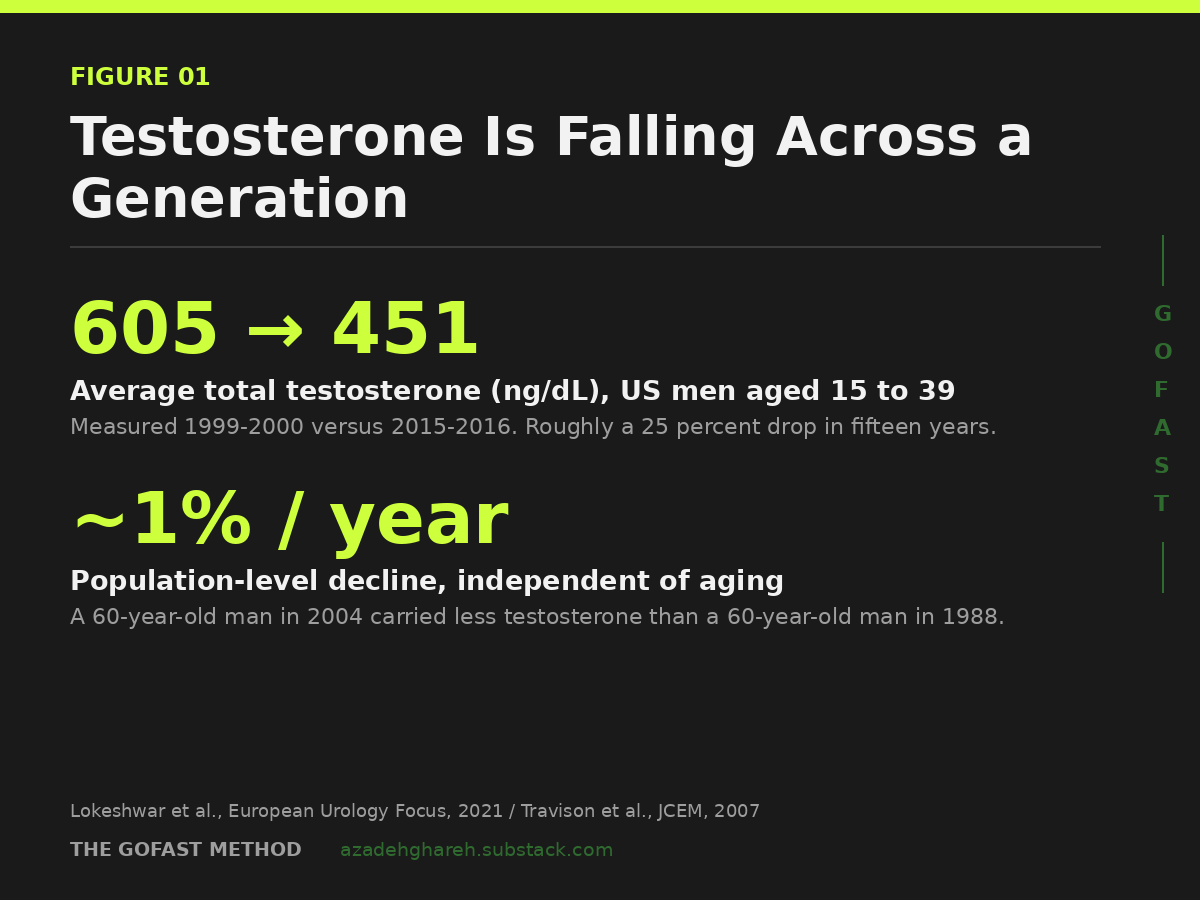
In 1999 and 2000, the average total testosterone measured in American men aged 15 to 39 was roughly 605 ng/dL. By 2015 and 2016, the same age group, measured the same way, averaged roughly 451 ng/dL. That is a decline of about a quarter in fifteen years, reported by Soum Lokeshwar and colleagues in European Urology Focus in 2021.
Here is what makes that number strange. Testosterone falls with age. Everyone knows this. What Thomas Travison and colleagues found in the Journal of Clinical Endocrinology and Metabolism in 2007 was a decline of roughly one percent per year at the population level that had nothing to do with aging at all. A sixty-year-old man measured in 2004 carried meaningfully less testosterone than a sixty-year-old man measured in 1988. Same age. Same country. Less hormone.
And it is not an isolated marker. Hagai Levine and colleagues published a meta-analysis in Human Reproduction Update in 2017 examining sperm concentration in Western men across nearly four decades. Between 1973 and 2011, the concentration fell by more than half.
Two independent measures of male biology, both sloping downward, both across the same window of time.
If you are a man in your late thirties or forties running a company, a department, or a practice, and you have quietly noticed that recovery takes longer, that motivation has flattened, that the fat around your midsection now behaves differently than it did at thirty, this is the context you are missing. You are not simply getting older. You are aging inside an environment that has changed underneath you.
Before you read another word, find out where you actually stand. The quiz takes about two minutes and scores you across the six inputs that suppress testosterone in professional men, and it returns the single lever that will move the most for you. Everything past this point reads differently once you have your own result in front of you. Take the Metabolic Quiz
Comments
Nothing yet. Say the first thing.
Sign in to join the conversation.