
Hello friend,
When I started coaching men, I assumed they would come to me about their weight, and most of them did. The surprise was how rarely the weight turned out to be the real problem.
One of the first executives I worked with was forty-seven. He ran a company, traveled most weeks, and looked fine in a suit. He came to me to lose fifteen pounds. On our first call, he mentioned, almost as a joke, that he had started pushing off his knee to get up from the floor after wrestling with his kids. That throwaway line told me more about his next forty years than the fifteen pounds ever could.
There is a thirty-second test that measures exactly what that moment gave away, and researchers have linked it to how long you will live. I will show you the test, the reason it works, and the twenty-minute fix that keeps the result in your favor. No gym, no equipment, no Monday required.
First, the test.
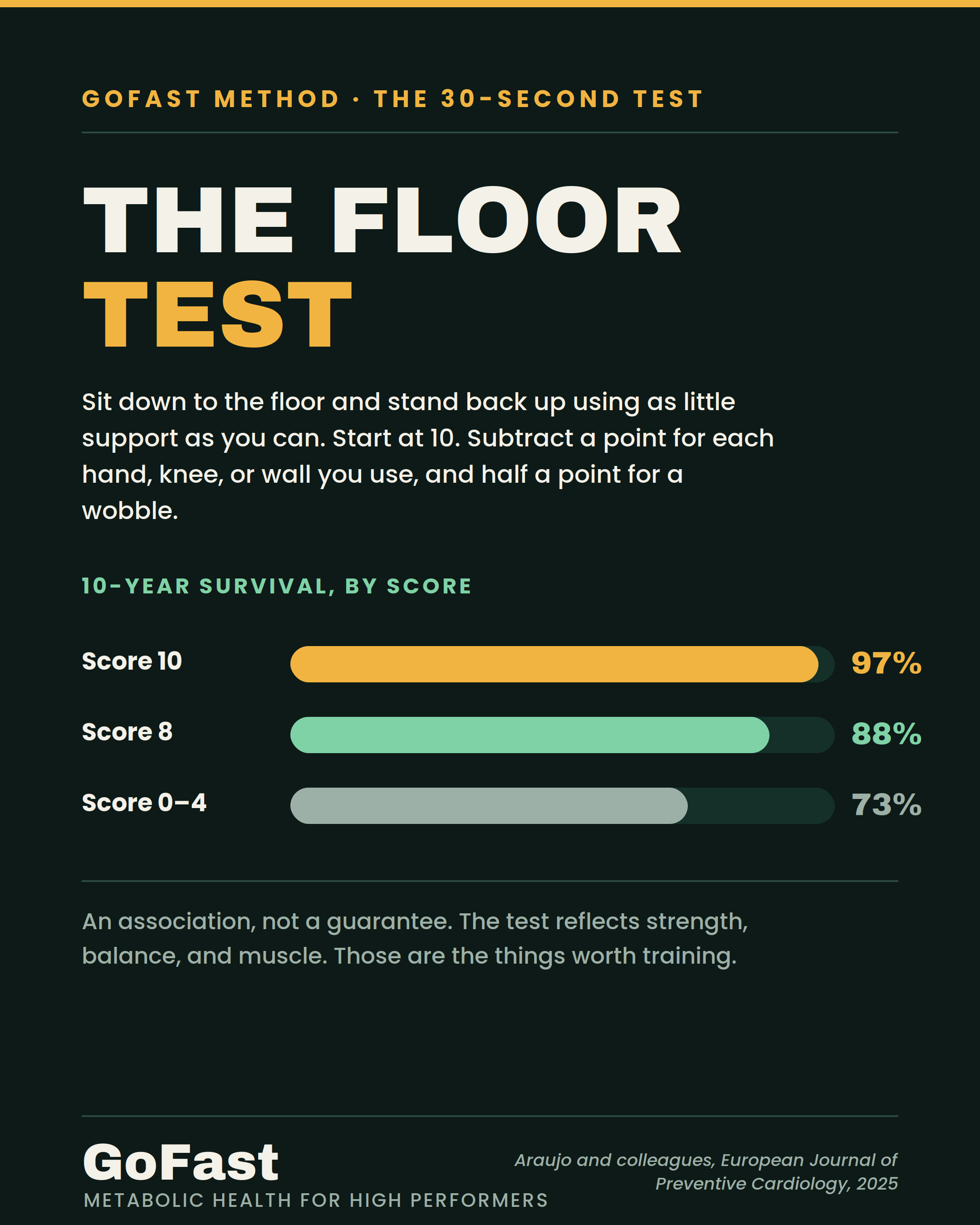
Lower yourself to the floor and stand back up using as little support as you can manage. No hands on the knees if you can help it. Score yourself out of ten, starting at ten and subtracting a point each time you use a hand, a knee, or a wall, and half a point each time you wobble.
That number means more than it has any right to. In 2025, Claudio Gil Araújo and colleagues published a study in the European Journal of Preventive Cardiology that followed more than four thousand adults aged 46 to 75 for a median of twelve years. The people who rose from the floor smoothly had a far lower rate of natural and cardiovascular death than those who needed help getting up. Among those who scored a perfect ten, survival at ten years was around 97 percent. Among those who scored in the lowest band, it dropped to roughly 73 percent.
I want to be precise about what that study can and cannot tell you. It was observational. It does not prove that learning to rise from the floor adds years to your life. What it shows is that the bundle of qualities the test measures, which is lower-body strength, balance, and the ability to move your own bodyweight through space, tracks closely with how long people stay alive and independent. The test is a window. What you see through it is muscle.
The men I coach are almost always focused on the fat they can see in the mirror. The more useful number is the muscle they cannot. Skeletal muscle is the largest organ most men own, and in midlife it is the one quietly leaving while they sit through back-to-back meetings.
This matters far more than the mirror suggests, because muscle is not passive tissue hanging off a frame. It is metabolically active, and it is where your last meal goes. In a 2016 review in the journal Nutrients, Soressa Kitessa and Mahinda Abeywardena reported that skeletal muscle accounts for up to 80 to 90 percent of insulin-stimulated glucose disposal. In plain terms, your muscles are the parking lot for the sugar in your bloodstream. When you have plenty of it, glucose has somewhere to go after a meal. When you lose it, that glucose has nowhere to park, and it stays in circulation, which is one of the first steps toward insulin resistance and the belly fat that comes with it.
So the man who loses muscle through his forties and fifties is not only getting weaker. He is shrinking the single largest system his body uses to manage blood sugar. The softening waistline he blames on age is partly a storage problem he created by letting the parking lot disappear.
Muscle also behaves like a gland. When you contract it hard, it releases signaling molecules. In a 2022 review in Nature Reviews Endocrinology, Lisa Chow and colleagues described this family of molecules, called exerkines, as chemical messengers released during exercise that travel through the body and act on the brain, the metabolism, and the immune system, contributing directly to healthspan and longevity. A hard set of squats is not only about moving your legs. It is releasing a dose of medicine that your liver, brain, and immune system read as instructions.
This is why people keep calling the lower body the engine of longevity. Your legs and glutes hold the largest slabs of muscle you own, so training them gives you the biggest glucose-clearing effect and the largest exerkine release available to you. Peter Attia spends much of his 2023 book Outlive on this idea, arguing that the strength and aerobic capacity you build in midlife decide whether your final decade looks like hiking with your grandchildren or being helped out of a chair.
Here is the part that almost no fitness article will tell a man in the Ozempic era.
The GLP-1 medications work. Semaglutide and tirzepatide produce weight loss that used to require surgery, and for many men that is genuinely good news. But the scale does not distinguish between fat and muscle, and these drugs do not either. Across the clinical trials, James Neeland and colleagues reported in a 2024 paper in Diabetes, Obesity and Metabolism that the lean mass lost on these medications can run from roughly a quarter to as much as 40 percent of total weight lost.
As much as 40 percent of the weight a man loses on these drugs can be the exact tissue that clears his blood sugar and protects his independence.
Now the honest nuance, because I will not scare you with half a fact. In most people the proportion of muscle relative to total body weight is preserved or even improves, because fat loss outpaces muscle loss. The danger is not that everyone on a GLP-1 wastes away. The danger is the man who takes the drug, watches the number on the scale fall, and assumes the work is done. He gets lighter and quietly more metabolically fragile at the same time, because he never defended the muscle he was shedding. The weight came off. The engine got smaller.
If you are on one of these medications, or thinking about it, resistance training and adequate protein are not optional extras. They are the difference between losing fat and losing yourself.
Most men have no idea their metabolism is slipping until something breaks. You do not have to guess. Your metabolic quiz scores show where you stand right now and where to start.
Comments
Nothing yet. Say the first thing.
Sign in to join the conversation.