
oh hi friend,
Quick question before we get into it.
When was the last time you woke up and genuinely felt like the man?
Not performing it. Not pushing through it. Actually felt sharp, lean, rested, and locked in before the coffee even kicked in.
If you had to think about that for more than three seconds, keep reading. Because that feeling did not leave because you got older, softer or less disciplined. It left because something shifted in your biology that nobody explained to you. And the thing that shifted has a name.
Cortisol.
The real, clinical, peer-reviewed version of what this hormone does when it runs unchecked in a driven man’s body for months and years at a time.
This letter is the full picture. What cortisol is, what it does when it breaks, and exactly how to bring it back under control.
I want to be clear about something the wellness internet usually gets wrong. Cortisol is not a villain. You cannot live without it.
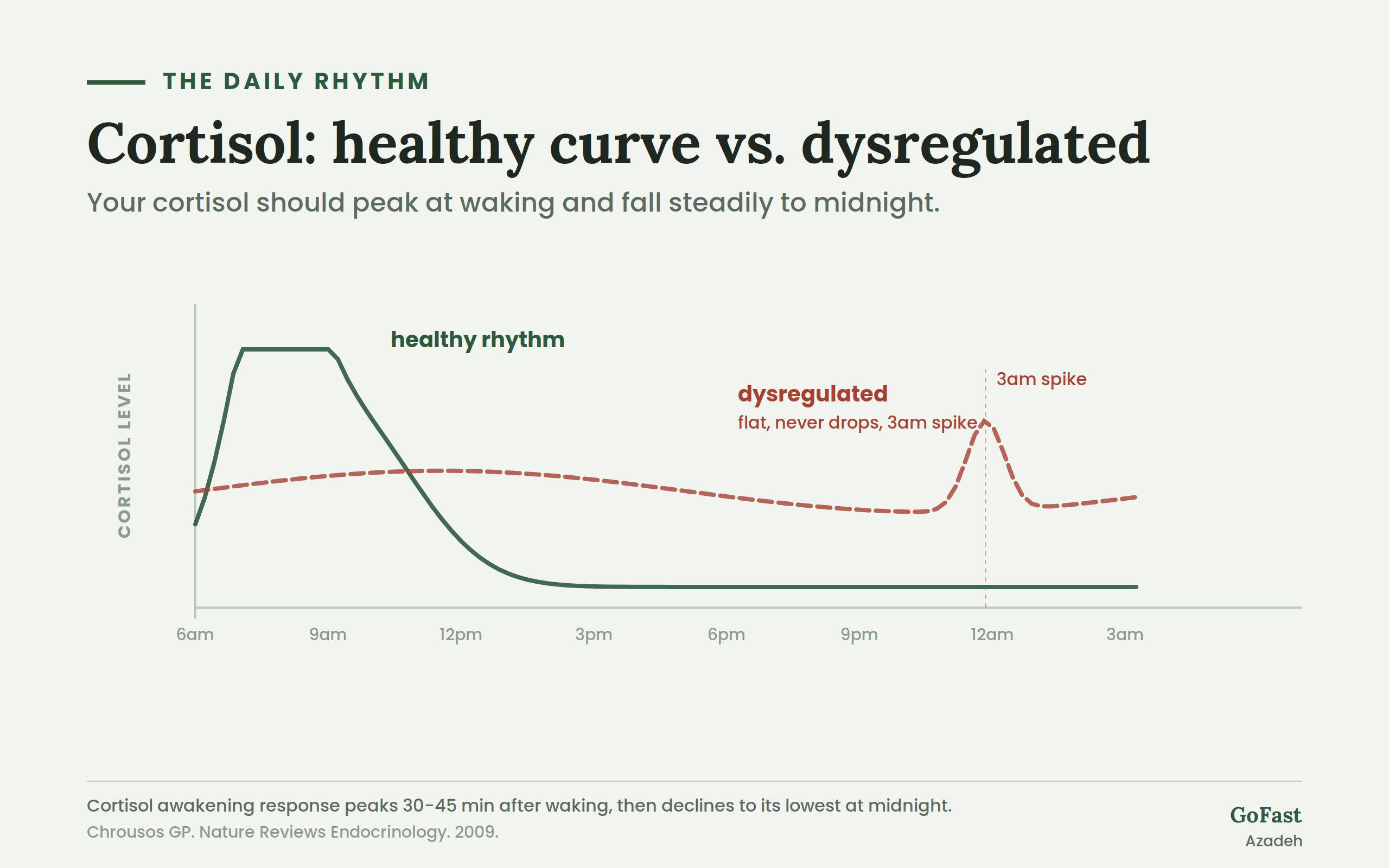
In a healthy body, cortisol follows a precise daily rhythm. It begins rising between 4 and 6am. It peaks about 30 to 45 minutes after you wake, giving you that clear, alert feeling first thing in the morning. Researchers call this the cortisol awakening response. From that peak, it gradually falls through the afternoon and evening, reaching its lowest point around midnight. That rhythm gives you energy when you need it and deep sleep when you need that.
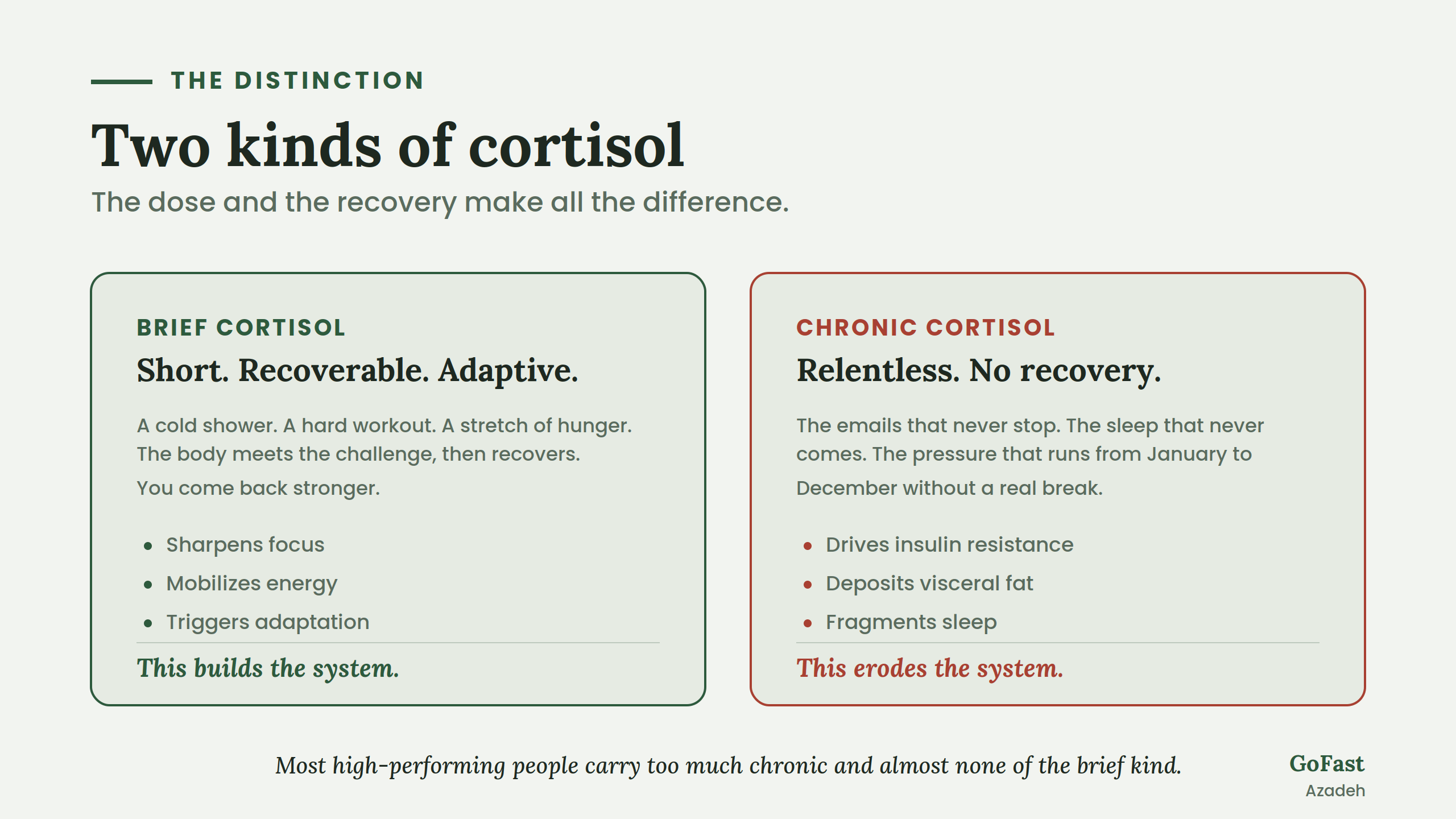
When something acutely stressful happens, cortisol does exactly what it should. It raises blood sugar so your muscles have fuel. It sharpens focus. It temporarily shuts down anything non-essential so the body can deal with the threat. Then the threat passes, cortisol falls, and everything returns to normal.
Brief cortisol, followed by recovery. The same hormesis principle I wrote about in my first letter. A short challenge, then a return to calm.
The problem begins when it never returns.
Here is what a typical day looks like for the men I work with. I am willing to bet it looks familiar.
You wake before the alarm, because a cortisol spike pulled you out of sleep too early. You reach for coffee before food, which tells the adrenals to push cortisol even higher. You check email or news within minutes of opening your eyes, and the stress response activates before you have taken a full breath.
By mid-morning, the body has already burned through a hormonal cycle that was designed to last all day.
The afternoon crash arrives. More coffee. A protein bar that is mostly sugar in a healthy wrapper. The body pushes through on cortisol and adrenaline because that is what it has been trained to do. Evening comes, and the mind should be winding down, but the emails keep arriving, and the nervous system stays locked in alert. Dinner is late. Wine softens the edge. Sleep is shallow.
At 3am, the crash comes. Blood sugar drops, cortisol overshoots, adrenaline follows. You are wide awake. By morning, the whole thing starts again.
For many of the men I coach, this is not a bad week. This is every day. For years.
When cortisol stays elevated for weeks and months instead of minutes, it stops being a survival tool and starts dismantling the systems it was designed to protect.
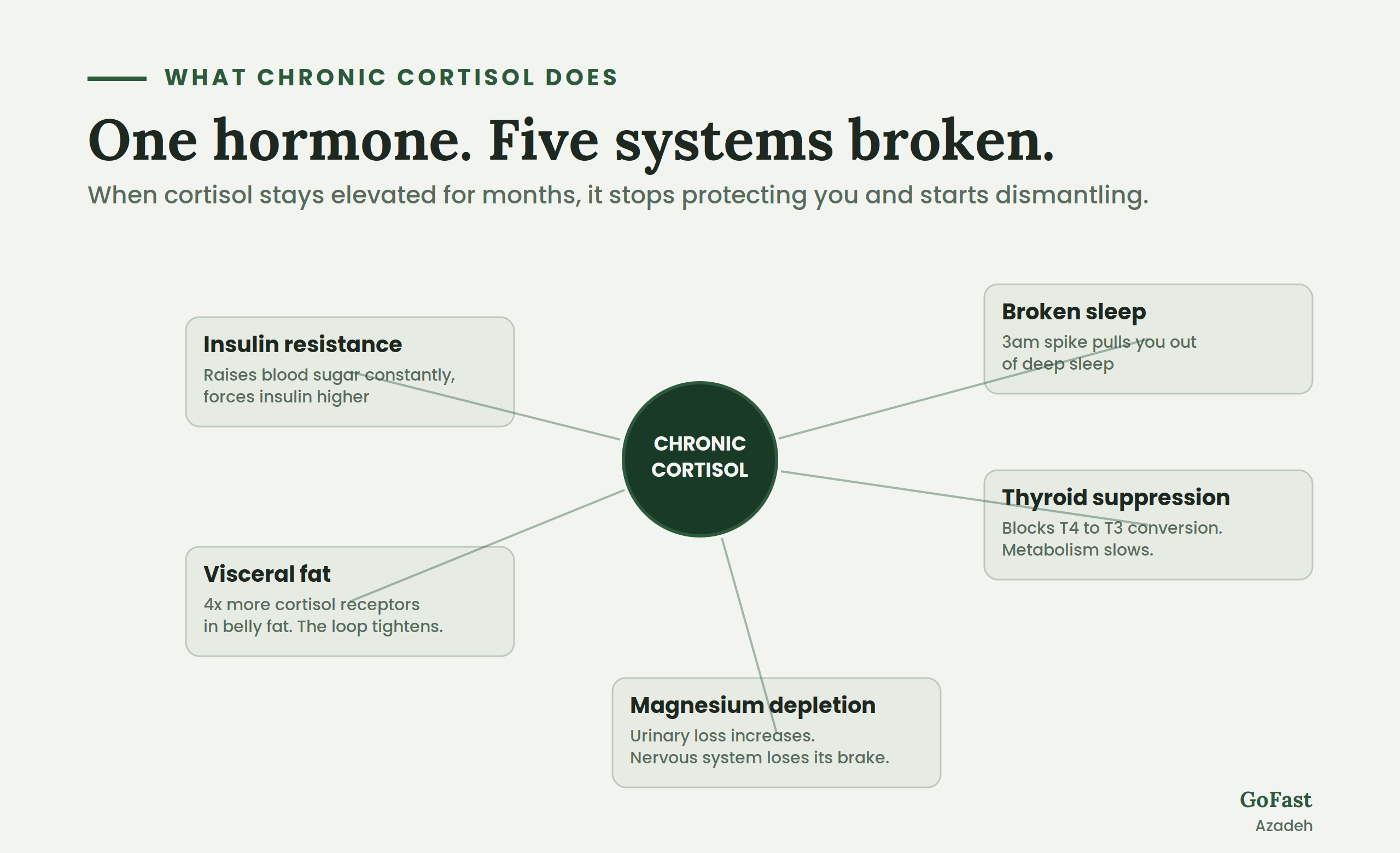
It drives insulin resistance. Cortisol raises blood sugar by design, to fuel the muscles for a threat that never arrives. The body pumps out insulin to bring that sugar back down. Over time, cells stop responding. This is the insulin resistance I covered in my second letter, and chronic cortisol is one of its most consistent drivers (Bjorntorp, Obesity Reviews, 2001). The mechanism is direct: sustained cortisol elevation increases both glucose output from the liver and insulin secretion from the pancreas, creating a metabolic environment where the body is simultaneously burning fuel and storing fat.
It stores fat in the worst possible place. Cortisol does not distribute fat evenly. It sends it to the abdomen, deep around the organs. Why there specifically? Because visceral fat cells have roughly four times more glucocorticoid receptors than fat cells elsewhere in the body. They are biologically designed to respond to cortisol’s storage signal. And the relationship runs both ways. Visceral fat produces an enzyme called 11-beta-HSD1 that locally converts inactive cortisone back into active cortisol, amplifying the problem right where the fat is accumulating (Stimson et al., Diabetes, 2009). Cortisol builds belly fat. Belly fat produces more cortisol. The loop tightens every month you stay in it.
It destroys your sleep. Cortisol should reach its lowest point around midnight. In a dysregulated system, it never drops far enough, and the natural pre-dawn rise overshoots. Add a blood sugar crash from a late or carb-heavy dinner, and the body floods with cortisol and adrenaline hours before the alarm. This is why you wake at 3 am, sharp and wired, mind already rehearsing tomorrow. A single night of partial sleep deprivation measurably worsened insulin sensitivity the next day in healthy subjects (Donga et al., JCEM, 2010). The broken sleep is not just robbing rest. It is actively making the metabolic problem worse by sunrise. And a worse metabolism makes the next night’s sleep worse.
It slows your thyroid and suppresses testosterone. Chronic cortisol reduces the conversion of T4 into the active thyroid hormone T3, which directly slows your metabolic rate. It suppresses growth hormone and testosterone simultaneously, both critical for maintaining muscle mass, burning fat, and sustaining energy. It disrupts leptin, the hormone that tells your brain you have eaten enough. The body under chronic cortisol is running on emergency power, indefinitely, shutting down the systems it needs most.
It drains your magnesium. Chronic stress increases urinary magnesium loss (Pickering et al., Nutrients, 2020). Lower magnesium weakens the parasympathetic nervous system, the calming branch that is supposed to bring cortisol back down. So the stress depletes the very mineral you need to recover from the stress. I covered this in detail in a recent LinkedIn post. If you read that and recognized yourself, this is the deeper explanation of why.
Curious where your cortisol stands right now?
I built a free Metabolic Health Quiz that takes two minutes. It won’t replace bloodwork, but it will tell you whether the pattern in this letter matches what’s happening in your body, and what to focus on first.
Comments
Nothing yet. Say the first thing.
Sign in to join the conversation.