
“Nah chica. I’m not that. I’m hip-hop. We had all the tech and still played outside.”
One woman’s response to her daughter calling her a Boomer. Eight words that contain the entire Gen X identity crisis and its entire rebuttal simultaneously. The generation that lived through the analogue-to-digital transition in real time, absorbed both worlds without losing either, and then got filed away by the industry they helped build.

This essay has several working titles. The Generation That Built What It Hates. Actually, It Was Gen X. We Had All The Tech and Still Played Outside. They are all correct. They describe the same thing from different angles. The angle that’s been keeping me up at nigh is the simplest (and slightly unhinged) one: Gen X broke the world and then complained about it. And the complaint, it should be noted, is largely accurate.
Thanks for reading The Culture Brief! Subscribe for free to receive new posts and support my work.
Nah Chica, I’m Hip-Hop: The Identity Problem
Gen X has always had a definition problem. Too young for the postwar prosperity narrative. Too old for the digital native story. The generational labels that stuck (Boomers, Millennials, Gen Z, Gen Alpha) all have clean cultural arcs. Gen X’s arc is messier, more contradictory and a bit harder to package.

They are the generation that got grunge and the first dot-com boom in the same decade. They built careers inside corporate structures they openly distrusted and went to work anyway. The self-awareness was always there. So was the participation. So, in some ways, yep, they kinda sold out. And so did everyone else. That was kind of the era.
Born roughly 1965 to 1980, they are 45 to 60 right now. The identity markers stack in ways no other generation’s do… namely hip-hop and grunge and MTV. The Walkman and the first personal computers and AOL. Early mobile phones copped at an age when you could still remember life without them, which meant you could feel the difference rather than just inherit it. And the played-outside dimension… they were pretty much the last generation with a genuine pre-internet childhood and a genuine post-internet career. So they remember what both sides felt like from the inside. Which makes them uniquely positioned and uniquely awkward to market to.
Most brands and marketers have responded to this complexity by ignoring it entirely…
We Had All The Tech and Still Played Outside

The most underreported fact about Gen X is their structural position right now.
They are raising Gen Alpha (and Z). Managing Gen Z in the workplace. Inheriting wealth from Boomers. Sitting in senior leadership at the brands and agencies that are actively ignoring them. They are at the intersection of every generational conversation happening in culture… not as fringe observers, but as the connective tissue that holds the whole thing together.
The spending data is a pretty big deal. Gen X is expected to drive $15.2 trillion in global spending in 2025. If Gen X were a country, they would be the world’s second-largest consumer market, spending roughly twice as much as China’s consumers today. In the UK, their spending is projected to hold through 2036. The “Gen X decade,” per NielsenIQ and World Data Lab, began in 2021 and runs through 2033. Gen X dominates daily discretionary spending and represents the greatest consumer ROI in large-basket, multi-category purchases across grocery, household, and wellness. NielsenIQ’s own report calls them “the most dependable, active spenders across the most profitable consumer segments.”
And still. Most brand strategy decks jump from Boomer, to Millennial, to Gen Z to Gen Alpha without a nod to X.
The parental angle is the one that baffles me most. Teneo research from last year found that Gen Alpha influences nearly half of all household spending decisions across the US and UK (representing around £25 billion in UK discretionary household expenditure). The parents making and filtering those decisions are overwhelmingly Gen X. The brands that want to reach Gen Alpha in ten years need to understand who is forming their relationship to brands right now… Gen X. The values being passed down, the brands allowed in the house, the conversations happening about what’s real and fake, all of this is shaping the next generation of consumers in ways these typical trend reports are not capturing.
But ok, let’s keep pouring budget into TikTok content Gen X will not watch, to reach Gen Z who will not convert, while ignoring the generation currently writing the largest household spending cheques on the planet. Seriously.
And another thing, Gen X discretionary spend is flowing in two directions simultaneously → downstream to children being aggressively marketed to, and upstream to aging parents. They are the invisible engine of household consumption across multiple life stages at once. The marketing lens reads this as Gen X spending less. Gen X moves differently, not less. The categories where they spend significantly (healthcare, financial services, home, auto, travel) operate on completely different purchase logic to the CPG and influencer-driven categories that dominate trend reports. Research, trust and utility drive the decision. There is no impulse buy or big influencer moment. There is no shareable purchase. The measurement systems built for the attention economy simply can’t see it.
The Complaint Department
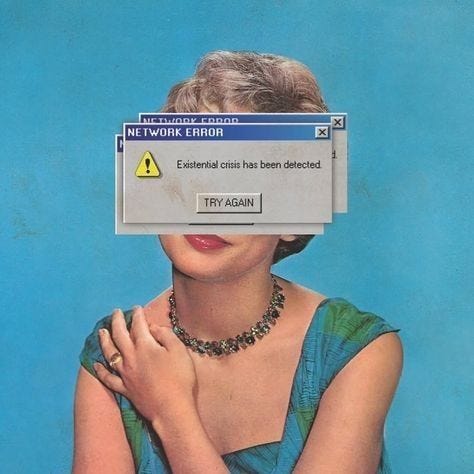
Gen X complains with a level of consistency and specificity that deserves its own taxonomy. (lol)
*screams in Gen X: The attention economy is broken. Authenticity has been commodified. Influencer culture is hollow. Corporate brand purpose is theatre. The parasocial economy is manipulative. Fast fashion brand cycles are cynical. Everything has been optimised for engagement at the cost of meaning!
These complaints are largely correct.
The critique is earned. Gen X cultural criticism (from David Foster Wallace through the current wave of Substack essayists writing with real vim about the collapse of institutional trust) is some of the most honest thinking about modern media and consumer culture produced in ages. They’re not wrong about what happened.
They are, however, describing a room they helped build.
(And, I oop)
Thanks for reading The Culture Brief! This post is public so feel free to share it.
Actually, It Was Gen X

Gen X built the machine they are describing.
Not alone or with malicious intent. But with full participation, and with enough self-awareness at the time to have clocked what they were doing.
They were the first generation to be marketed to as individuals, the shift from household demographics to personal identity targeting happened on their watch, and their wallets proved the model worked. Nike selling identity, not shoes. MTV selling a lifestyle, not music. The birth of cool as a commercial product, managed and monetised by people who are now in their late 40s and early 50s posting about the death of authenticity on LinkedIn.
The attention economy was no accident, dear friends. It was designed… largely by Gen X creatives, strategists and executives, in the 1990s and 2000s. The influencer industrial complex runs on foundation Gen X built. The parasocial economy they critique was the logical extension of the parasocial relationship with musicians and celebrities that Gen X pioneered and monetised.
“Come on, Ayo, you’re being very, very harsh”. Don’t get me wrong. Every generation inherits a world and makes it worse in their specific way. Boomers got postwar prosperity and turned it into asset hoarding. Millennials got the internet and turned it into the creator economy. Gen X got the attention economy at its most malleable moment, I mean, when the architecture was being laid and the consequences were not yet legible, and they built the machine that Gen Z (maybe Gen Alpha too) are now trying to dismantle.
The “we played outside” line is important here. They remember what it felt like before the machine. And that makes the critique more painful and more credible. It also makes the participation more interesting. They knew what they were giving up. Some chose to anyway. Some did not realise the cost until the machine was already running at scale and the choice had passed.
The generation that built what it hates.
The cynicism loop, that’s not quite a loop
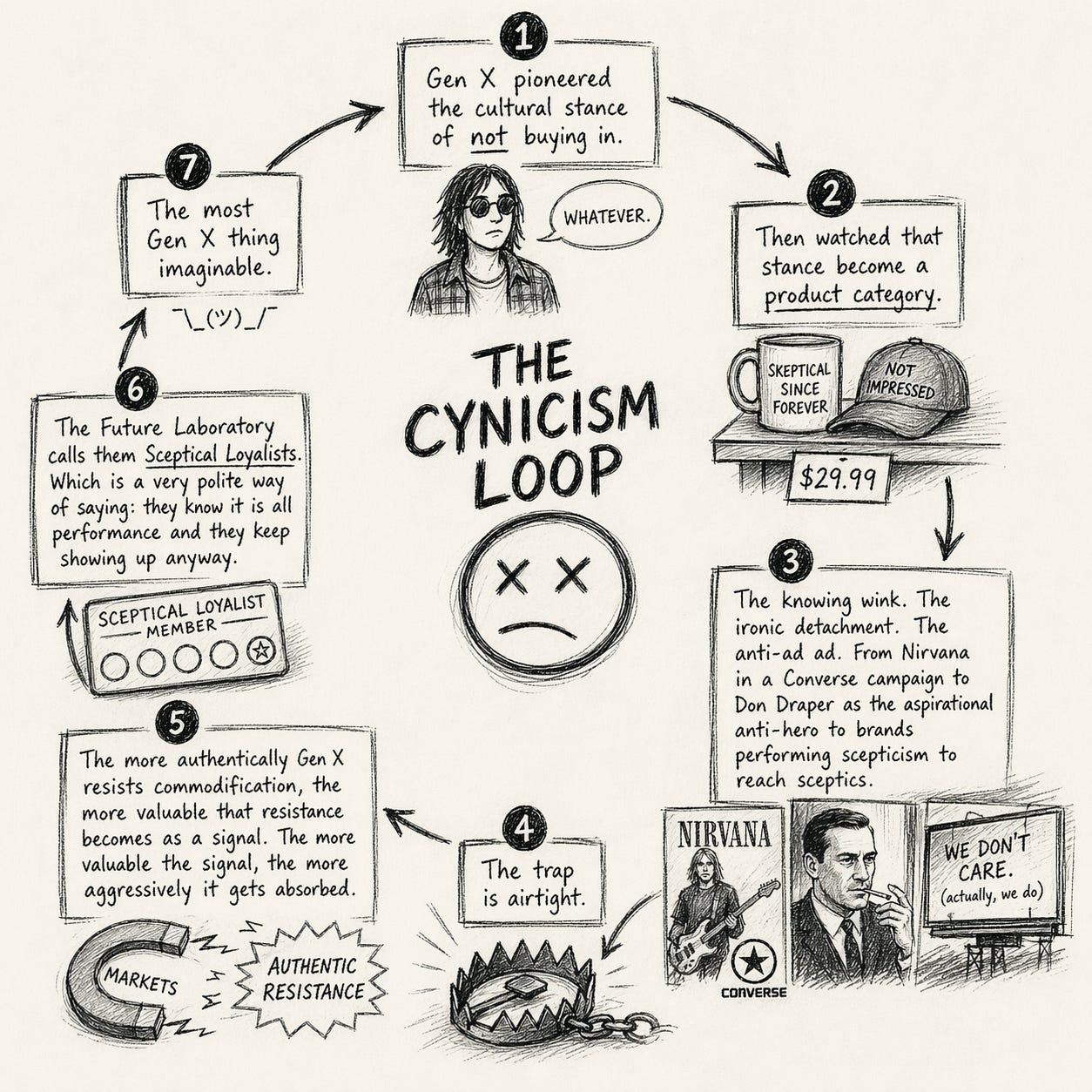
Gen X cynicism was the first to be commodified back to itself.
Gen X pioneered the cultural stance of not buying in. And then watched that stance become a product category.
The more authentically Gen X resists commodification, the more valuable that resistance becomes as a cue. The more valuable the cue, the more aggressively it gets absorbed. There is no exit from this loop that does not involve either full withdrawal or full acceptance. Most Gen X occupies the uncomfortable middle, which looks a bit like, knowing the game, playing it anyway, maintaining enough irony to preserve self-respect.
The Future Laboratory describes them as “Sceptical Loyalists.” That is a very polite way of saying: they know it is all performance and they keep showing up anyway. Which is, when you think about it, the most Gen X thing imaginable.
They made detachment legible as a position. And then watched everyone else learn to perform it. Including, eventually, the brands selling to them.
The Generation That Built What It Hates: Why Marketers Are Not Entirely Wrong

A genuine defence of the industry decision to deprioritise them. But obvs, if you read between the lines, I’m in fact stating, that as a cohort, they’re quite possibly the G.O.A.T.
Gen X helped design the measurement systems that are now excluding them. The ROI frameworks, the engagement metrics, the performance marketing logic, these came about from the same 1990s and 2000s marketing machine that Gen X built. They are now being evaluated by tools they created, and the tools do not rate them.
Gen X does not perform loyalty publicly.
They do not share purchase decisions in ways that generate reach.
They do not build brand communities or create organic content or drive the visible social proof that modern marketing ROI is measured by.
They buy things and say nothing.
They recommend things in conversations that leave no digital trace.
By every metric that currently matters in brand marketing, they appear to be a poor return on attention.
And, this is a measurement failure rather than a value judgement. The metrics were designed for the attention economy, for reach, engagement, for virality. Gen X participates in none of those things at scale, by design and by temperament. So the algorithm deprioritises them and the budgets follow the algorithm.
The uncomfortable irony at the bottom of this is that the machine does not see its makers. Gen X built the scoreboard and the scoreboard doesn’t even have their name on it.
The Cost of Underestimation
What brands are actually losing.

$15.2 trillion in global spending this year, leading through 2033. The typical Gen X household spent $96,941 in 2024 (the highest of all generations) [PYMNTS]. They dominate the categories with the longest purchase cycles and the highest lifetime value: healthcare, financial services, home, auto, travel. Once loyal, very loyal. The recommendation network effect - they do not post but they do tell people, and the people they tell tend to trust them, because Gen X recommendations arrive without a discount code attached.
The Gen Alpha pipeline is the most important point and the one most absent from current brand strategy. Gen Alpha influences nearly half of all household spending decisions in the UK, representing around £25 billion in discretionary spend. [Teneo’s 2025 research] The parents making those decisions are Gen X. The brands being allowed through the door (or quietly vetoed) are being chosen by the generation most brands and strategists have stopped talking to.
Cultural credibility is the other thing worth talking about. Gen X approval still functions as a legitimacy signal that money cannot manufacture. When something crosses from digital native culture into Gen X consciousness, it has genuinely broken through. That filter is not being measured.
What Talking To Gen X Probably Requires

Not nostalgia. Not even nineties aesthetic packaging or performed irreverence or knowing winks. Gen X invented the toolkit for spotting inauthenticity. They will find it.
Honesty about the product. Respect for the intelligence. Acknowledgement that they have seen everything and still have the capacity to be moved by something genuinely good. Long form over short form. Substance over signalling. A reason to trust built over time. Meeting them in the categories where they actually spend, considered, research-led, utility-driven, rather than chasing them into influencer-friendly formats they were never going to respond to.
The brief for reaching Gen X is essentially: be so good at the actual thing that the story tells itself. Remove the performance layer entirely. Let the product, the service, the experience carry the weight. Gen X is not hiding. They are waiting for something worth finding.
Ain’t nobody got time for all that.
And that is precisely the problem. Modern marketing was not built for patience. It was built for speed, for engagement metrics, for results that show up in a dashboard. Earning Gen X trust is a long game, and the industry that Gen X helped build has optimised itself entirely for the short one. The machine cannot wait. The generation that made the machine will not be rushed.
The irony is almost too much.
She said she is hip-hop. She had the tech and still played outside. She is not a Boomer. She is something more specific and more interesting than that — a person who remembers both worlds, built a life across the seam between them, and is raising a child in a world that looks nothing like either.
That vantage point is the data.

The generation that built what it hates. The sceptical loyalists. The ones who played outside and then went inside and built the internet and now spend their weekends complaining about the internet while using it constantly.
Figuring out how to earn their trust will bring about a recommendation network that operates below the algorithm. Credibility that money cannot buy. And early insight into the generation that will define consumer culture for the next fifty years… because Gen X is raising them.
I have been calling Gen X the forgotten generation. I stand corrected.
They got outrun by their own creation. The machine they built got faster than they could run, and the industry just kept going without them.
But the actual tea…
The most dependable, highest-value spenders across the most profitable categories. The CFOs of their households, shaping what Gen Alpha buys, believes, and brings home. A recommendation network operating entirely below the algorithm, where no one is watching, no one is measuring, and somehow it still works.
And I want someone to explain to me why every single marketer in this industry is not currently locked in a room building the case that gets this funded.
Because from where I am standing, Gen X are the f*cking cheat code that the entire industry decided not to use for some reason.
What have we been so busy chasing that we missed the one generation who was quietly, reliably, actually there.
— Ayo
P.S. Massive shout out to @dcjanini (IG) who slid into my DMs and asked me the question that sent me down the rabbit hole that led to all of this. Sometimes the best briefs come from the comments section. Also, S.O to for giving me an extra layer to consider and great food for thought!
Thanks for reading. Subscribe for free to receive new posts and support my work.
ICYMI 👀
Get my frameworks
The Wedge Framework find your position before you find your voice
The Culture Engine the system I use to analyse D2C brand strategy and digital culture
The Operator Control System the full bundle for running your content operation
Work with me
Find me
Comments
Nothing yet. Say the first thing.
Sign in to join the conversation.