
Let’s get to the end of it, this opening of Nineteen Eighty-Four, in both first and final versions.
They are very different. In his first go, Orwell has Winston Smith push the lift (not elevator) button, and wait:
Nothing happened. He had just pressed a second time when a door at the end of the passage opened, letting out a smell of boiled greens and old rag mats, and the aged prole who acted as porter and caretaker thrust out a grey, seamed face and stood for a moment sucking his teeth and watching Winston malignly.
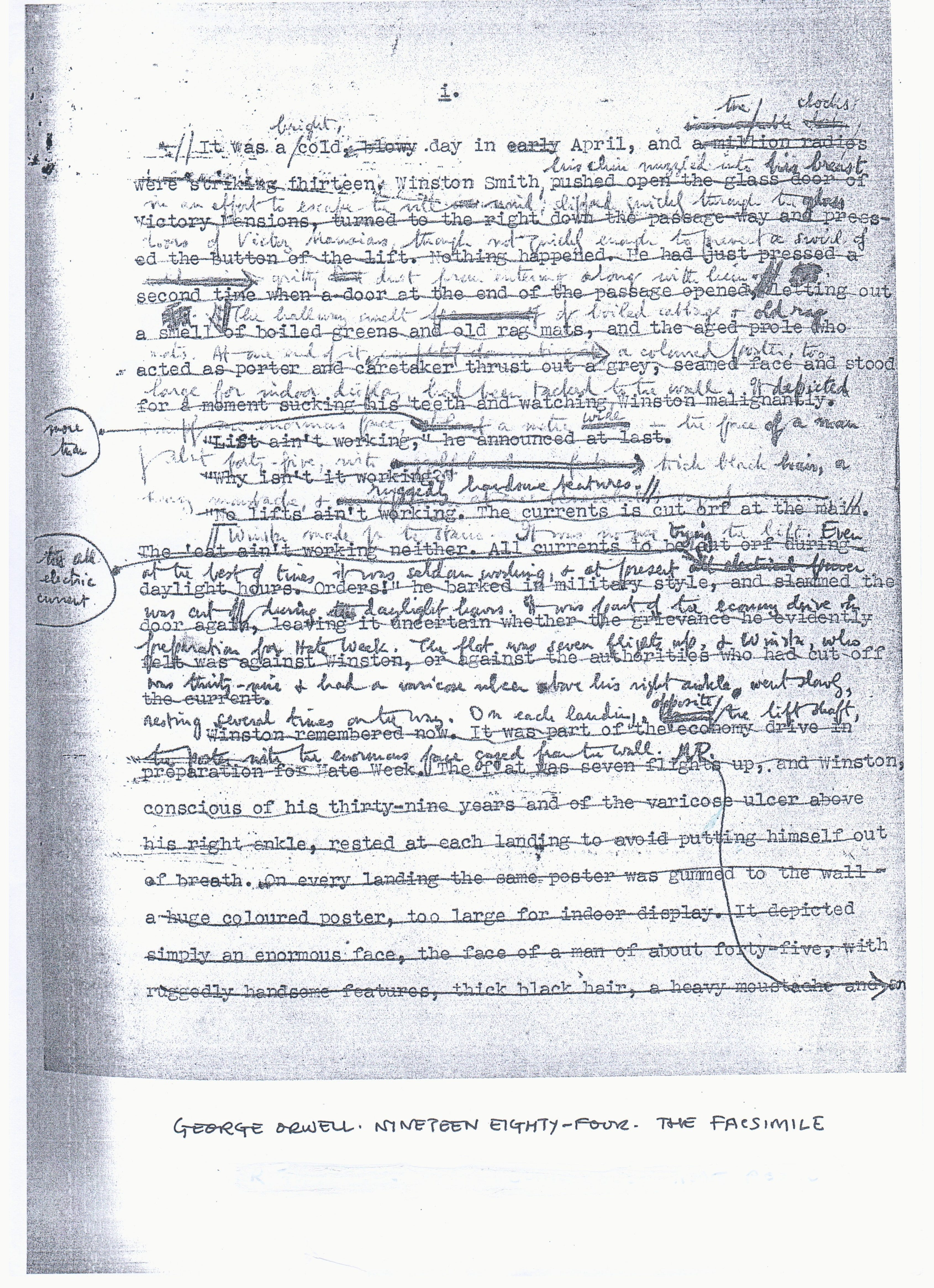
Not bad. But unlike the entry of gritty dust, it locates the unpleasantness — the smell — as coming from inside someone’s flat. In the redrafted version, that stench is everywhere; it’s not private and individual but public and communal. Orwell begins:
The hallway smelt of boiled cabbage & old rag mats.
Orwell isn’t letting those good, specific, Dickensian details go, but he’s getting to them directly. He continues:
At one end of it a coloured poster, too large for indoor display, had been tacked to the wall. It depicted simply an enormous face, at least a metre wide: the face of a man of about forty-five, with [thick black hair] a heavy [black] moustache, & ruggedly handsome features.
In the original version, Winston meets with active, malevolent hostility from a prole; after the redrafts, his first encounter is with Big Brother himself. Not as a person but as an outsize image of a person.
This is the essential conflict of the novel, man vs icon, and once he gets back to the beginning of the novel, Orwell decides to have Winston face to face with Big Brother as early as possible.
He realises the poster would be there, because it is everywhere, and that he better use it. The novel isn’t going to be about the minor conflict with the caretaker, but the bigger one with abstract totalitarian authority.
With the ‘aged prole’ (introducing that strange word, a bit of worldbuilding Orwell again chooses to delay), there originally follows a hostile dialogue:
“Lift ain’t working,” he announced at last.
“Why isn’t it working?”
But in the revised version, Winston knows why. Of course he knows. The power goes off all the time in his world, just as the passage-way always smells of boiled cabbage and old rag mats.
“No lifts ain’t working. The currents is cut orf at the main. The ’eat ain’t working neither. All currents to be cut orf during daylight hours. Orders!” he barked in military style, and slammed the door again, leaving it uncertain whether the grievance he obviously felt was against Winston, or against the authorities who had cut off the current.
Winston remembered now…
Somewhat clunkily.
Well, atrociously clunkily, if truth be told.
It’s a bit like not knowing what colour your front door is.
Whereas in the final version, Winston is in full possession of the facts of his life — and we get a download from his head as he approaches his flat:
Winston made for the stairs. It was no use trying the lift. Even at the best of times[1] it was seldom working, & at present was cut off during daylight hours. It was part of the economy drive in preparation for Hate Week. The flat was seven flights up, & Winston, who was thirty-nine & had a varicose ulcer above his right ankle, went slowly, resting several times on the way.
Ladies and gentlemen, your hero — pitiful creature already. The Last Man In Europe, as Orwell wanted to title him. Do we leave him here. Isn’t a killing touch needed?
On each landing, opposite the lift shaft, the poster with the enormous face gazed from the wall. [It was one of those pictures which are so contrived that the eyes follow you about when you move. BIG BROTHER IS WATCHING YOU, the caption beneath it ran.
Orwell, going back to the beginning of the typescript, now that he knows his alternate world so well, uses his redrafting to make each story beat and detail more telling — bringing the most significant slogan of the novel onto the first page, in CAPITAL LETTERS.
What have we learned here?
Orwell writes with endless humility. He is completely unattached to his previous decisions, to his first draft. He will have a good idea (‘a million radios’) then sense it was too much, and so try an ingenious fix (‘innumerable clocks’) but then realise that a more direct solution works best (‘the clocks’). He is happy to admit the best ideas often take the simplest forms (‘the’).
However, he is at the same time extremely ambitious and expansive. He has the whole book in mind when he makes sentence-level decisions about phrasing or punctuation. He writes strategically. Orwell will make any local change to improve the overall work.
When he sees a good reason for it, he brings information in earlier (Hate Week) or delays it (who else lives in Victory Mansions?)
Orwell works but doesn’t overwork his prose. He knows that a gain in one area will be a loss in another. (To increase the physical unpleasantness of Winston’s environment, he has to diminish the clean efficiency of Winston’s progress to the lift — but then Orwell’s realised Winston wouldn’t even bother trying that, because it’s always broken).
In this, in writing, he is not abstractly striving for either long or short sentences, wordy or taciturn prose. If a sentence needs to expand to make its contribution, let it (‘entering along with him’). But if a few words will do, let them. (‘Winston made for the stairs.’)
[1] For any doubting the Dickensian voice, here’s a confirming phrase from one of the most famous opening sentences in nineteenth century English literature: ‘It was the best of times, it was the worst of times’.
Comments
Nothing yet. Say the first thing.
Sign in to join the conversation.