
Sentence two of Nineteen Eighty-Four originally reads:
Winston Smith, his chin nuzzled into his breast in an effort to escape the vile wind, slipped quickly through the glass doors of Victory Mansions, though not quickly enough to prevent a swirl of gritty dust from entering along with him.
This clumsy beast of a thing is edited down to the far more elegant and efficient:
Winston Smith pushed open the glass door of Victory Mansions, turned to the right down the passage-way and pressed the button of the lift.
Thank goodness.
Here’s a writer doing their job of simplifying and clarifying and helping the reader and —
But no.
That’s exactly what doesn’t happen.
I swapped the two sentences around, so you’d read the rewrite as the original, Version 2 as Version 1.
Orwell is doing the opposite of making his sentence smoothly cover more action.
Take another look at the typescript.
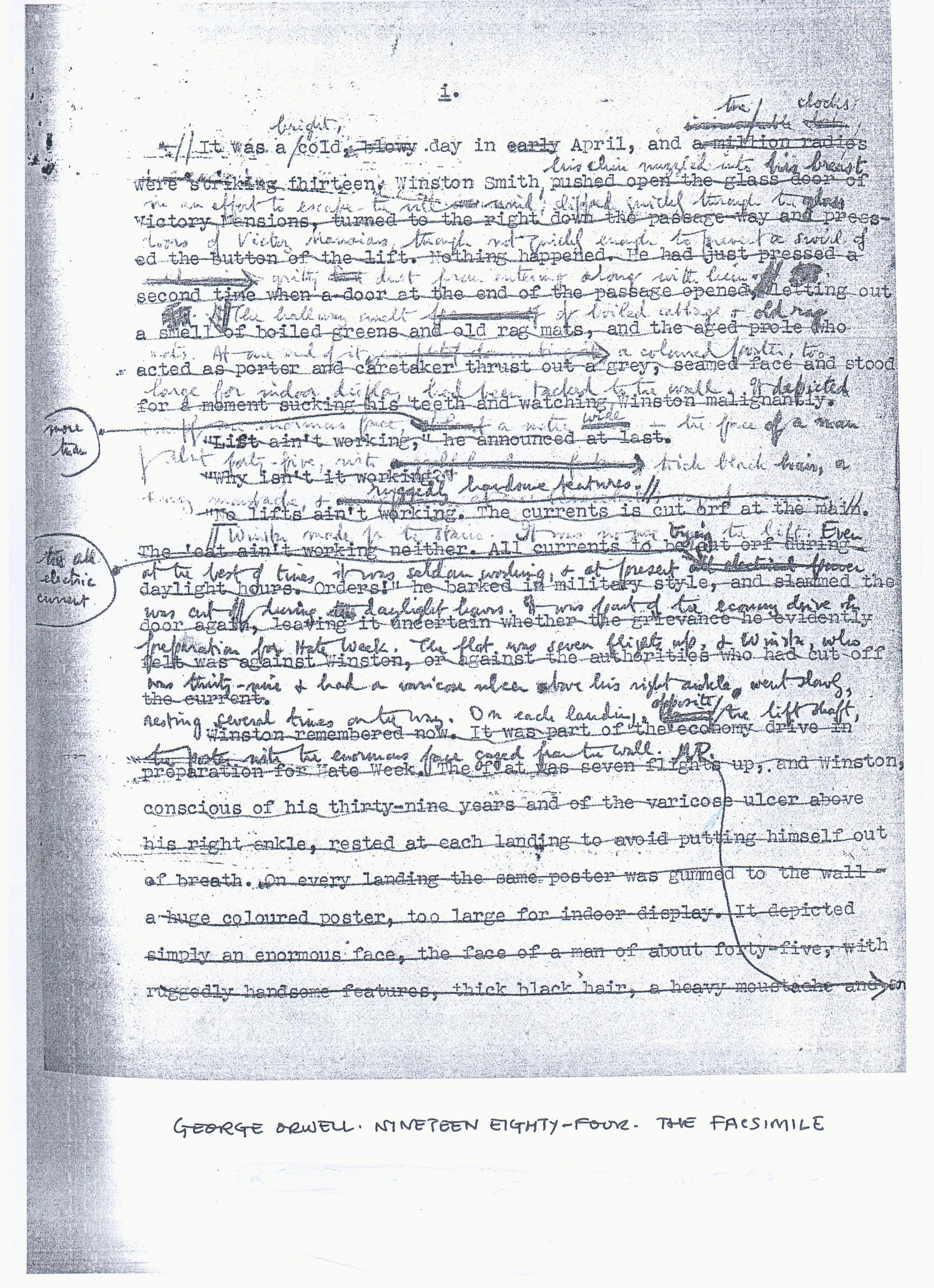
By the end of version 1, Orwell’s first draft, Winston is already at the lift —
Winston Smith pushed open the glass door of Victory Mansions, turned to the right down the passage-way and pressed the button of the lift.
In version 2, the final rewrite, he’s still yet to walk down the passage-way, let alone press the button and start wait for the lift to arrive —
Winston Smith, his chin nuzzled into his breast in an effort to escape the vile wind, slipped quickly through the glass doors of Victory Mansions, though not quickly enough to prevent a swirl of gritty dust from entering along with him.
Read both drafts again, a couple of times. What are the shifts here?
If this were a Creative Writing workshop, and the students were presented with both versions, I’d guess they would assume the far more deadpan, just-the-facts first draft was the rewritten, cut, simplified one. Because the action flows, and there are fewer adjectives.
Lord, see how heavily Orwell loads them to emphasize the physical unpleasantness of Winston Smith’s environment: ‘vile’, ‘gritty’.
It’s almost as pushy as Charles Dickens at the opening of Bleak House1. Orwell is, I’d say, going from underwriting to overwriting — or at least risking overwriting.
What are the losses and gains?
In the redrafted version of the sentence, Winston is more active. He is not just a male body moving through neutral space without opposition. The changes put Winston immediately into a fight with discomfort. He wants to achieve something (getting inside the building without letting in more dirt) and he fails, because he’s not fast enough. (He’s tired, we will soon learn, and he has a varicose ulcer above his right ankle.)
A mini-drama plays out2.
Something curious happens to time in this new version of the sentence, in the second half. It’s far more complex than the original series of three consecutive actions — although we should note that even in Version 1 there’s a small, discrete jump forward in time between ‘pushed open the glass door’ (because Winston is left not having passed through it) and ‘turned to the right down the passage-way’ and then another jump forward between this and ‘pressed the button of the lift’ (because Winston isn’t described walking along the passage-way to reach the lift). This apparently smooth description of an unbroken series of actions is in fact very fragmented.
In the redrafted version, the time of the door closing replays twice. It would be a grammatically complete sentence if it just read:
Winston Smith… slipped quickly through the glass doors of Victory Mansions.
It would also be a successful action. However, after Orwell’s comma, following ‘Victory Mansions’, we get an instant replay that reveals — in a rhetorical flourish (quick, but not quick enough) Winston’s failure. More information comes to us, about the character’s movement and about their world:
..not quickly enough to prevent a swirl of gritty dust from entering along with him.
Alone, Winston is not alone.
I’ll leave it to you to get what you can out of the contrasted alliterative pairings of ‘glass’ and ‘gritty’, ‘doors’ and ‘dust’.
What we’ve witnessed here, though, is a writer — a great writer — who seems to be deliberately overwriting his prose, overloading it, in order to bring us closer to the character in their moment-by-moment struggle.
‘Smoke lowering down from chimney-pots, making a soft black drizzle, with flakes of soot in it as big as full-grown snow-flakes — gone into mourning, one might imagine, for the death of the sun.’
John Yorke would read this as a fractal story structure, complete with five acts. See Into the Woods.
Comments
Nothing yet. Say the first thing.
Sign in to join the conversation.