
Our very first impression is of hard work. Orwell hasn’t left a single phrase unchanged. Everything on the page has been reconsidered, rewritten, and — I will argue — improved.
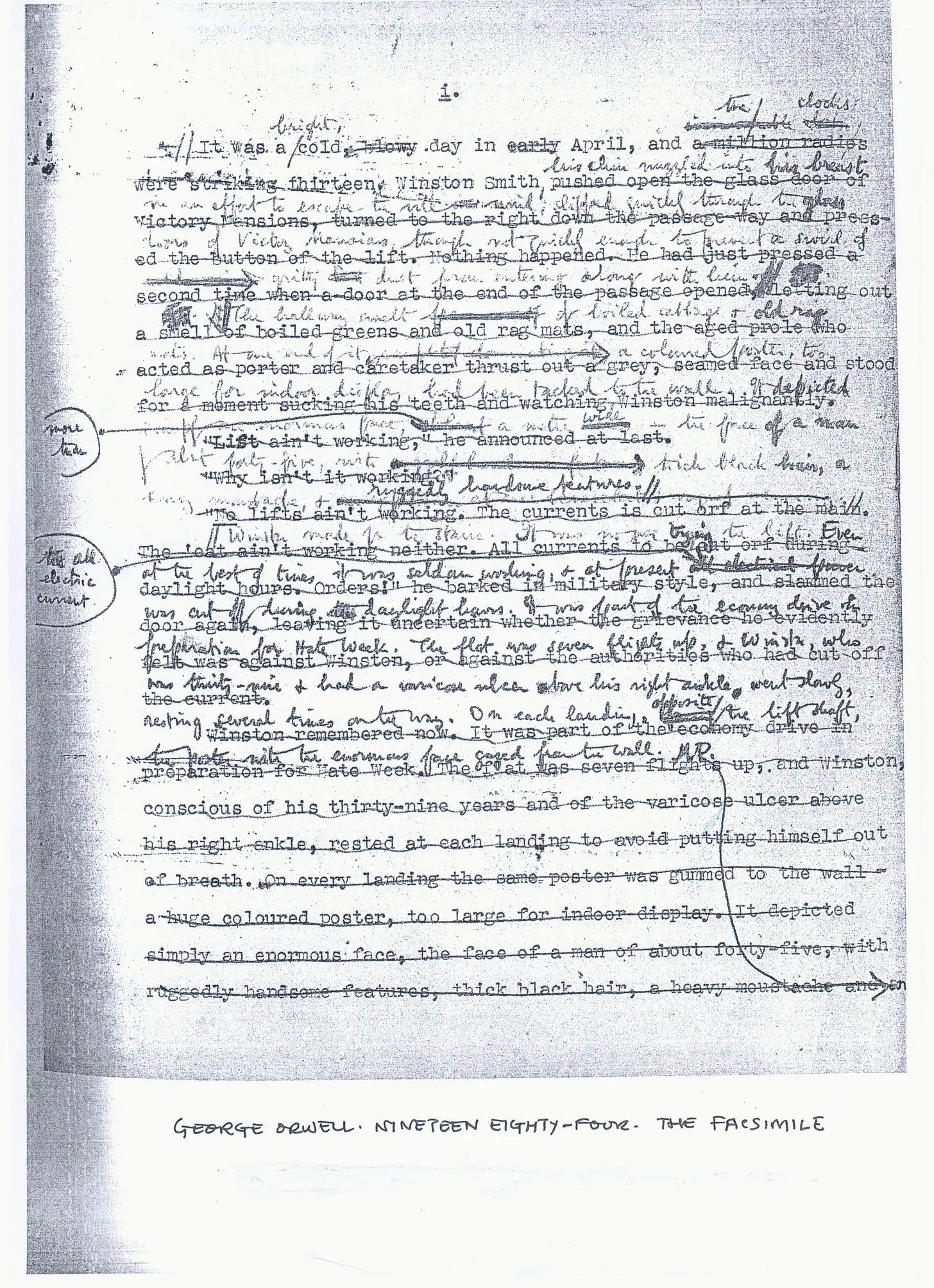
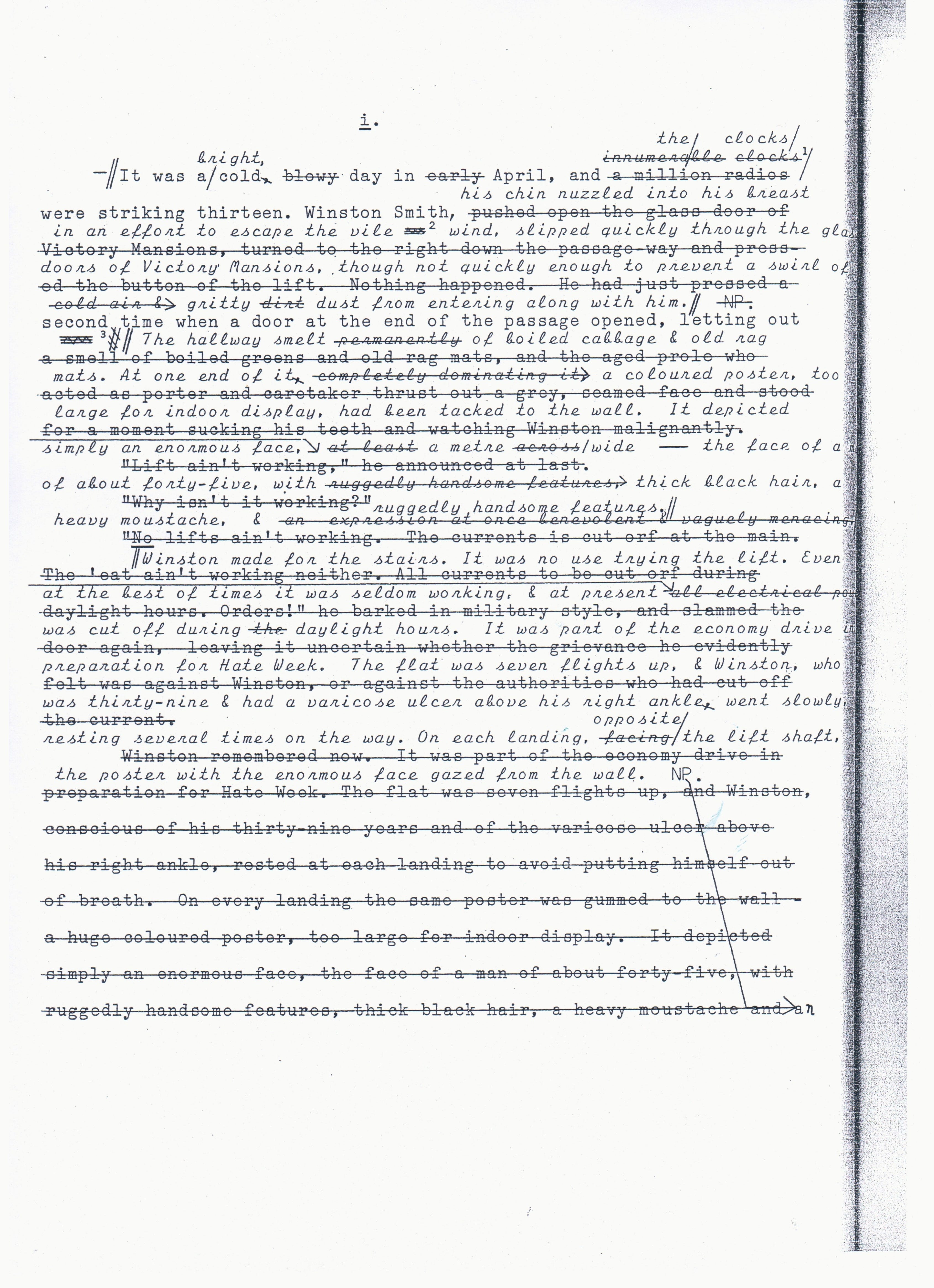
This would have been hard, exhausting, physical work for Eric Blair (Orwell’s real name). In 1946 and 1947, Orwell was already very unwell with the lung disease, tuberculosis, that would kill him in 1949.
Orwell had to work lying in bed, sometimes even typing in bed on his heavy manual typewriter.
He had moved with his wife Sonia to a farmhouse on the clear-aired Scottish island of Jura. But Orwell lived in a self-created smog. He smoked sixty or eighty cigarettes a day, and his bedroom was heated by a fumy paraffin stove or a chimney that didn’t draw. In these circumstances, retyping the whole novel would prove to be a killing task. And so, once he had a full text, he worked every page for all he could. There are five or six distinguishable layers of drafting after the typewritten original.
Let us begin by appreciating the desperate care here; the willingness to labour on the reader’s behalf.
We are not going to go through the whole page, line by line. Instead, we will read the first three sentences closely, and then quickly consider what follows.
Orwell’s opening sentence is among the most famous in twentieth century English literature.
(Just a moment’s pause to say, isn’t this wonderful? To be able to follow, as it happens, the emergence from blankness of a work that has been so important in so many lives, so many unfreedoms?)
Let’s clear away the revisions and see Orwell’s first thought, his first draft:
It was a cold, blowy day in early April, and a million radios were striking thirteen.
What’s most remarkable here — Orwell’s main science fictional effect — is that it’s radios not clocks striking. Originally, Orwell went for the more futuristic detail, then decided to pull back. But we have a small way to go before we reach his three layers of decision about what best tells the time.
Let’s bring in the final draft of that world-renowned sentence):
It was a bright cold day in April, and the clocks were striking thirteen.
Before radios regress to clocks, we have the more straightforward, less worldbuildy change of ‘a cold, blowy day’ to ‘a bright cold day’.
What do you think the gains and losses are?
Read both through a couple of times and compare.
Most basically, Orwell loses a syllable — down from three (cold, blo-wy) to two (bright cold); more specifically, he loses an unstressed syllable (the weee sound of -wy).
The sentence becomes slightly more efficient, in terms of sound, and a lot more tense. I feel that the reader lands on ‘bright’ with more force than ‘cold’. It has a crisper, more brittle sound. It awakes rather than confirms.
‘Blowy’ relates to the wind, which Orwell knows he’s going to cover in the next sentence, so here he can do something different; ‘bright’ relates to the sun and sky, which don’t get a look in otherwise.
For the English (as for most people) a bright day denotes good weather, a cold day bad. With ‘bright cold’ Orwell can therefore begin a rocking motion, pleasant followed by unpleasant, good followed by bad, and both followed by something very bland — ‘day’; you might perhaps even call this a dialectic (thesis, antithesis, synthesis; bright, cold, day) that continues throughout the book.
What Orwell doesn’t lose are the first letters of the words. But c and b are reversed and become b and c. Have you ever noticed this? ‘It was a bright cold day...’ It was a b c d.
We are entering a world of simplifications.
Next we come to the comma, followed by the ‘and’. This is a grammatical choice: I’ll do the work of two sentences in one. Without going into it too much, this is Orwell’s default sentence structure in Nineteen Eighty-Four — and in much of his other writing.
Such a construction says, There’s something to say, and there’s also more to say.
(Read the novel, and look out for how many times Orwell does this.)
And how much better the use of ‘and’ is, for Orwell’s purposes, than what a minimalist might insist on:
It was a cold, blowy day in early April. A million radios were striking thirteen.
That’s choppy and builds up no rhythmic momentum. Thirteen comes as a fact, not a surprise.
After he uses a comma, Orwell’s next punctuation mark is almost always a full stop. Orwell doesn’t do multi-clause sentences unless he has a very good reason. Two or three clauses is plenty.
Now we reach the radios/clocks. Why do you think Orwell makes this change?
My guess is that he doesn’t yet want to introduce the telescreens, which so dominate the rest of the action. He is concentrating here on what we would call worldbuilding. When do we, the readers, leave our world and enter his?
In the first version, that moment comes two thirds of the way through the sentence, and with the double-take word ‘radios’.
We double take because we reach ‘were striking’ and say to ourselves, ‘Hang on, radios don’t strike. Something funny here.’
But with the rewritten version, Orwell makes our point of transition far more abrupt — shocking even. It delays the revelation of difference to the final word of the sentence. We’re reading along — it’s ‘clocks’, yes, ‘striking’, yes, so far so usual, ‘thirteen’.
What?!
Clocks striking thirteen is far more unnerving than radios striking. It’s momentarily hard to imagine radios striking, because they have no moving parts. But thirteen tollings of Big Ben, that we can imagine without a problem — though it immediately makes us queasy.
What’s wrong with this world? Why do they, in this different world, need to do that? Who has messed with the perfectly good clocks?
Thirteen is the unluckiest number.
All we need to do now is appreciate how Orwell, a consistently practical writer, couldn’t live with the failed hyperbole of ‘a million radios’, because in England, even in 1948, there were far more than a million, and the hyperbole of ‘innumerable radios’ is even worse (if you count them, if you do a clock census, if you are a surveillance society, you can establish exactly how many clocks).
Again, as with losing that unstressed syllable, Orwell tightens up the sound: ‘the clocks’ is enough.
It was a bright cold day in April, and the clocks were striking thirteen.
Think what that unmodified definite article does. The clocks —clocktowers, town clocks, carriage clocks. This is a society where many things are unified in being one thing. Think how weakly it would read as ‘the nearby clocks’.
For me, this opening sentence appears as an Einstein montage of different clocks in different places heroically contributing one strike to the collective effort of thirteen. Together they achieve the fulfilment of their temporal quota — then add one more than expected.
Orwell has done but not overdone his worldbuilding. He could have pushed the futuristic details with ‘radios’ or ‘telescreens’ but decided to restrain himself.
You don’t need to press every button at once.
We won’t spend so long on each of Orwell’s sentences. But I hope you can begin to appreciate what — I think — the opening sentence has gained in being redrafted.
And also start to see what Orwell’s attitude was, as a drafter, as a writer.
Comments
Nothing yet. Say the first thing.
Sign in to join the conversation.