
With my other on-the-page examples (James, Orwell, Ballard, Carter), I will be picking out technical aspects of their drafting.
That is, I will be looking at the developing language of the marks they make on the page to convey with certainty their decisions and intentions.
Jane Austen’s Persuasion manuscript teaches us little beyond the most basic tool of rewriting, the crossing out.
She inserts a colon in the middle of a word that has reached the right margin, when she’s run out of paper space. If you want to adopt that, feel free. Most writers would use a dash.
This is what her manuscript page looks like:
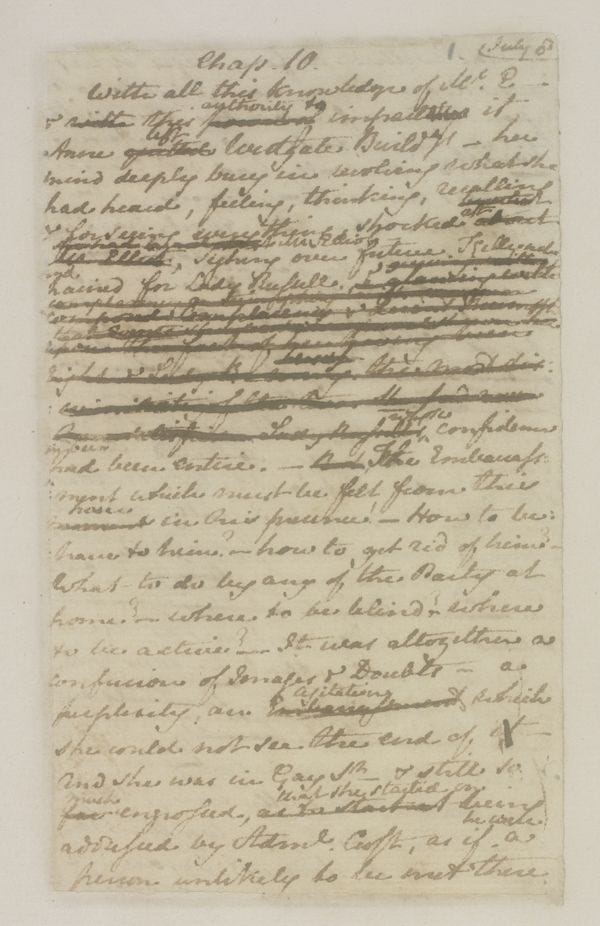
At first glance, there doesn’t seem to be that much difference, certainly not in meaning, between Jane Austen’s first and final drafts of the opening of Chapter 10 of Persuasion.
So you can read the words more easily, here is a typed out transcription of Austen’s page:
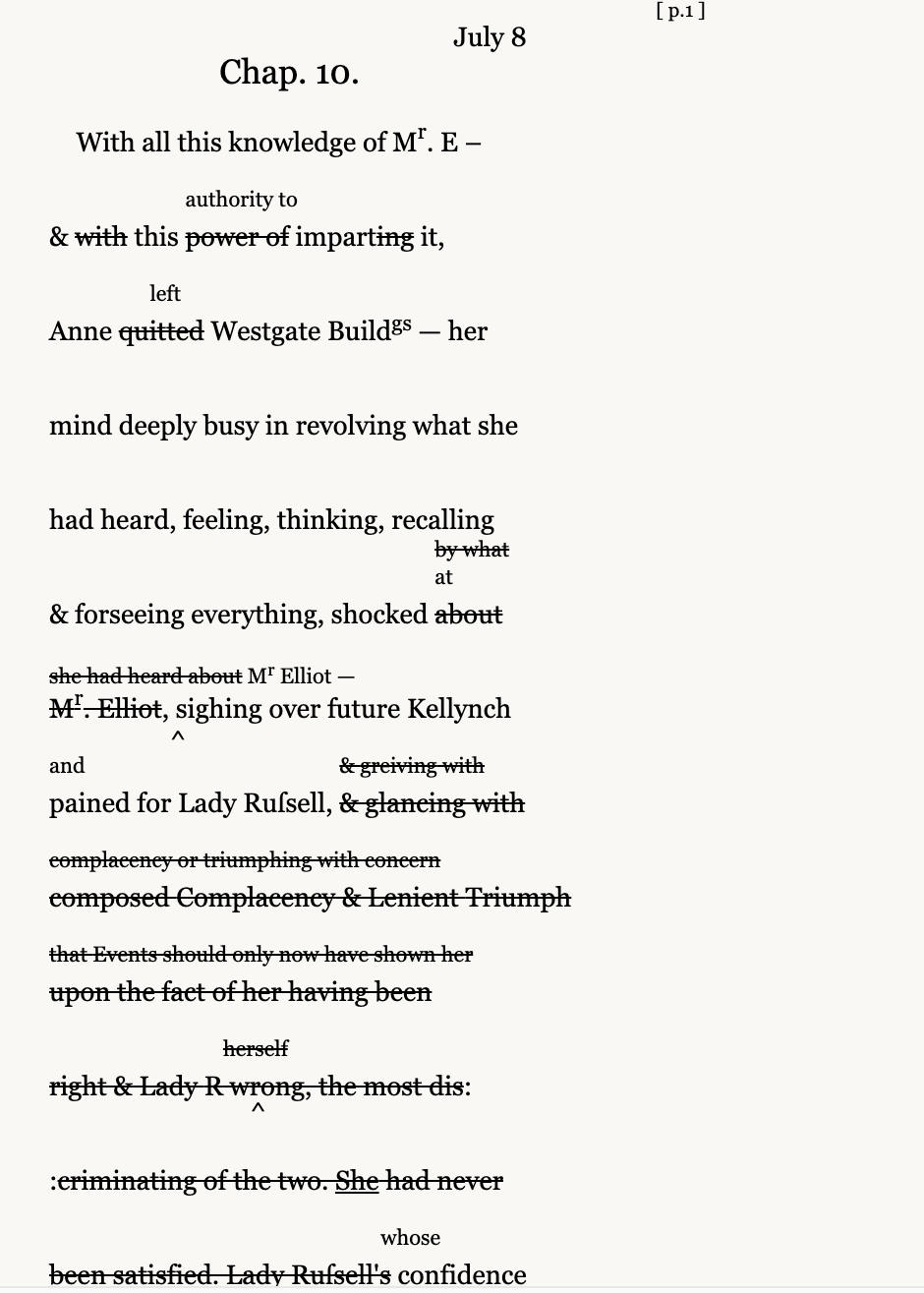
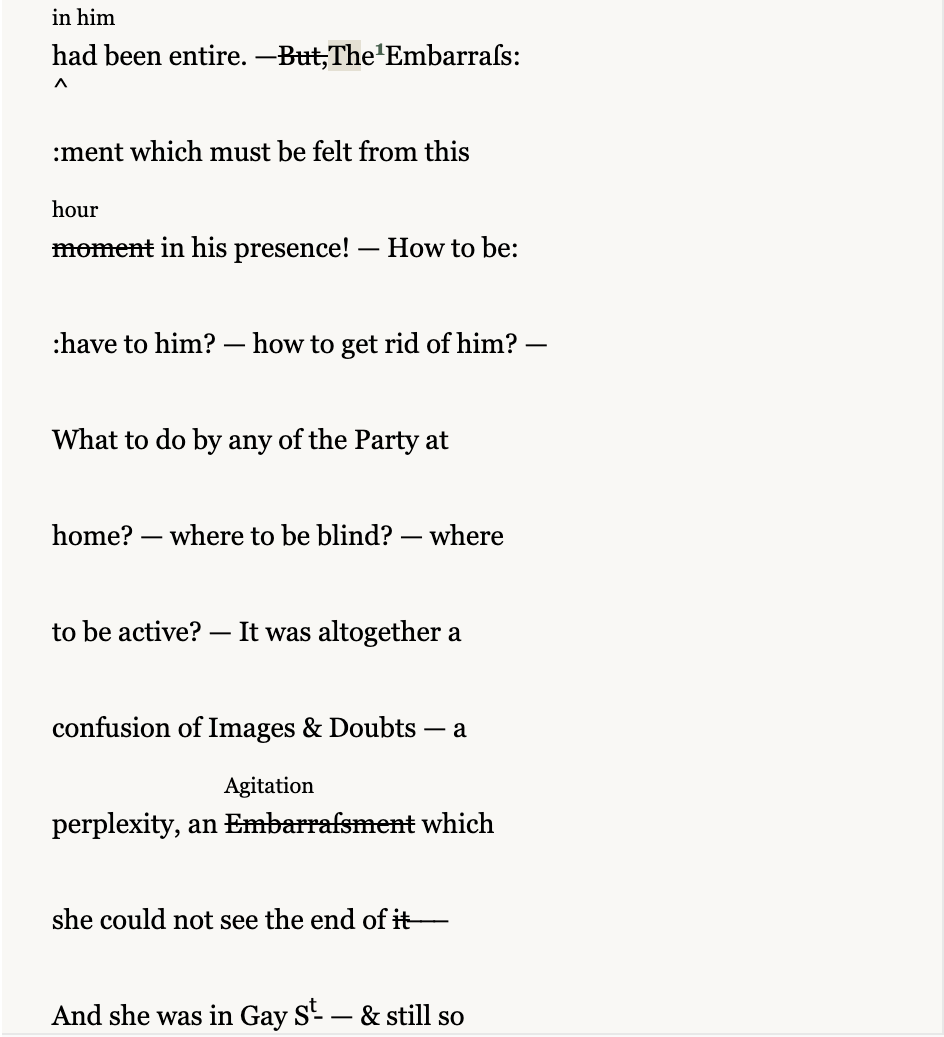
Let’s look at the opening sentence, to see what we can learn about how Jane Austen approached rewriting. What were the questions in her mind? What were the choices she made?
Note: Austen left tidying up the text (i.e., inserting a character’s full name for their initial) to her publishers.
Here is where Austen ends up, the final version —
With all this knowledge of Mr. E — & this authority to impart it, Anne left Westgate Buildings — her mind deeply busy in revolving what she had heard, feeling, thinking, recalling & forseeing everything, shocked at Mr Elliot — , sighing over future Kellynch — and pained for Lady Rufsell, whose confidence in him had been entire. — The Emabrafsment which must be felt from this hour in his presence! — How to behave to him?
And this is what she began by putting down her first draft (so far as we can tell) —
With all this knowledge of Mr. E — & with this power of imparting it, Anne quitted Westgate Buildings — her mind deeply busy revolving what she had heard, feeling, thinking, recalling & forseeing everything, shocked about Mr. Elliot, sighing over future Kellynch pained for Lady Rufsell, & glancing with composed Complacency & Lenient Triumph upon the fact of her having been right & Lady R wrong, the most discriminating of the two. She had never been satisfied. Lady Rufsell’s confidence had been entire. — But, the Embarrafsment which must be felt from this moment in his presence! How to behave to him?
Let’s begin by saying, this is not elegant, controlled prose writing. Nor is it properly punctuated. It’s a deliberate carriage crash of subjective feeling, given in repetitive verb forms (eleven -ing endings) and sentence fragments. Austen’s heroine has just learned that Mr E., Mr Elliot, is a total rotter. Her trust in him has been undermined by her genteelly impoverished friend, Mrs. Smith — who has witnessed his iniquity and kept the receipts until she was asked to produce them.
Almost all Austen’s changes from the first to third or fourth draft (on the same page) go toward making a preoccupied and bewildered Anne more prey to her emotions, and of reining in her gloating.
This gloating is, at first, extreme. After discovering she was right about Mr. E and Lady Russell (the woman who persuaded nineteen year-old Anne not to marry the love of her life when he had insufficient money) was wrong, Anne is shown —
glancing with composed Complacency & Lenient Triumph
Anne is not involved in these states of mind, which hardly amount to emotions. In a late Henry James-type phrasing, she casts a quick eye over them with the verb ‘glancing’ as the most disengaged verb of looking.
Think how different it would be if Austen described her as ‘peering’ or ‘gazing. Both would make her seem less hoveringly superior than does ‘glancing’. (One ‘glances with distain’.)
As for ‘composed Complacency’, with its heavily obvious alliteration, and ‘Lenient Triumph’, with its rat-a-tat Ts, together they would leave Anne as a smug told-you-so merchant it would be very hard to continue liking — at the key turning point scene of the novel.
We want Anne to be right, and Lady Russell to be wrong, and for Lady Russell to be shamed into apology, but we don’t want Anne to revel in that. She needs to leave the moral triumphancy to the reader.
Austen realises this, and we see her having one go at a line-level fix. How about if she shoehorns in a verb of emotion, but keeps the nub of the thought? In this second draft, she wants to retain but moderate ‘Complacency’ and ‘Triumph’. Anne is morally victorious, and doesn’t she just know it —
& grieving with complacency or triumphing with concern that events should only now have shown her right and Lady R herself wrong
No, this still will not do. It is bordering on incoherent.
I don’t think’s it’s possible for any human to grieve with complacency; and to triumph with concern is something only an Austen baddie would do[1].
Wisely, after this rescue attempt, Austen gives the whole passage up as a bad job. She crosses out six lines. In making this cut, she is also able to strengthen the following late Henry James-type sentence[2] —
Lady Russell’s confidence had been entire.
In the final version, Anne is fully immersed in her emotions, not glancing over her moral superiorities —
shocked at Mr Elliot, sighing over future Kellynch and pained for Lady Rufsell whose confidence in him had been entire.
Whenever you need to think about what makes a sympathetic central character, remember these changes. With this finely judged cut, which is pretty savage for her, Austen leaves it entirely to the reader to say, But, Anne, you were right — that’s a fact — aren’t you even going to give yourself a moment’s credit for seeing through Mr. E’s deceptions, you sainted woman?
If anything surprises me, when examining these drafts, it is that Austen drew Anne so crudely, and almost cruelly, in her first draft.
We catch Austen naming the emotions she wants her readers to feel but ascribing them to her heroine — which is entirely the wrong way round.
We couldn’t wish for a better example of telling, not showing.
In the scenes that follow, between this page and the end of the novel, the reader is left to experience composure (that it’s all turned out right in the end), complacency (that they, and Anne, have been the wise ones), leniency (that they want the baddies socially punished but not obliterated) and triumphant (that Anne’s going to marry Captain Wentworth — take that, Lady Russell, you interfering old bag!)
With every change, Austen improves the prose, and makes her heroine less unsympathetic.
Thanks for reading A Writer's Diary! This post is public so feel free to share it.
[1] When Mrs Elton crows to Emma about the adorable foibles of her caro sposo, her darling husband, and wishes single Emma the delightful trouble of such a husband, she is being triumphantly concerned. But the reader is always aware Mr Elton would have preferred to marry Emma, and that she rejected his proposal.
[2] Seymour Chatman in The Later Style of Henry James, on page 8, analyses James’ growing tendency to attribute feelings and agency to abstract nouns —
Lady Russell’s confidence had been entire
rather than directly to fictional people —
Lady Russell, whose confidence in him had been entire
An example would be the change he made, in the opposite direction to Austen’s, where the original 1878 version of the sentence —
Roderick was peculiarly inscrutable.
becomes in 1909 —
Roderick’s reflecting surface exhibited, for the first time, something of a blur.
There’s a discussion to be had about whether this rewrite, which includes a visual image (‘blur’) and gains subtlety, is much better or frankly awful and overwritten.
James felt he was moving away from tell and towards show, from abstraction to the concrete, but his later writing takes a greater effort to grasp.
How does a person, not a Terminator, have a reflecting surface?
Comments
Nothing yet. Say the first thing.
Sign in to join the conversation.