
I have spent years sitting across from the hardest-to-reach, most skeptical buyers in the world.
CISOs who have been lied to by vendors so many times that their default posture in any sales interaction is practiced suspicion.
Security engineers who have been on call at 3am cleaning up after decisions made by someone who believed a demo from a product company that has over-promised and under-delivered.
IT practitioners who have absorbed enough vendor “thought leadership” to recognize and dismiss it before they finish the first paragraph of that whitepaper.
I do not blame them for any of it.
I blame the playbook.
The “modern” B2B marketing playbook.
You know…the one almost every tech company is still running in 2026, which created the exact conditions that make buyers almost impossible to reach.
And the companies doubling down on it are not going to be able to outspend their way out of the hole it dug.
Let me explain what I mean.

There is more vendor content in the world right now than at any point in the history of B2B marketing.
More emails. More LinkedIn posts. More “thought leadership,” workflows, sequences, aliases.
More AI-generated everything - technically correct, strategically assembled, efficiently produced, and yet, pigeoneholding our industry into a dangerous, disconnected, and emotionally empty world.
Interestingly, marketers notice this problem. But what concerns me most is that we, as an industry and as people, have made peace with it.
We acknowledged that buyers were tuning out and then we decided the answer was volume of more AI-generated “slop” as they call it.
If the message and format isn’t resonating and converting, send it to more people more often.
“Optimize” the subject line.
Add another touchpoint to the sequence.
Create more talking heads with fancy captions and AI effects.
The machine got more efficient. The results got worse.
And somewhere along the way, the industry accepted that declining engagement was a targeting and algorithm problem rather than a trust problem.
It was never a targeting or algorithm problem, my friends.
What actually happened is that buyers became immune to the shitstorm of mediocracy.
I’ve talked about this relentlessly for years - in the podcast episodes, in the live streams with WTF DId I Just Read? Tech Sales and Marketing Edition, in the LinkedIn posts, the conference talks, the conversations behind closed doors with buyers.
Buyers have developed filters that trigger before conscious thought.
Why? Because we have treated them as targets before humans.
And when someone is treated as a target, their natural response is to protect themselves and block that shit out.
The response most companies had to this was to produce more touchpoints, sequences, cheesy or flashy ads, at higher volume.
The logic was: if the message isn’t getting through, send it more times to more people.
You’ve heard of the spray and pray phenomenon. Not phenomenal at all, actually. It’s just on steroids now.
That logic made the problem worse.
Every additional piece of AI-powered-whatever-you-want-to-call-it that ends up in a buyer’s ecosystem is one more data point training them to ignore the next one.
The more you push in front of them, the better they get at filtering it.
The better they get at filtering it, the less anything resonates.
The less anything resonates, the more you send.
This is the vicious loop we are dealing with.
And too many B2B tech companies are doubling down on it while doing more of the same, every year.

The metrics that B2B marketing teams are measured on have never been good proxies for trust.
Badge scans. MQLs. Open rates. Click-through rates. Impression counts. Video views.
These metrics tell you who took an action. They tell you nothing about whether that person trusts you, remembers you, or will ever buy from you.
For a long time, that was fine. The market was less crowded. A click meant something. A badge scan turned into a conversation.
The metrics were imperfect but they pointed toward revenue often enough that nobody questioned them too hard.
That is no longer true.
Today, the dashboard can look fine and the pipeline can look bleak. Both things are often true at the same time for too many of my peers.
A buyer clicks your email (if you’re lucky) and forgets you by the end of the day. They attend your webinar with it open in a background tab.
You forcibely scan their badge at your conference booth and they automatically mentally file you under vendors they will never engage with post-conference.
Every one of those interactions registers as a positive metric. None of them produced trust with that human.
The problem is seemingly invisible inside the organization because the tools companies use to measure marketing were never designed to measure trust.
And I say seemingly because deep down inside, most stakeholders in the organization know this is an issue.
Anyway, those tools you use for measuring performance were designed to measure activity…or…noise. Some call it signal.
Activity is not the same thing as progress.
The buyers I interview describe feeling like data points. Like the destination of a sequence rather than the subject of genuine curiosity.
They say vendors know their tech stack, their budget cycle, their title and nothing about who they actually are.
I have sat in enough buyer interviews to know this is not a fringe perspective.
It is the majority view. The gap between what dashboards measure and what buyers actually experience is where the trust deficit lives.
B2B tech companies solve their distribution problem by borrowing someone else’s audience.
They sponsor a conference and reach the attendees.
They buy a media placement and reach the subscribers.
They run ads against a platform’s targeting and reach whoever the algorithm decides to serve.
The numbers look real. The reach is real.
The relationship between the brand, or more importantly, the people that represent the brand, and that audience, however, is not.
This is called renting an audience and it has one defining characteristic:
It resets to zero the moment you stop paying.
The audience never belonged to the vendor.
The trust that might have started forming in that borrowed space evaporates when the context that created it disappears.
They are building audiences that follow because they want to, communities that share because the content earns it, relationships that exist independently of any platform or paid placement.
These assets do not reset. They compound. Each piece of content, each genuine interaction, each episode builds on the last.
The vendors I watch who are actually winning are not renting attention, they are building something that accumulates and using organic distribution as R&D before they spend any other dollar on distribution.
They thoughtfully uild audiences that follow them because they want to.
Communities that share because the content deserves to be shared in trust ecosystems.
Relationships that exist independent of any platform, paid placement, or transaction.
Those assets do not reset when the campaign ends. They compound.
Each piece of content, each genuine interaction, each episode builds on the last.
This pattern of borrowed reach producing borrowed attention creates a third consequence that most companies are not connecting back to its source.
The storytelling in most B2B tech marketing is technically competent.
It follows the frameworks we, as marketers, are taught - problem, solution, proof.
Create the customer story with the challenge and the outcome.
Share thought leadership with the pragmatic, key takeaways.
It is assembled correctly but does it really persuade anyone to deeply engage?
I’ve found that IT buyers are not moved by competence.
They are moved by the truth and vulnerability.
And the truth in most vendor storytelling is that it was produced at a distance from the people it is supposed to be about.
The case study with the customer name redacted.
The persona-based messaging that describes a version of the buyer’s reality that is accurate at the category level and wrong at every specific level that matters.
The “human-centric” content written by someone who has never had an unstructured conversation with a CISO about what their actual day feels like.
Nuance matters.
Buyers sense this distance and see the lack of nuance immediately and not always consciously.
It is not that they analyze the content and conclude it is inauthentic; rather, that emotionally thin storytelling produces the feeling of being spoken at rather than spoken to.
That feeling activates skepticism rather than trust.
What happens then is the buyer’s guard goes up.
And because of that, the vendor spends more money to make their next conversation happen, if it will happen at all.
Sadly, this is simply the predictable outcome of a model that optimizes for production volume over human connection and vulnerability.
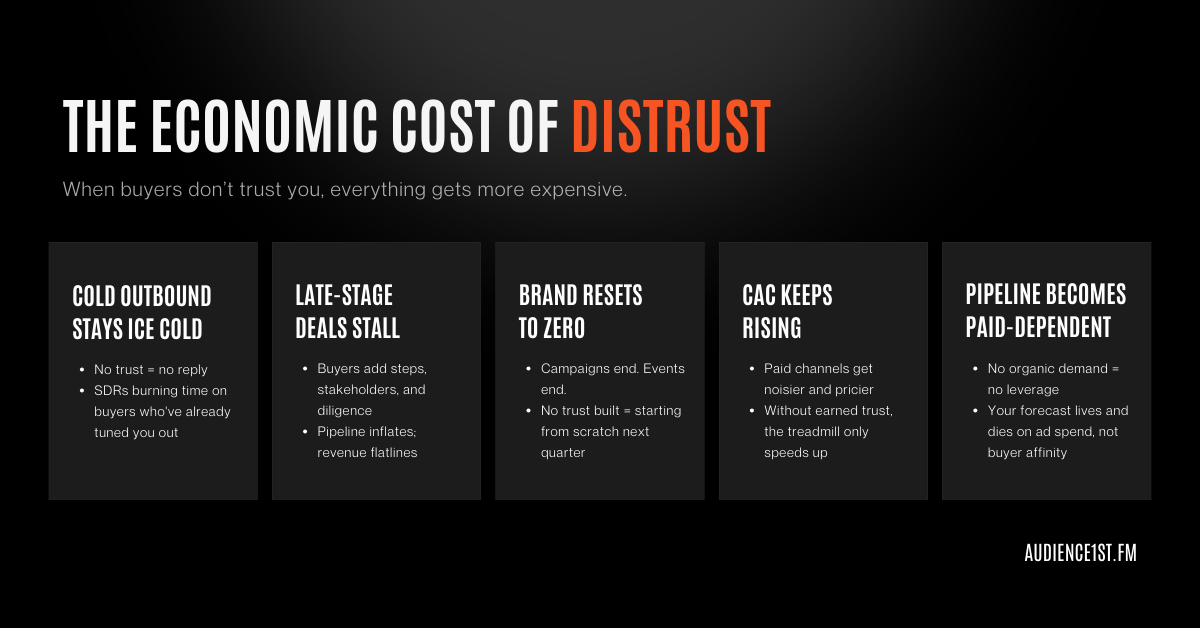
All of this - the skepticism, the filtering, the emotional distance, the borrowed reach that resets to zero - has a direct economic consequence that is rarely framed as a trust problem even though that is exactly what it is.
Cold outbound stays ice cold. No trust means no reply. SDRs burn hours on outreach to people who have already tuned out the entire category, not just the company.
Late-stage deals stall. Buyers add stakeholders, create diligence steps that were not in the original evaluation criteria, and slow the timeline down. The pipeline inflates. Revenue flatlines.
Brand resets to zero. Campaigns end. Events wrap. Without trust built into the relationship independent of any single activation, everything starts from scratch.
CAC keeps rising. Paid channels get noisier and more expensive. Without earned trust generating organic demand, the treadmill only speeds up. There is no leverage in a model with no compounding component.
Pipeline becomes paid-dependent. No organic demand means no resilience. The forecast lives and dies on ad spend rather than buyer affinity and the moment the spend stops, so does growth.
Trust is not a brand metric. It is a revenue multiplier.
The companies that understand this are not asking how to get more impressions or more MQLs.
They are asking how to build something that makes the conversations they do get matter more.
That is a fundamentally different question and it leads somewhere fundamentally different.
Underneath all of the above is a market dynamic that ties every other problem together.
When every vendor in a category is using the same messaging framework, running the same conference playbook, producing the same demand gen motion, the buyer cannot tell them apart.
The logos are different. Everything else is functionally identical.
Differentiation has collapsed, which has forced buyers even further to more predictable ways to make decisions - with their friends and colleagues in trusted ecosystems.
They make decisions based on who they already know. Based on a peer who told them about a vendor.
Based on the conversation that happened two years ago in a setting that had nothing to do with a marketing campaign or sales cycle.
The peer referral wins every time.
The trusted voice in a Slack community wins every time.
The vendor who had a genuine, unhurried, human conversation with a CISO at a conference two years ago - not at a booth, not in a scheduled thirty-minute meeting, but in the kind of moment that actually forms a memory - wins every time.
This is the market signal most B2B tech companies are misreading as a distribution problem.
They think they need more reach.
What they actually need is more trust.
And reach, purchased at scale, in a market where every competitor is competing for attention, produces nothing that compounds.
This is the problem.
All of it - the skepticism, the disengagement, the fractured attention, the rising cost of acquisition - traces back to the same root.
A model optimized for metrics that are easy to count and poor predictors of whether a human being will ever genuinely trust you and collaborate with you.
I know this model.
I built parts of it.
And I have spent years learning from the buyers we are all trying to reach - what they actually need from us.
The next post is about what that looks like in practice and why the window to get there before your competitors is still open.
Stay tuned.

Deals close faster with trust. Buyers trust their peers above everything else. So we put them on camera with you, in experiences so human, the relationship that’s built can’t be manufactured any other way.
No posts
Comments
Nothing yet. Say the first thing.
Sign in to join the conversation.