
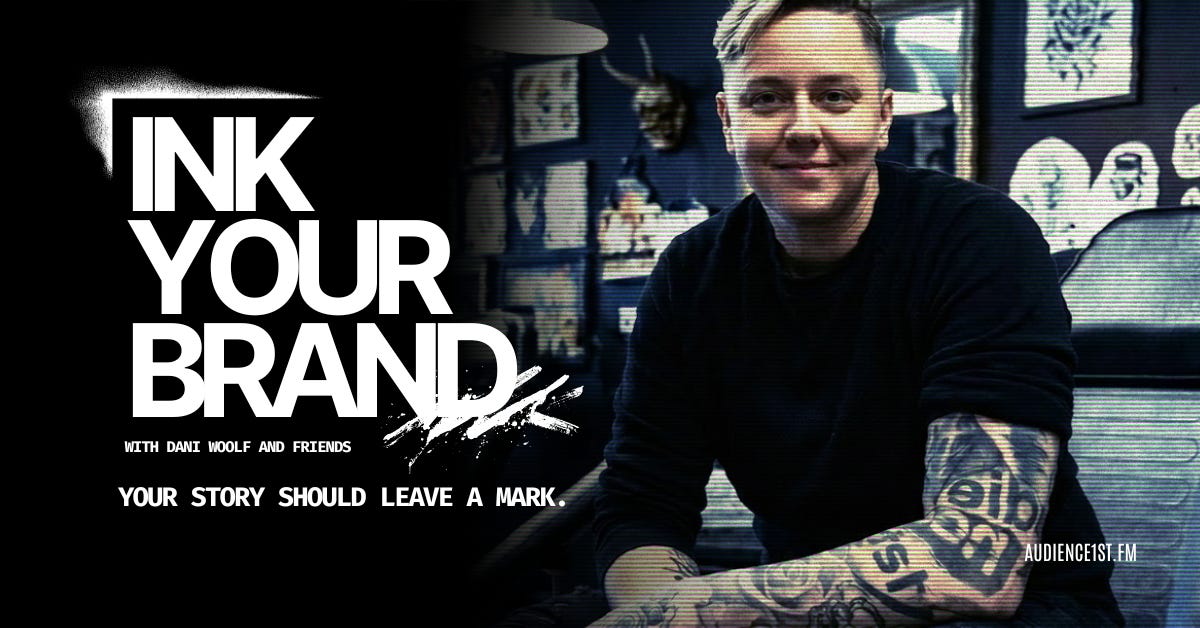
I am sitting in a tattoo chair.
The needle hasn’t touched my skin yet, but I can already hear it - that flat, relentless buzz that lives in the precise gap between excitement and dread, the one that reminds you that no matter how many times you’ve done this, you never actually know what the next few hours are going to take out of you.
Across from me is someone I’ve known for about forty minutes.
They’re settling into their own chair.
Their tattoo artist is prepping the stencil.
There’s a camera pointed at both of us, catching the nervous energy, the slight forward lean, the moment just before everything becomes permanent.
We are about to have a conversation that neither of us would have had on a podcast, a webinar, a LinkedIn Live, or any other format that B2B marketing has approved for public consumption.
And that is precisely the point.
This is Ink Your Brand - my new social show, produced by Audience 1st.
And if you’re reading this wondering whether I’ve finally lost it, I want to offer you a different hypothesis:
Maybe I’m the only one in the room who’s actually paying attention.
Subscribe for free to watch the show and follow the full production diary - from guest recruitment through filming day through distribution and everything that surprises me along the way.
Here is a thing that is true and that almost everyone in B2B marketing privately agrees with but almost no one will say at full volume:
Traditional content is showing diminishing return.
Why?
Because buyers have seen every move.
They’ve been marketed to so many times, in so many of the same ways, that the part of their brain that used to engage with a well-produced webinar or a cleverly written email now just...routes around it automatically.
The filters aren’t conscious anymore, they’re reflexive.
And every new piece of traditional content that lands in their feed, however polished, however well-targeted, is training those reflexes to fire faster.
The more the industry produces, the less any individual piece of it means.
Volume became the strategy at exactly the moment volume became the problem.
And now everyone is sitting on content calendars full of AI-generated assets that get published, get ignored, and get replaced by next week’s assets, which will also get ignored, in a cycle that generates a lot of activity and very little trust.
I’ve spent the last several years sitting across from the most skeptical IT buyers - CISOs, VPs, cybersecurity directors and practitioners - asking them what they actually think, why and how they engage with vendors.
What comes out when nobody’s pitching them anything.
And what comes out is this:
They can’t tell your company apart from the other twelve vendors in their inbox.
They stopped watching the webinars.
They’ve stopped going to the massive tradeshows.
They’ve stopped going to the steak dinners (minus the steak mafia).
What the buyers I talk to want - and what almost nobody in this industry is giving them - is the feeling that someone on the other side of the table actually sees them.
That the content made for them was made with them in mind, not for a quarterly board slide that says “we have leads coming in!”
Fifteen years in this industry has given me a clear enough view to say that somewhere along the way, B2B marketing decided that looking credible was the same thing as being trustworthy.
That producing content was the same thing as creating connection.
That talking at buyers, with enough frequency and enough polish, would eventually feel like a relationship.
It doesn’t.
The buyers will tell you so themselves if you find a way to ask them somewhere they actually feel safe enough to answer honestly.
So what does work?
I’ve watched (and launched) enough marketing experiments succeed and fail over fifteen years to have a strong opinion about this and it comes down to one structural truth:
Buyers don’t trust brands, they trust people.
This is not revolutionary by any means.
Today, however, AI, what with it taking over the way marketers operate and create content, has forced the industry to become more disjointed and disconnected than every.
My friends, your differentiator is human proximity.
The formats that win are the ones that put real people, real stakes, and real stories on camera at scale, in a way that feels like something worth watching rather than something worth skipping.
That format is the social show.
A social show is an episodic, character-driven media program built specifically for the feeds where your buyers already live - short enough to binge, human enough to feel, and structured enough to build a narrative that compounds over time instead of disappearing into the void like every other piece of content you’ve ever published.
It’s branded entertainment that happens to be about the things your buyers care about most, featuring the people they already trust or want to hear from, in formats designed to stop a scroll rather than fill a content calendar.
The reason social shows are the right vehicle right now is not complicated, it is just underacted on.
Attention has collapsed in B2B.
The average buyer is drowning in vendor noise and their filters have become extraordinarily precise.
What cuts through is not more content.
It is better stakes. It is something that feels like it was made for a human being to watch, not for an algorithm to index.
It is, above all, the sense that something real is happening - that the people on screen are not performing but actually participating in something together.
A social show, done right, is not awareness.
It is not demand gen in the traditional sense.
It is the deliberate, repeatable act of building the kind of trust that makes a buyer think of you first, believe you when you speak, and tell their peers about you before you ever send them a proposal.
The byproduct? Partnership. Pipeline. Revenue. Brand affinity. Customer retention.
That is the benchmark. That is what I am chasing.
And the question I kept asking myself - the one that eventually led me to a tattoo chair with a camera pointed at my face (and body) - was:
What format creates that kind of feeling so reliably that you could build a whole show around it?
I didn’t arrive at Ink Your Brand by thinking about content strategy.
I arrived at it by thinking about something I personally like doing - getting tattoos.
I have them. Several.
And anyone who knows me knows that the story behind each one matters more than the ink itself.
There’s something about the ritual - the choosing, the committing, the sitting still in vulnerability while something permanent happens to your body - that strips away performance almost completely.
You can’t be “on” when you’re wincing.
You can’t give a polished answer when the needle is doing its thing.
The discomfort is a truth serum, the permanence is a commitment ceremony, and together they create a kind of conversation that simply does not happen in any other context.
I started thinking:
What if that’s exactly what B2B marketing needs?
Not the tattoo as gimmick.
Not “edgy branding” for its own sake.
But the experience - the real, unscripted, embodied, impossible-to-fake experience - as a media format.
What if the format itself was the argument?
What if, instead of making content about the importance of doing things differently, I just did something radically different and filmed it?
That thought became Ink Your Brand.
Ink Your Brand, produced by Audience 1st, is a social show where I sit down with the top B2B GTM professionals, content creators, CMOs, founders, product marketers, and - crucially - the tch buyers themselves: CISOs, VPs, directors, practitioners who live on the other side of the table from the vendors trying to reach them.
We get meaningful tattoos together, on camera.
And while the needle does its work, we have the conversations that nobody is having on camera in this industry.
We talk about the pain of standing out in saturated markets.
About the content that buyers ignore and why.
About what it actually takes to build a brand that doesn’t just get noticed but gets believed.
About the moments of failure and the pivots that followed.
About conviction - what it means to actually stand for something when your whole industry is telling you to hedge.
Two chairs. Two needles. No script. No safe talking points. No pre-approved narratives.
Every episode follows a natural emotional architecture - seven stages that mirror the tattoo itself, from the nervous energy of The Sit to the mirror moment of The Reveal - and the result is something that doesn’t look or feel like anything else in the B2B media landscape.
Because nothing in B2B media is built quite like this.
The needle is the truth serum. The tattoo is the commitment. The conversation is the story.
Each full session runs 90 to 120 minutes of real tattoo time and yields one 10-to-15-minute supercut, eight mid-form thematic segments, and seven short-form clips: single moments of truth that can live on LinkedIn, Instagram, TikTok, and YouTube, built to stop a scroll and start a conversation.
Season 1 films eight guests across two days.
That’s 56 episodes, 120 total assets, and a content library built to run for months = not from a studio full of talking heads, but from a tattoo chair, where the stakes are visible on skin.
Here is the meta-layer that I want to be transparent about, because I think it’s the most important part of this entire project.
Ink Your Brand is a living demonstration of the exact thesis I am bringing to B2B marketers.
My company, Audience 1st, produces social shows for B2B tech and cybersecurity vendors.
We build the kind of buyer-led, experiential media programs that I’m describing above - original show concepts where your buyers become co-stars, where the experience is the production studio, and where the trust you build on camera compounds forever.
That is the service. That is the product.
So when I sat down to think about how to market that service, the answer that kept presenting itself was:
Don’t explain it. Do it.
Don’t write a whitepaper about why social shows create trust. Make a social show that creates trust.
Don’t give a keynote about how vulnerability unlocks buyer relationships. Get in a tattoo chair on camera and be vulnerable.
Don’t produce a case study about why non-traditional formats break through noise. Be the case study.
This show is my proof of concept, my portfolio, my pitch, and my practice all at once.
Every episode of Ink Your Brand is simultaneously a piece of content for the show and a demonstration of what Audience 1st builds for clients.
Every conversation about brand and story and conviction is a conversation about what we do and why it works.
I launched a social show to show how to create a social show.
The irony is the strategy. The meta is the message.
If that reads as too clever by half, I understand.
But I’d argue that the B2B world is full of companies that tell you they can make you stand out and then hand you a PDF.
I’d rather show you, permanently, on my arm.
(Literally. I tattooed my company’s logo there. People ask about it at every conference. That’s a different kind of brand impression than a sponsored LinkedIn post.)
The buyers I talk to (and I have spent years building relationships with over a thousand of them) are not withholding trust because vendors are saying the wrong things.
They’re withholding trust because vendors are saying things at all, in formats designed for vendor comfort rather than buyer resonance.
The formula for breaking through is not complicated, but it is uncomfortable.
It requires doing something that not everyone will do, because that is the filter for who stands out.
It requires telling a real story, not a polished one, told in partnership with the people you’re trying to reach.
It requires making a commitment that’s visible, costs something, and can’t be faked.
That is what every tattoo is. And that is what every great social show is.
The stencil before the needle.
The pilot before the full series.
You validate before you commit, but then you commit fully, with both hands, and you don’t flinch when people tell you it’s too risky or too weird or too much.
Vulnerability is the point. The pain is what makes it real. And what’s real is what people remember, share, and believe.
Ink Your Brand lives on Substack, LinkedIn, Instagram, TikTok, and YouTube - published as short-form episodes 7 to 10 times per week (dropping this week).
Subscribe to Watch When an Episode Drops
Episode 0 is dropping this week.
Plus, I am building this show in public on the Ink Your Brand Substake - if you want to follow the full production diary - from guest recruitment through filming day through distribution and everything that surprises me along the way:
Every decision, every mistake, every lesson from pre-production through launch and distribution - I’m going to write about it.
I’m not a content creator posting about content creation.
I believe there is a serious, teachable, replicable framework for how B2B companies can use social shows to build brand, create demand, and earn the trust of the buyers they’ve been trying to reach for years.
And I learn best by doing it myself first, then sharing exactly what I learned.
Future issues will go deep on the questions I get asked most:
How do you design a show format with a real narrative arc?
How do you recruit guests who will actually open up on camera?
How do you build a content machine from a single production day?
How do you get the CISOs and CMOs who decline every media request to get in a tattoo chair on camera and mean it?
I know the answers to these questions because I’ve built this - for myself and for clients.
And now I’m building it again, on camera, in a tattoo chair, with the people I trust most in this industry (and if you’ve agreed to sit in a chair with me and get tattooed - deeply trust me too).
Join us on Ink Your Brand.
And if you want to sit in the chair - as a guest, a sponsor, or a brand that’s ready to do something that can’t be ignored - let’s talk. There are limited placements available, and the chair doesn’t stay empty for long.
No posts
Comments
Nothing yet. Say the first thing.
Sign in to join the conversation.