
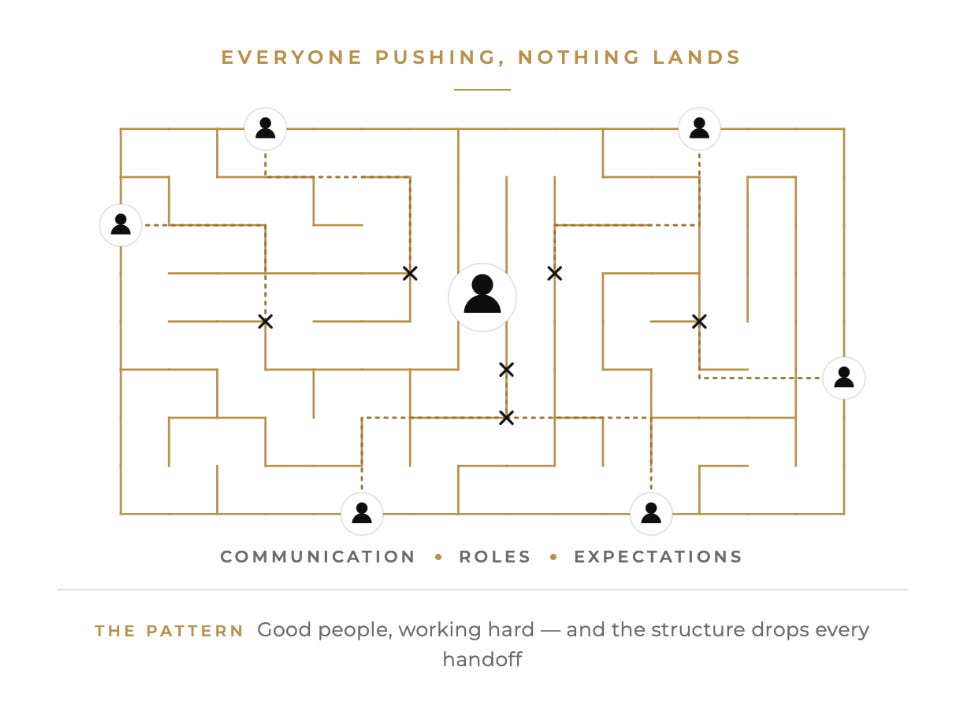
A few months ago, a woman who chairs a board came to me at the end of her rope, and within about ten minutes of listening to her, I knew exactly the kind of mess she was in — because I’ve been in it myself, more than once, on more than one board.
Her story came out in a rush. The organization’s leader was drowning — buried under a tide of tasks that kept rising no matter how hard she swam, missing the kind of deadlines that make a board lean forward in their chairs and start asking pointed questions. Board members had started going around one another, and around her. And one of them, convinced the leader simply wasn’t up to the job, had begun to quietly campaign to put her on a performance plan.
None of it surprised me. The biggest challenges almost never do — because they’re often the same three: communication, roles & responsibilities, and expectations.
I see this exact knot inside Fortune 500 companies — the same tangle, operating in precisely the same way. Just with some gilding overlaid.
The thing nobody wanted to see
But here’s what took the two of us a while to see, sitting with it together. The leader wasn’t failing.
The organization had grown — quietly, steadily, the way these things happen — and the work had roughly doubled while the structure beneath it hadn’t shifted an inch since the place was half its current size. She wasn’t underperforming. She was the only thing holding together a system that was never designed to hold itself together in the first place.
Asking her to carry it was like blaming a single beam for sagging under a roof twice the weight it was built for. The board wanted to fix the person. The thing that was actually broken was the architecture around her.
The quiet truth: What looks like a people problem is almost always a structure problem.
You can coach, replace, or write up individuals until you’re exhausted and never lay a finger on it — because the broken thing was never the person. It’s the absence of clarity all around them: who owns what, who decides what, and how the work is meant to move from one set of hands to the next.
This isn’t to say there’s never a people problem. When I coached the board chair, I was honest with her: there were so many structural problems that we couldn’t fairly assess the leader yet — some gaps may well surface once things are realigned. And as an organization grows, a leader can max out at a certain stage of that growth. But that’s a conversation for a different newsletter.
So what did we actually do?
Defined the immediate steps to clean things up and tighten communication.
Built out a 30/60/90-day action plan.
Set up a facilitated strategic planning session a few months out — with pre-work on where things felt foggy: expectations, priorities, and what people believe each stakeholder is actually responsible for.
The part AI can’t touch
This is the heart of the strategic planning and coaching work I do — and I don’t mean the kind that produces a lovely vision statement on a retreat (though that’s an important first step). I mean the unglamorous, load-bearing kind: mapping who’s responsible for what, setting expectations people can actually be held to, and building the lines of communication that hold steady even when the room gets tense.
I love helping sort out the mess. AI can hand you a flawless org chart in about four seconds flat. What it can’t do is walk into a room full of people who don’t quite trust each other and get them to commit to it — to have the hard conversation, to feel heard, to actually buy in and follow through. That work is human, stubbornly so — which is exactly why this problem will keep surfacing in organizations.
“The fix is rarely another hard conversation about the person. It’s clarity — who owns what, who decides, and how the work moves from one set of hands to the next.”
— What I’d tell that board
If your team feels shaky right now, the problem probably isn’t your people. It’s the structure around them — and that, I promise you, is fixable.
A place to start? Ask open-ended questions to find out from your various stakeholders what they’re seeing and feeling. Gather enough of that data and a pattern emerges — one you can then assess for next steps.
How can I help? If a specific situation came to mind while you were reading, just reply and tell me what’s going on. Untangling exactly this kind of knot is the work I love most.
No posts
Comments
Nothing yet. Say the first thing.
Sign in to join the conversation.