
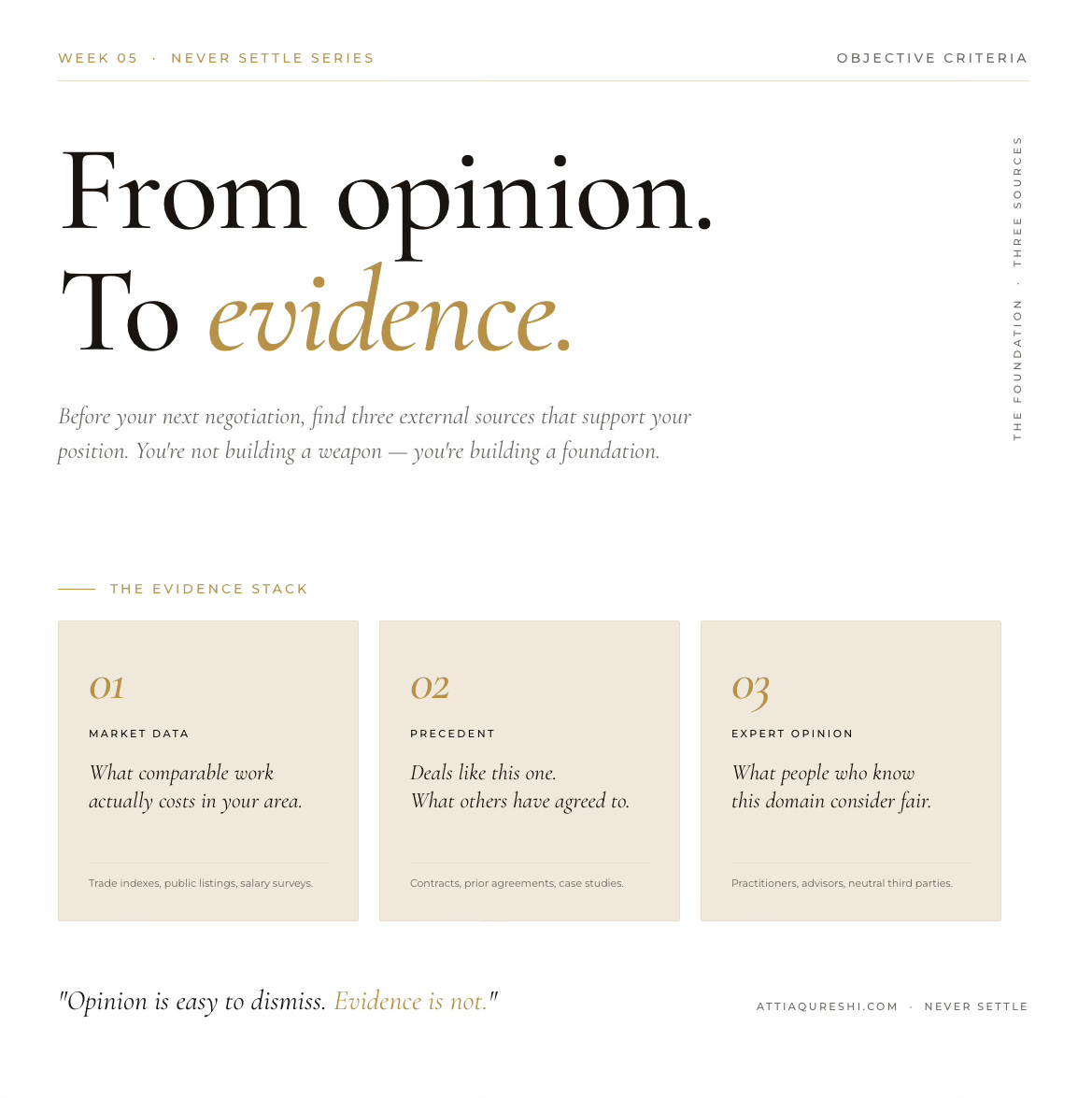
Opinion is easy to dismiss. Evidence is not.
This week was about one of the most immediately useful skills in negotiation: objective criteria. The external standards, market data, and benchmarks that take a conversation out of the realm of “I think” and into “here’s what the evidence says.”
Monday: The deck story — and why it changed my thinking
I needed a deck built. The first quote came in significantly higher than I expected.
My instinct was to push back on gut feeling. Tell him it was too much. Try to negotiate on pure opinion. But that’s not a negotiation — it’s a fight about feelings. And in a fight about feelings, the most stubborn person wins.
So I did two things instead. I researched what comparable work actually costs in my area. And I got two more quotes from other contractors.
Then I went back to him — not with “I think that’s too much,” but with: “Here’s what comparable work is running locally. Here are two other quotes I received. I’d love to work with you — can we talk about the price?”
He came down. Significantly.
Not because I was aggressive. Because I came in with something he couldn’t argue with: objective evidence of what the market said the work was worth.
That’s the shift. From opinion to evidence. From a fight to a conversation about what’s fair.
The exercise: before your next negotiation, find three external sources that support your position. Market data. Comparable quotes. Industry rates. Write them down. You’re not building a weapon. You’re building a foundation.
Wednesday: Where to find it — and how to present it
Four categories of objective criteria worth having in your toolkit: market data, precedent, expert opinion, and published standards.
But finding the right criteria is only half of it. How you present it is the other half — and most people get this wrong.
There’s a significant difference between “here’s what I found — help me understand your thinking” and “the data says I’m right.” One opens a conversation. The other closes it.
The test: for every piece of criteria you plan to use — ask yourself if they challenged this, could I defend it? If not, find something stronger, or name its limitations before they do.
Friday: Where it breaks down
Three mistakes I see most often: using data as a weapon rather than a reference point, cherry-picking sources and getting caught, and dismissing the other side’s criteria instead of engaging with it seriously.
The most counterintuitive insight here: naming the limitations of your own evidence before they do actually builds trust. It signals you’re interested in fairness — not just in winning.
What’s coming next week
Week 6 is about option generation — the skill of finding more possibilities before you start bargaining.
Most negotiations feel like zero-sum games: whatever I get, you lose. But most negotiations aren’t zero-sum. They just feel that way because nobody took the time to generate options first.
Next week I’ll show you how to expand the conversation before you divide it.
No posts
Comments
Nothing yet. Say the first thing.
Sign in to join the conversation.