
Most negotiations feel like zero-sum games. Whatever I get, you lose.
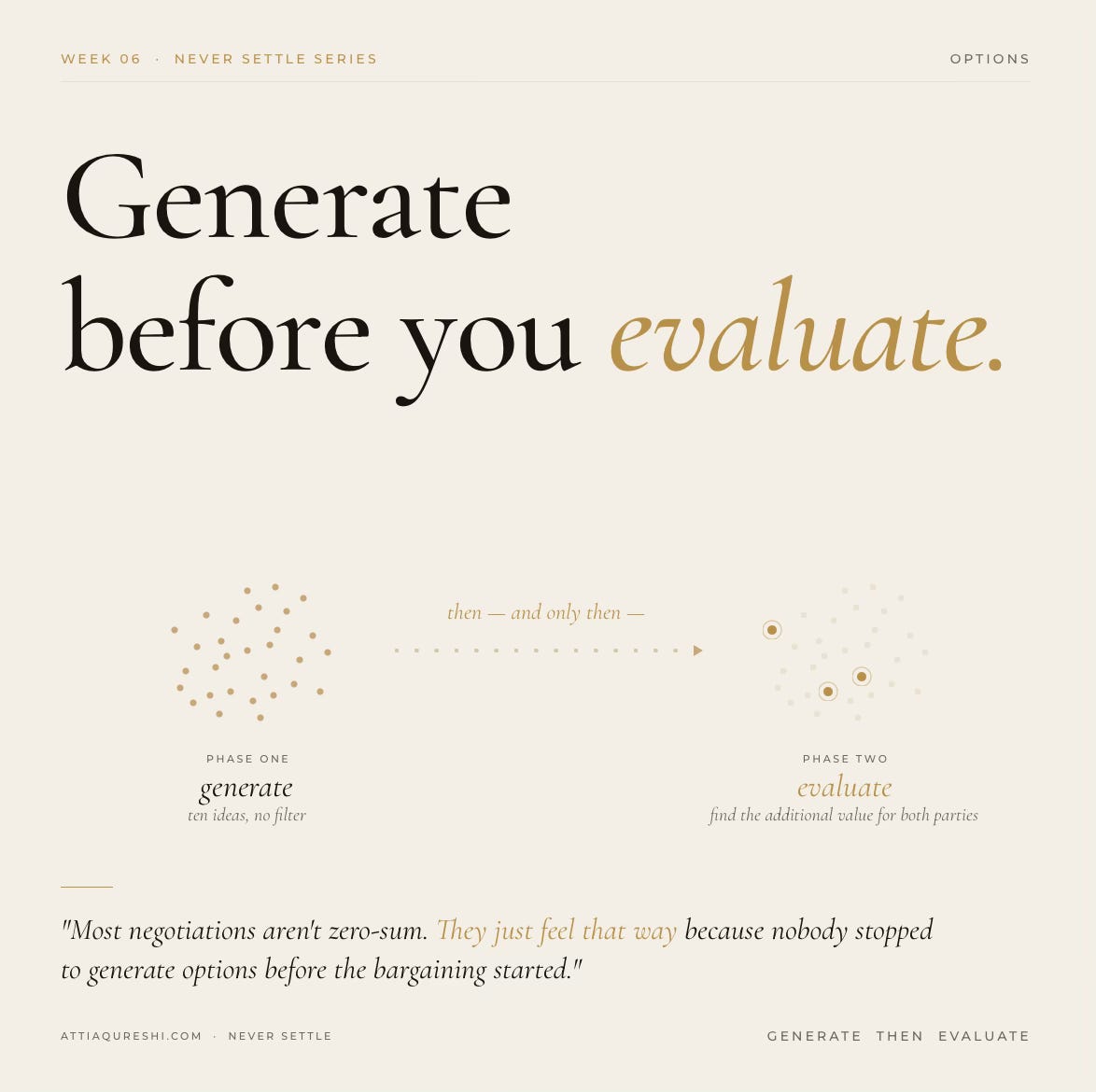
But most negotiations aren’t zero-sum. They just feel that way because nobody stopped to generate options before the bargaining started.
This week was about changing that.
Monday: Generate before you evaluate
The most common pattern I see: two people walk in with positions already decided, state those positions, and haggle toward the middle. They call it negotiation. But what they’ve actually done is divided a fixed pie without asking whether the pie could be bigger.
Option generation is the step that happens before bargaining. Before you start dividing — ask: what else is possible here?
The most valuable options are the asymmetric ones. What costs you very little might matter enormously to the other side. What matters most to you might cost them almost nothing. But you can only find those options if you’ve taken the time to look.
One rule: generate before you evaluate. The moment you say “that won’t work,” you’ve stopped generating. Keep the phases completely separate.
The exercise: set a timer for five minutes. Write ten possible options — no filter, no judgment. Then ask: which of these costs me little but might matter a lot to them?
Wednesday: How to expand the pie
Three questions worth asking before any negotiation: What do I want most that might cost them very little? What might they want most that would cost me very little? Is there anything we both want that we haven’t talked about yet?
And three techniques that work in practice: trading across issues (instead of haggling on one dimension), making contingent agreements (building future uncertainty into the deal structure), and separating issues (agreeing on what you agree on, setting aside what you don’t, and returning to the harder items with more goodwill in the room).
Friday: Where it breaks down
Three patterns that derail option generation even when people understand the concept: evaluating while generating, coming to the table with only one option, and generating options alone instead of exploring them collaboratively with the other side.
That last one is underrated. Some of the best options in a negotiation emerge from a simple conversation before the formal bargaining begins. “I’ve been thinking about a few different ways to approach this — can I share some ideas and get your reaction?” That question opens doors neither side finds alone.
What’s coming next week
Week 7 is the final week of this series — and we’re ending with the skill that gives you real leverage in any negotiation.
Your BATNA. Your best alternative to a negotiated agreement. What you’ll do if the deal doesn’t happen.
Most people walk into a negotiation without knowing this. And it costs them — because the person who knows their alternatives is the person with real power.
That’s next week.
No posts
Comments
Nothing yet. Say the first thing.
Sign in to join the conversation.