
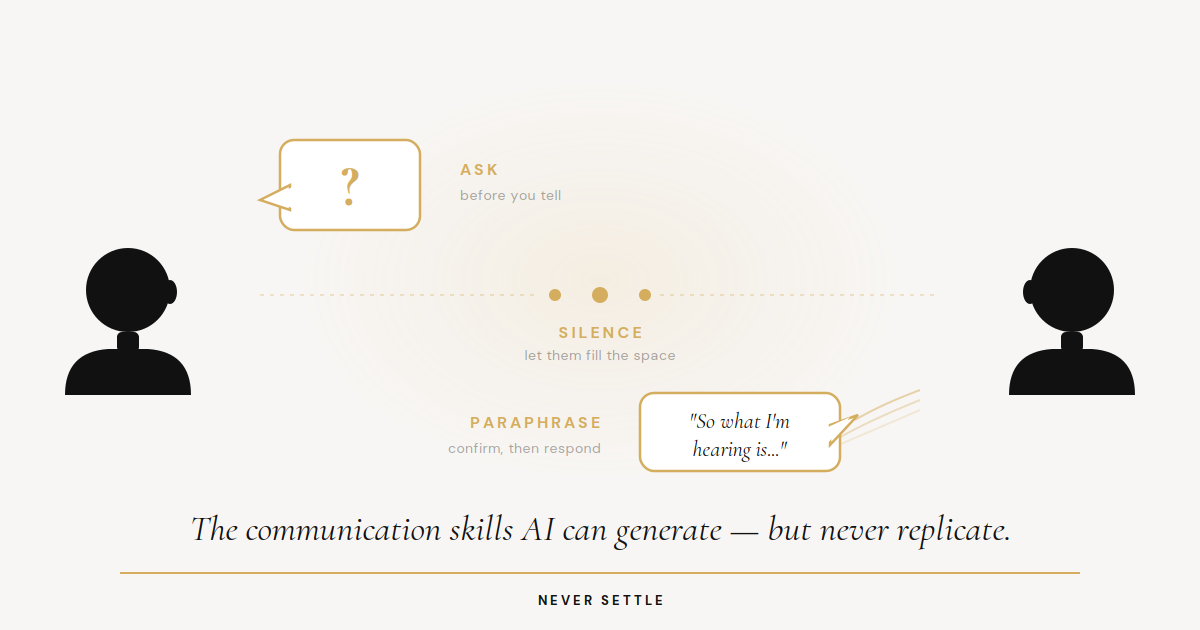
AI can write. It can produce emails, talking points, responses, and scripts faster than any human being.
What it cannot do is listen.
It cannot sit across from another human being, notice the hesitation in their voice, read what they’re not saying, and know which question to ask next — or when to say nothing at all.
In a world saturated with AI-generated communication, the person who actually listens has become the most powerful person in the room.¹ This week was about building that skill.
Monday: Ask instead of tell
Good negotiators come prepared to make their case. Great negotiators come prepared to ask.
Every question you ask before you state your position does three things: gathers information you didn’t have, signals genuine curiosity, and lowers the other person’s defenses — because people who feel heard become more open.
Most people in a negotiation are mentally rehearsing their next point while the other person is still talking. Which means they’re missing everything being said. And everything not being said.
Active listening isn’t passive. It requires you to set aside your own agenda long enough to genuinely understand someone else’s. AI can generate questions — but it cannot read the room and know which one to ask next.
The exercise: before your next important conversation, write down three genuine questions to ask before you make any ask of your own. Ask them. Listen to understand, not to respond.
Wednesday: Silence and paraphrasing
The most underused tool in any negotiation costs nothing and requires no preparation.
Silence.
When you make an ask and stop — when you resist the urge to fill the space — the other person fills it. They elaborate. They explain. They sometimes offer concessions you never would have gotten if you’d kept talking.
Then — when they finish — paraphrase before you respond.
“So what I’m hearing is...” “It sounds like what matters most to you is...”
This confirms you understood — which prevents solving for the wrong problem. And it makes the other person feel genuinely heard — which makes them dramatically more open to what you say next.
Knowledge is power. Silence and paraphrasing are how you gather it.
AI can generate a paraphrase. It cannot sit in silence with a human being and know when to speak and when to wait.² That distinction matters more than ever.
The exercise: after your next ask — stop. Let them fill the space. Then paraphrase before you respond.
Friday: The mistakes I see most often
Four patterns that show up in almost every negotiation — at every level, in every industry.
Talking too much. Every extra word gives the other side more to push back on. Say what you need to say. Then stop.
Listening to respond instead of to understand. Most people miss everything being said because they’re already composing their next point. You cannot respond until you can paraphrase what they said accurately enough that they nod.
Confusing being direct with being aggressive. The difference is almost never the words — it’s tone, framing, and whether the other person feels respected. You can say exactly what you mean without making them defensive. In fact, that’s the only version that works.
Reacting instead of responding. Something lands wrong, emotion takes over, and whatever you were trying to accomplish gets buried. Fix: pause before you respond. Even one breath changes what comes out.
Think about a recent conversation that didn’t go the way you wanted. Which one showed up? That’s your focus.
What’s coming next week
Week 5 is about objective criteria — the data, standards, and external benchmarks that give your position legitimacy and take the negotiation out of the realm of opinion.
In an AI world, everyone has access to more data than ever. The advantage isn’t having the data. It’s knowing which data matters, how to present it, and how to use it to anchor a conversation without making the other person feel cornered.
That’s next week.
Not on the list yet? [website URL] Take the free Negotiation Archetypes Quiz → [URL]
No posts
Comments
Nothing yet. Say the first thing.
Sign in to join the conversation.