
Reformation rang the bell at the New York Stock Exchange last week and closed its first day at $15.08, a tick above its $15 debut. That sentence would have been unremarkable a decade ago, and in 2026 it is the story, because the public markets have spent the last four years punishing nearly every fashion brand that dared to list. The SPAC class of 2021 is a graveyard. Allbirds went public at a $4 billion valuation and lost more than 95 percent of it, and venture capital has largely walked away from apparel altogether. A fashion brand holding its price at the bell is now the exception, and many other major retail brands are watching closely, because Reformation’s performance in public will decide whether the window opens for any of them.
What earned Reformation the listing is a rare set of numbers, including 24 consecutive months of double-digit growth, 98 percent revenue retention on a two-year basis, and 20 percent of the customers who found the brand in 2015 still shopping a decade later. Numbers like these do not come from a hot product or a viral quarter.
They come from a model, and the model breaks down into four plays, each of which is available to a founder at any scale.
The conventional fashion model designs a year ahead and commits to inventory before a single customer votes, which means the entire business is a bet, and a wrong bet means markdowns that bleed margin and brand equity at the same time. This is the structural problem underneath most fashion failures, i.e., the industry’s default operating system requires predicting what people will want twelve months out, and almost nobody can.
Reformation removed the bet. The company launches in small quantities, reads what sells, and then produces more of the winners fast, with half its product made in 60 days or less. The misses stay small because nothing was committed to them, and the winners scale because the supply chain can chase them. The consistency investors bought, i.e., the 24 straight months of double-digit growth, is the direct output of this system. A business that responds to demand compounds steadily, whereas a business that predicts demand lurches between hit seasons and markdown seasons. The takeaway for founders is simple to state and structural to execute, i.e., stop trying to predict your customer and build the system that responds to them.
20 percent of Reformation’s new customers last year were under 25, and 20 percent were over 50, which means moms and daughters are shopping the same brand. In fashion, this almost never happens. Most brands lock onto one generation, and when that generation ages out of the aesthetic, the brand ages out with it, i.e., growth becomes a treadmill of re-acquiring a new audience every five years at rising acquisition costs, which is precisely the treadmill that has exhausted the DTC cohort Reformation came up with.

The escape was designed at the product level. Reformation builds fits and pieces that move with the customer across life stages, fitting everything on multiple women before release, so the same woman keeps buying at 25, 35, and 45, and the 2015 cohort keeps showing up in the numbers a decade later. The 98 percent two-year revenue retention is the result, and the lesson sits in where the work happened, i.e., retention is not a loyalty program bolted on at checkout. It is a product decision, made in the design room, years before it shows up in a cohort chart.
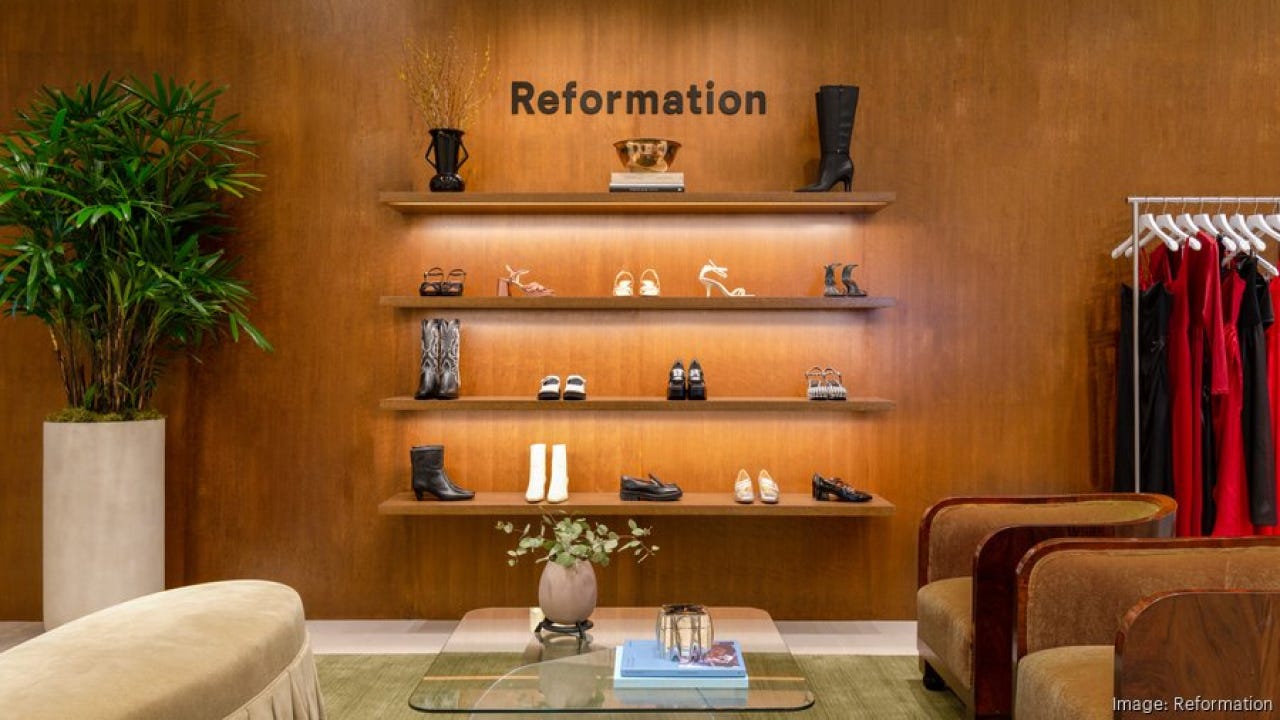
Reformation is a 90 percent DTC business, with e-commerce making up two-thirds of that, and it keeps opening stores, which looks like a contradiction until you see the math the company disclosed in its S-1, i.e., opening a store in a new market accelerated customer acquisition in that region up to 6x the following year. The store is not competing with the website. It is feeding it.
The reframe matters because the DTC era spent a decade treating physical retail as the enemy, and then spent the following five years discovering that renting awareness from Meta gets more expensive every quarter. Reformation’s answer is to give every channel one job, i.e., the storefront does the acquiring, functioning as the best ad unit the brand owns, a billboard you can walk into and try on, and the site does the conversion. For founders, the principle scales down cleanly, i.e., the pop-up, the market stall, and the single retail door are acquisition instruments, and judging them purely on four-wall revenue misses most of what they produce.
Every public fashion brand eventually faces the same pressure. A bad quarter arrives, and the fastest fixes are always available, i.e., discounts, outlet expansion, licensing deals, each of which trades brand equity for short-term revenue. That trade killed Calvin Klein, hollowed out Gap in the 2000s, and runs through most of the category’s obituaries, because the revenue shows up once, whereas the discount customer and the diluted positioning stay forever.

Reformation set the standard before the pressure existed. The company went public telling investors explicitly that brand is not an area of leverage, i.e., the brand will not be spent to make a number, in any quarter, for any shareholder. Whether that discipline survives the public markets is the real experiment here, and it is the one Skims, Quince, and Vuori are watching closely, because it tests whether a brand can compound equity in public rather than have it extracted. The principle underneath it is one I have written about through Charvet and Chick-fil-A, and it applies at every scale, i.e., the brands worth the most decided in advance what they will never trade, and made the decision before someone offered them a price for it.
None of the four plays requires Reformation’s size. Launching small and chasing demand is available to a founder with one production partner. Designing for retention is a product decision, not a budget line. Running physical spaces as acquisition works for a pop-up the same way it works for a fleet of stores, and deciding what you will never trade costs nothing today and everything later if you skip it.
What the IPO adds is proof that the market now pays for exactly these behaviors. The graveyard of the last four years is full of brands that ran the opposite playbook, i.e., big inventory bets, single-generation audiences, channel wars, and equity spent to make quarters. Reformation held its price at the bell on the strength of the boring numbers, and boring numbers, it turns out, are what durable brands produce.

Xx Camille
—
Want my team on your brand? Book a call here with Third Eye Insights, my international brand strategy and creative agency.
Apply my frameworks and teachings to your own brand with my Masterclass and Social Media & Brand Planners
Get the Friday debrief: Join my newsletter here for weekly inner circle content that keeps you winning.
Comments
Nothing yet. Say the first thing.
Sign in to join the conversation.