
News hit this morning that Béis sold to Samsonite for $210 million, and I suspect we are about to get a frenzy of content built around that number. What is fascinating is that the company sold for almost exactly what it made in revenue last year, roughly $210 million, which is a very different picture than the one everyone has in their head about celebrity brands right now. Rhode did $212 million in three years and sold for a billion. Nearly identical revenue, five times the multiple, and the temptation is to read that as Béis leaving money on the table.
I do not think that is what happened. Skincare and luggage are different businesses, and the gap between them is why this case study is worth examining.
Samsonite is reportedly paying $178.5 million in cash for 85%, funded from cash on hand and its revolving credit facility, with the deal expected to close in Q4 pending regulatory approval.
Béis stays a standalone brand under CEO Adeela Hussain Johnson and the existing team.
Shay Mitchell rolled over about half her equity, kept 15%, and stays on as leading creative.

Beach House Group, the LA incubator that co-founded the brand with her in 2018 and also built Pattern with Tracee Ellis Ross and Florence by Mills with Millie Bobby Brown, sold its entire 70% stake. Its biggest exit to date.
A customer buys a suitcase every five to ten years. A Rhode customer reorders the same treatment every six to eight weeks. When an acquirer buys a repeat-purchase business, they are buying an annuity, and when they buy a one-time-purchase business, they are buying an audience that has to be replaced from scratch every year.
Same revenue, entirely different asset.
Everything else about luggage compounds the problem. The incumbents have a century of retail relationships, airport doors, and sourcing infrastructure. The product is stubbornly functional, i.e., a suitcase rolls well and survives baggage handling, or it does not, which caps how far a story can carry before the wheels have to. And most people make one meaningful decision in the category per decade, so the brand has to be famous at exactly the moment a customer starts looking, and invisible-but-remembered for the nine years in between.
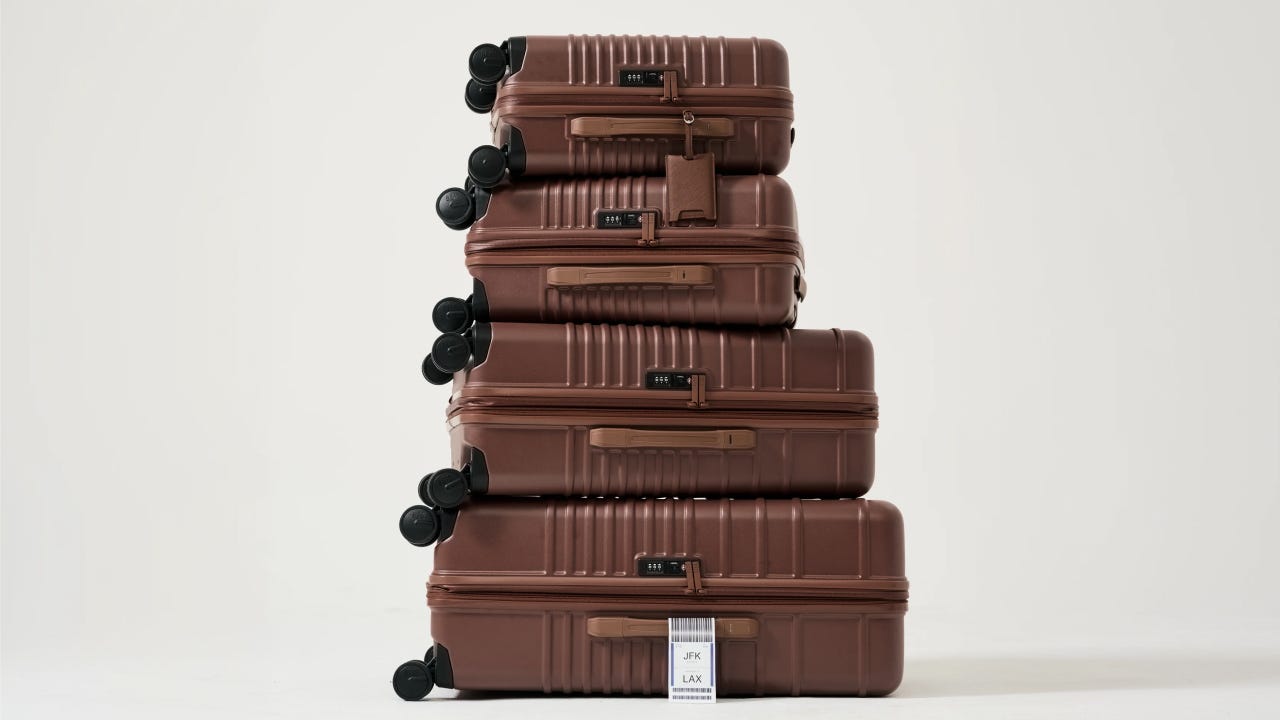
Which is what makes the achievement worth studying. Béis went into that category and built a $210 million business in seven years, profitably, with a $218 carry-on sitting next to Samsonite and Tumi products at $350 to $800.

Mitchell treated a functional category as a world, which almost nobody does in durable goods. The brand launched in 2018 on the idea that the customer is in motion generally, not just flying, so the range covered the gym bag, the road trip, the commute, the weekender, the diaper bag. That is a world rather than a product line, and it is what kept the brand present during the nine years between suitcase purchases.
Everything else came off that. The color drops gave a durable-goods category a fashion cadence. The pricing kept the world enterable. Mitchell is not a name on a product; she is the customer, and the two million-plus people following on TikTok and Instagram were following a person who travels rather than a company that sells luggage. The design language got identifiable enough that you can spot a Béis bag at baggage claim from across the hall, which is about as close to a moat as this category offers.
That is why the brand hit $210 million instead of $40 million. The execution was not the limit. The category was.
Samsonite dates to 1910 and has a relevance problem. Full-year 2025 net sales fell 2.5%. The Samsonite brand was down 10.5% in North America in the third quarter alone. Q1 2026 constant currency growth came in at 0.4%, i.e., flat, while the company pursues a US dual listing to lift its valuation. The press release says it plainly, citing Béis’s social following as aligned with strengthening digital capabilities.
Samsonite has distribution, sourcing, and scale Béis could not build in another decade. Béis has cultural presence Samsonite has not been able to manufacture at any level of spend. Each side bought what it could not build, which is the only kind of acquisition that reliably works.
Here is the part that applies beyond this deal.
Most founders benchmark against whatever number was loudest that quarter. Rhode sold for a billion, so a billion becomes the target. But a multiple is not a scoreboard; it is a description of what the buyer is actually acquiring, i.e., how often the customer returns, what the margins look like, how defensible the position is, and how many credible buyers exist when you decide to sell.
That last one matters more than founders realize. Rhode had every beauty conglomerate in the world as a potential acquirer, and competitive tension is what produces a premium. The list of companies that could credibly buy a luggage brand at scale is short, i.e., Samsonite, LVMH through Rimowa, maybe Tapestry or Away. A thin buyer pool sets a price ceiling no amount of brand equity overcomes.
Chasing someone else’s multiple does real damage. It pushes founders into categories where they have no advantage, or it convinces them to hold out for a number their category will never produce until the window closes and the offer gets worse.
The benchmark that matters is internal. How far is the ceiling in the category I am actually in, how close am I to it, and what would it take to move it? Béis got remarkably close and sold to the buyer best positioned to raise it, with the founder still in the building.
Effectively, none of this means anything without the structure underneath, i.e., purchase frequency, margin, category size, defensibility, and how many credible buyers show up when you sell. A billion-dollar exit in consumables tells a luggage founder nothing, and chasing it produces real damage, i.e., launching into categories you have no advantage in, or holding out for a multiple your category will never produce until the window closes.
The benchmark that matters is internal. How far is the ceiling in the category I am actually in, how close am I, and what would move it? Béis got remarkably close and then sold to the buyer best positioned to raise it, with the founder still in the building.

Béis built a $210 million business in seven years, profitably, and exited to the largest luggage company in the world with its founder still leading creative. That is a win by any measure, and the lesson underneath it is the question most founders never ask, i.e., how often does your customer come back?
Know whether you are in a repeat-purchase or a one-time-purchase business before you build anything. That single fact shapes your valuation, your acquisition math, your marketing budget, and your exit, and it gets decided the day you pick the category.
If the product is not repeatable, build the repeat into the brand. This is the Béis lesson and the most portable one, i.e., the accessories, the adjacent categories, the community, the reasons to be in the customer’s life between the purchases that count. A world keeps you present during the nine years the product cannot.
And know what is actually defensible. Taste that can be photographed can be copied, and Béis lookalikes were on Amazon within a season of every launch. Rhode owned formulation. Charvet owned 188 years. If the honest answer for your brand is aesthetic alone, the ceiling is lower than it looks, and the negotiating table is a bad place to find that out.

Thanks for reading,
Xx Camille
—
Want my team on your brand? Book a call here with Third Eye Insights, my international brand strategy and creative agency.
Apply my frameworks and teachings to your own brand with my Masterclass and Social Media & Brand Planners
Get the Friday debrief: Join my newsletter here for weekly inner circle content that keeps you winning.
Comments
Nothing yet. Say the first thing.
Sign in to join the conversation.