
You think you're working toward the same goal, but something feels off. Discussions happen, decisions are made, yet execution falls apart. People nod in meetings, but once they leave, they act based on their own understanding—which often isn't aligned.
Why? Because not everyone sees the full picture.
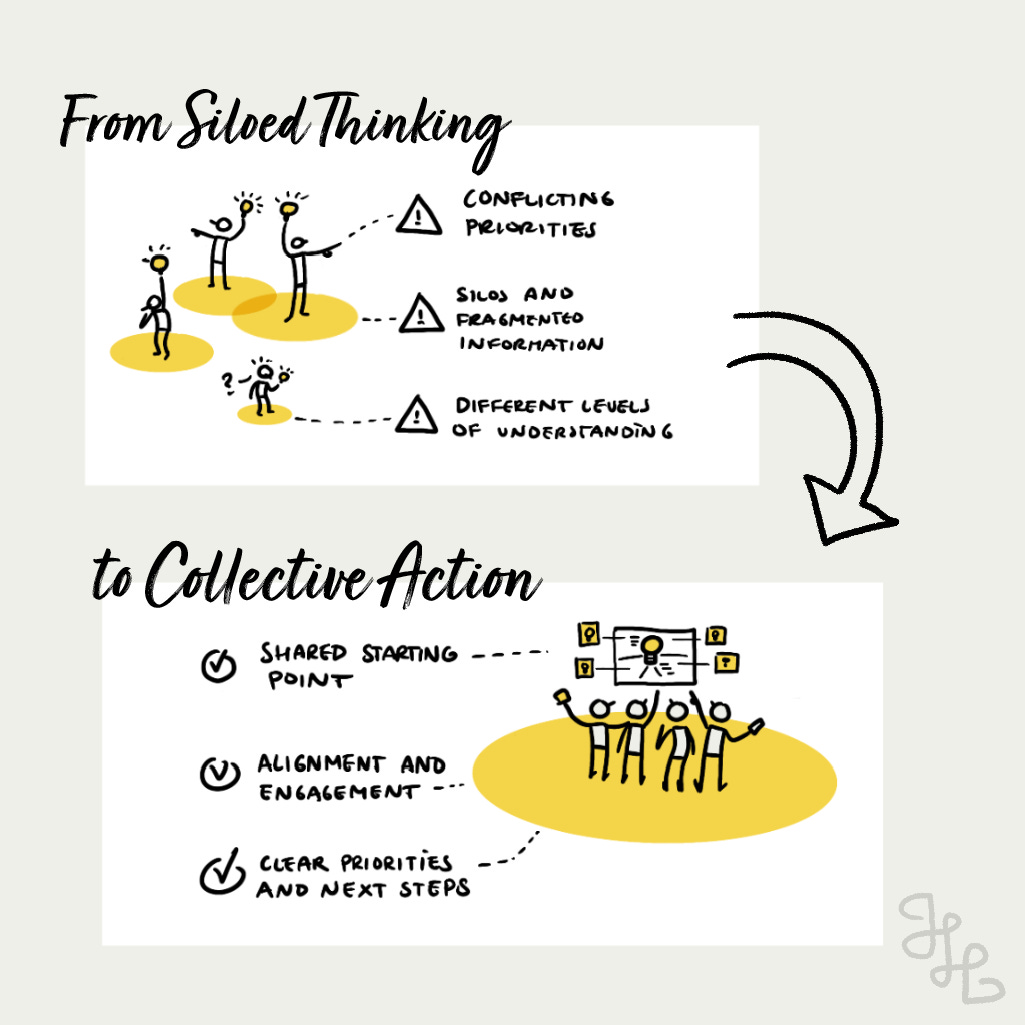
⚠️ Conflicting Priorities – Different teams focus on different goals, leading to friction and slow decision-making.
⚠️ Silos and Fragmented Information – Crucial insights stay locked in departments, preventing a shared understanding.
⚠️ Different Levels of Understanding – Some stakeholders grasp the details deeply, while others struggle to connect the dots.
⚠️ Lack of a Shared Vision – Without a common goal, alignment is temporary, and execution lacks direction.
The result? Frustration, slow progress, and missed opportunities.
Stakeholder alignment isn’t just about getting people into the same room—it’s about making sure they leave with the same understanding. And that requires more than just words.
Visual Thinking helps break through these barriers. By mapping out different perspectives, you create a shared starting point, ensuring that:
✅ Everyone sees the same reality – No more conflicting interpretations of the challenge.
✅ Alignment happens faster – When people visualize a problem, they engage more deeply and get on the same page.
✅ A shared vision emerges – Once the current state is clear, teams can co-create the way forward.
✅ Priorities become actionable – With alignment on the destination, the next steps become obvious.
A well-crafted visual doesn’t just illustrate ideas—it shapes understanding and drives action. And when people truly understand, they commit.
So next time you find your team stuck in endless discussions, ask yourself:
Are we actually seeing the same challenge?
Is our information fragmented across different teams?
Do we have a clear and shared vision of success?
If not, it might be time to put the pens (or digital styluses) to work. Because when you can see it, you can solve it.
No posts
Comments
Nothing yet. Say the first thing.
Sign in to join the conversation.