
For decades, Human-Centered Design (HCD) has helped us build products that feel intuitive, engaging, and rewarding. It’s about making things frictionless, enjoyable, and easy to use. And yet, looking at the bigger picture, I wonder: does Human-Centered Design still serve us as human beings?
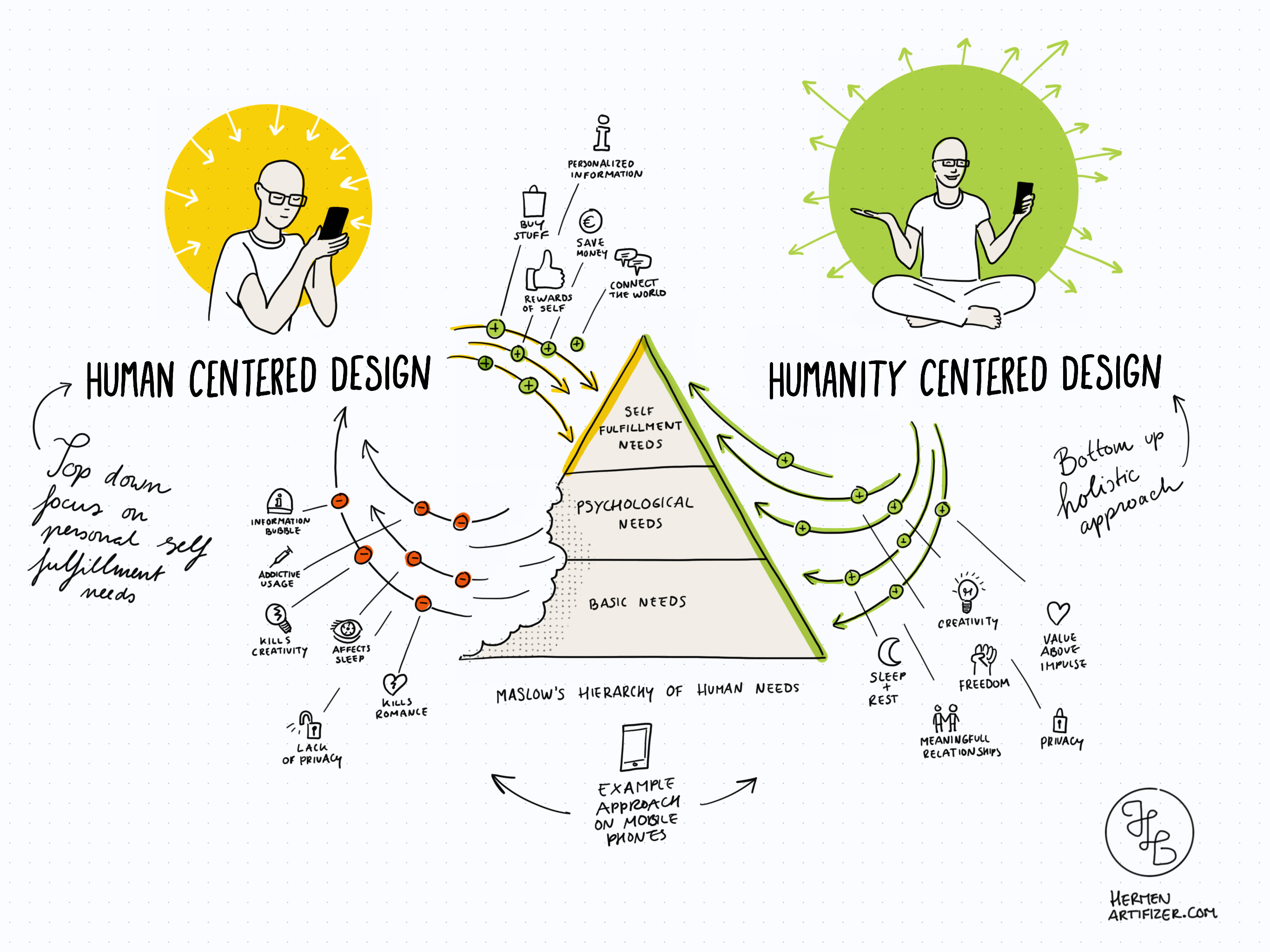
This is exactly what my drawing explores.
On the left, we see Human-Centered Design at work—a person immersed in their phone, surrounded by an inward pull. HCD, in its current form, often operates top-down, catering to personal self-fulfillment needs while neglecting the broader impact. It feeds into our natural cravings for dopamine, validation, and instant gratification—all of which are deeply ingrained survival mechanisms.
The problem? These same biological drivers that once helped us thrive are now being hijacked.
🔁 Endless scrolling taps into our brain’s reward system.
🔔 Notifications create a cycle of anticipation and dopamine hits.
🛍️ Personalized nudges trigger impulse-driven behavior.
We’re designing not just for humans—but for human weaknesses.
Now, contrast that with the right side of the drawing: Humanity-Centered Design—a person in balance, surrounded by an outward energy. This approach takes a bottom-up, holistic view, focusing on foundational human needs rather than just momentary desires. It prioritizes:
✅ Creativity over consumption
✅ Privacy over surveillance-driven personalization
✅ Rest and deep thinking over constant stimulation
✅ Meaningful relationships over algorithm-driven engagement
Maslow’s hierarchy of needs sits at the center of this tension. HCD often jumps straight to self-fulfillment (the peak of the pyramid), while skipping the foundation. Humanity-Centered Design, however, starts at the base—ensuring that what we create actually sustains and supports us in the long run.
So here’s my question: Are we still designing for people, or are we just designing for what keeps them hooked?
If Human-Centered Design has brought us to where we are today, maybe Humanity-Centered Design is what we need to get us to a better future.
I’d love to hear your thoughts!
No posts
Comments
Nothing yet. Say the first thing.
Sign in to join the conversation.