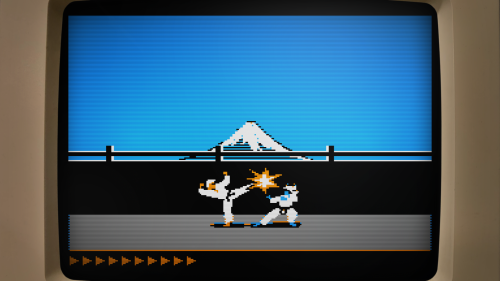
I never played Karateka in the 80s, but as a big fan of Prince of Persia and Jordan Mechner’s journals, I was stoked to hear that an interactive documentary about Jordan’s prototypical cinematic platformer was in the works by Digital Eclipse.
Released this week, The Making of Karateka on the surface looks like any other game you buy through Steam ($20, Windows-only), GOG, or whichever favorite store or console you prefer (available also for Xbox, PS4/5, Switch). Once the thing loads though, you really get 3 things: a documentary, the original Karateka, and a new remaster.
The documentary part is an audio-visual slideshow retelling Jordan’s development story starting with his teenage years pitching his earlier title Deathbounce to the publishing house Brøderbund. It’s an interesting look into the iterative process, seen through correspondence letters, journal entries, and many playable builds at various stages of completion. After we reach the eventual rejection of that title, Jordan comes back with a prototype of a visual-narrative experience unseen on home computers. We get to follow Karateka’s full life cycle from pre- to post-production, ending with the conception of its sequel (which eventually turned into Prince of Persia). It’s a real treasure trove! Fellow pixel artists will appreciate the many graph-paper sketches and interactive overlays of final game sprites compared to rotoscoped outlines and filmed footage. There are also video segments, from a comprehensive breakdown of the music to interviews with other developers reflecting on the impact Jordan’s games had on their careers. You’ll even encounter a fan letter signed by the one and only “John Romero, Disciple of the Great Jordan and worshipper of the Magnificent Mechner!” (I kid you not, you can’t make this stuff up).
Perhaps just as crucial for an interactive documentary like this, you can launch any of the floppy disks in the emulator, trying out various iterations and ports of Karateka.
The emulation is fantastic and lets you fiddle with display settings (monochrome or color display, scanlines, pixel perfect or zoomed) as well as enhance the frame rate. You can even rewind the many deaths you will face if you’ve never played the game before (like me). If you spend some more time obsessing over the weird artifacts of the Apple II hi-res graphics, you might even go down the rabbit hole of realizing that on the Apple II you didn’t really paint colors as much as you used different monochrome dithering patterns that the graphics display would then turn into 4 different hues. A fascinating learning experience if you include some of your own research online!
Add to this the Commodore 64 and the Atari 8-bit versions to compare how the graphics got adapted across the earlier ports and you have a nice way to relieve the mid-80s with a bit of help from modern emulation (I did beat the C64 version without rewinding though!). I’d love to see more art from the other remakes, especially the 16-bit Atari ST port, but I understand their decision to omit playable versions of those due to the lower quality on the gameplay side of the translations.
This brings us to the final part of the package, the modern remaster. Unlike the 2012 complete reimagining of the game (with 3D graphics and all), Digital Eclipse approached the remake as the ultimate port of the original to an imaginary system along the lines of a 90s VGA PC.
It’s well done. Some of the fully-redrawn scenes are a bit overpainted for my taste (I’d prefer a pixel art rendition of the castle than a blurry photographic collage, although there were many games in the 90s that did take this approach), but the in-game graphics are really in style, including the smooth animations that are like one would imagine granted a beefier CPU. It’s also a sort of director’s cut with previously unseen scenes added, in particular, the battle with the leopard as a clever action-puzzle in the middle. The AI is unfortunately even less challenging than Jordan’s implementation. As great as the 6-move fighting system could have been, you yet again resort to simply kicking away opponents as they tirelessly crawl into your range. There isn’t even the nuance from the original where you were the one who had to approach some enemies with skilled timing. On the other hand, you now have optional goals and achievements that make the repetitive/easy combat work in your favor (stringing various combos, beating opponents or the level under a time limit …). As the Digital Eclipse president Mike Mika admits at the end of the welcome commentary mode, they didn’t manage to achieve their perfect port, but they did come close.
In conclusion, I thoroughly enjoyed playing both the original as well as the remake and while the combat system lacks any sort of depth beneath its stunning animations, Karateka is instead a monumental experience for its presentation. Big characters with personality and realistic motion are displayed through cinematic camera cuts and story vignettes (3 years before Ron Gilbert came up with the word “cutscene”). There are details like animating the unfortunate falling off the cliff at the start of the game, or respectfully bowing to the first guard as they bow in return. Jordan’s creative work is precious and worth the attention this release gifts it.
I highly recommend The Making of Karateka to all retro gamers and/or game developers for its immersive documentation which provides an experience that goes beyond the usual video documentaries. It’s interactive—just like the subject it’s talking about—something I want to see more in the future. And if the $20 by any chance seems high to you, consider that the original retailed at $35 (and that was in 1984 dollars).
If you haven’t heard yet, Apogee is back! They announced their return to publishing back in April with a combination of new titles and remasters of their classics. They already released Crystal Caves HD back in October last year and I was very happy about it since a good buddy of mine, Primož from Emberheart Games (Courier of the Crypts), made the conversion.
This week another Apogee remaster was released, Secret Agent HD! The classic title from 1992 was drawn by George Broussard and now comes with spruced up colors thanks to Primož.
That’s what I love about Emberheart Games’ remakes, they’re remasters with a wider palette, but otherwise stick to the original pixel art. Just like Crystal Caves HD, the new Secret Agent also comes with a bunch of other goodies like smooth scrolling and movement, a level editor, a completely new episode with more enemies …
If this brings out a tear of nostalgia, you can relive your childhood memories on Steam or GOG ($8).
As for Primož, he’s already working on the next remaster, Monster Bash HD! Check out the Emberheart Games Discord to stay in touch.
I was a big fan of Antoine ‘Sir Carma’ Lendrevie’s voxel art ever since I wrote my big article on pixels and voxels in 2016. Not long after, Antoine moved to Vancouver—the home of Brace Yourself Games—and started working as lead artist (and now art director, among other artists) on the simulation/strategy game Industries of Titan.
What followed were 4 years of patiently looking at cubes being carefully arranged into delicious dioramas on his Twitter, merging slowly into vast sci-fi cityscapes you can marvel at in the screenshots above (make sure to see them up big to take in all the voxel detail).
Finally the good news, you can now start colonizing the largest moon of Saturn yourself, as Industries of Titan landed in early access yesterday on Steam and Epic!
Since Lospec launched in 2017 with its limited-color palettes list, the site quickly grew into the best resource for digitally restrictive art as it elegantly calls art forms such as pixel art, voxel art, ASCII/ANSI, low-poly 3D, chiptune and anything else digital that purposefully uses restrictions, often inspired by technologies of the past.
After adding an extensive database of pixel art tutorials and many other features such as an online pixel art editor, a merch shop, and user accounts, the site’s creator Sam ‘@skeddles’ Keddy would like to go into full-time development on the next big feature, the Lospec Gallery.
The idea is to have all the pixel-art-specific features of galleries such as Pixel Joint (sharp pixels with integer magnification scales), but open to everybody without purist requirements, as well as extended to other digitally restrictive artworks that also lack a dedicated place on the web.
Check the video on top for details or hop directly over to the Kickstarter campaign where you can show support for this very much welcome effort for our community. The project’s base funding has already been reached, but plenty of stretch goals remain for things to get even better (2021 release date, 3D and audio display types, personal portfolios, collaboration features, an API …).
I promised one more thing from Ultimate Pixel Crew yesterday. As much as permanent teams are not common in pixel art (I can only think of eBoy off the top of my head), the advantage is clear if you want to tackle bigger projects. Game companies sometimes have a lasting core of pixel artists, but it’s more common to outsource the work to a band of freelancers that stick together for just one project (or even less). We’ve had music videos created in this way as well, for example Goldfish’s We Come Together had a team of 15 working on it. Today we’ll look at a smaller production though, coming from an established team.
Ultimate Pixel Crew, specifically @motocross-arts and @setamo-arts, early last year created a video for SKY-HI’s song Role Playing Soldier. The lyrics, neatly supported by gaming-themed visuals, tackle the often absurd nature of RPGs where the player essentially grinds their way to the end by killing and looting a never-ending wave of enemies. The meaningless task is questioned in the music video by both the player character and a melancholically-woke monster that is tired of the mindless violence. Where Elvis and Dimmi gave a satirical take on the same topic, Motocross Saito and Setamo paint a more positive resolution. I’ll let you find it out yourself in the video that clearly gives a nod to Hyper Light Drifter as well:
One of my favorite things of 2019 was—surprisingly enough—a mobile app! Less surprisingly, it included mesmerizing pixel landscapes painted in the 90s by Mark Ferrari (Loom, The Secret of Monkey Island, Thimbleweed Park) for a calendar/organizing software called Seize the Day. What set Seize the Day apart was its ‘living worlds’ art—specially made illustrations for each of the 12 months of the year.
Now, before you say you’ve seen these images a hundred times already (as they often circulate the web), unless you’ve been around in the 90s, you haven’t seen all the special effects incorporated into the software. You might have seen the GIFs of the scenes with animated snow, rain, and waterfalls, and at best you went to the HTML recreation of the images where you could change the time of the day with a slider. While that’s immensely impressive as it is, there was even more to the art. Sizzling chimney smoke, beautifully shaded clouds, changing weather, lights turning on and off, fireflies flying around, luminescent fish, people with torches walking across a bridge in the evening, even auroras borealis!
Over the course of 2019, Ian Gilman, one of the authors of Seize the Day, painstakingly recreated all the extra effects within a mobile app called Living Worlds - Art by Mark Ferrari. At the start of each month we’d get a new masterpiece, which I’d leave idling on my iPad, quietly brightening my workspace. The amounts of joy this would bring me was quite unexpected (although, now that I think about it, not many things make me happier than beautiful pixel art).
So yeah, if you have a tablet and you know what’s good for you, you can get the app yourself for iOS or Android and make 2020 as happy as 2019 was for me.
Anyone wants a copy of @kronbits’ PixaTool? I have two keys to give away, message me. Keys have now been claimed.
Otherwise it’s on sale right now on itch.io for $10 ($28 otherwise). You can get some decent results with it if you play long enough (kind of like Photoshop, if you know what you’re doing).
It doesn’t have any automatic filters (a la Instagram) that would make things look great with a press of a button. For that you can check out Retrospecs (iOS only).
Gorgeous environments by Soren Huges a.k.a. @tallsoren. Pixel art is a bit of a departure from their usual illustration and animation style, but as you can see, we’re in for a real treat. Even more so, since the backgrounds come from an upcoming game by Meredith Gran, the creator of the much loved webcomic Octopus Pie. After a 10-year run of the comic, Meredith’s next project is a point-and-click adventure game Perfect Tides.
The story will be character driven, following a teenager growing up around year 2000 in those sweet early internet days of IRC, MSN messenger, Geocities, and AOL emails. Don’t expect to live a life in the browser though—instead you will see your surroundings (and the protagonist) change through four seasons, exploring a fictional island placed in North-East USA. As it usually goes with teens, I expect a story about growing up and discovering yourself.
I really like how Meredith is producing the project. A Patreon campaign from the days of Octopus Pie has been transformed to support Perfect Tides and allows Meredith to work full-time on the game, no matter what else happens. The else part refers to the recent launch of a Kickstarter campaign that will cover additional production such as Soren’s backgrounds and an original soundtrack. It’s not like the funding won’t succeed (it’s well on its way already), but it’s nice to see someone that has a sound plan to finish the game without needing side gigs or publishers, even in face of delays (which, let’s face it, no game escapes from).
I’m looking forward to beautiful island scenes, relatable narrative, and gameplay that doesn’t involve jumping on enemies’ heads. Take a look at the video and chip in for the project yourself on Kickstarter.
Hello everyone, I am Matej Jan a.k.a. Retro. Welcome to Retronator—my blog and game development studio.
I started Retronator in 2007 with the goal of making video games focused on
creativity. Along the way I started writing about art and gaming, featuring artists and projects that
caught my attention. Nowadays this mostly includes pixel art, with occasional diversions into voxels,
low-poly 3D, low-res digital painting, and basically anything that makes me feel like a kid again
(text adventures, chiptune, LEGO …).
I'm also very nostalgic about 20th century games that didn't neglect their educational potential.
I expected titles like Sim Ant, Caesar II, and Sim City to continue into the future, expanding their
power to teach us something along the way. Games such as Kerbal Space Program and ECO continue to carry
the torch, but are far in between in the current gaming landscape. Expect Retronator to cover more
games like that in the future.
Finally, on these pages I document my own journey as an illustrator and game developer. I'm working
on an adventure game for learning how to draw called Pixel Art Academy. This newspaper lives
in the game world and I'll make that quite obvious soon. Thanks to backers of the game and supporters
on Patreon I can create this content full-time. Thank you for making this possible!
It's been 10 years since I started this journey and there is no doubt the next 10 will be
absolutely amazing. Stick around and I hope you will enjoy the ride.
Happy pixeling, —Retro
Notes from Retronator Store customers
To leave a note, include a tip when checking out in the store.