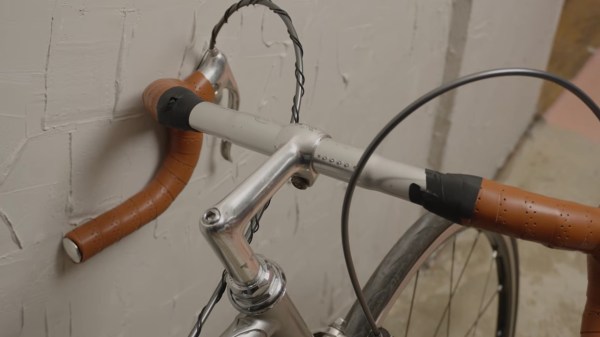
Brown wrapped chrome handlebars leaning against a light grey wall. Near the stem, a series of four small pins protrude from the bars to indicate a full battery charge of 100%.

Sleeper E-bike Has Solenoid Display

[GRMNT] decided to bring his grandpa’s beautiful road bike into the future by making a sleeper e-bike conversion.

Going into the project, [GRMNT] didn’t really know what he was working with, but it turned out grandpa had good taste and was rocking a Bianchi. No stovepipe bike boom stuff here, only high quality Tange steel. After cleaning off the years of grime, it was time to rebuild a second-hand Bafang mid-drive electric motor for the electric boost for the ride.

We really like the custom solenoid-powered display that [GRMNT] built into the handlebars for an excellent electromechanical readout of the battery charge. Coupled with the hand-built battery pack inside a leather case and hidden motor actuation button, this build looks slick without screaming e-bike.

We’ve covered some other conversions in the past including this one using an electric skateboard motor or this plug-and-play kit. If you’d rather power things with your bike, you’ll like this hack that can make everything bike powered.

Continue reading “Sleeper E-bike Has Solenoid Display”

Historical Hack: Henri Giffard’s Steam Injectors

Here’s a historical hack for you: you have a big, rolling pressurized kettle, also known as a steam locomotive. It needs water to make up for the steam constantly chuff-chuff-chuffing away, or bad things happen. How do you get water from an unpressurized tender into a high pressure boiler with no moving parts? What you need is a some way to inject steam with no moving parts — a steam injector, if you will. [Marc Flint] found that the steam injectors were the hardest part of a loco to understand, so he made a video for all of us once he’d figured it out.

The steam injector isn’t a new idea. [Henri Giffard] came up with it back in the 1850s to replace expensive and maintenance-hungry pumps. It’s rather ingenious and uses the fluid mechanics uncovered by another European bloke by the name of Bernoulli. First, the high-pressure steam from the boiler goes through a converging-diverging nozzle to drop its pressure and speed its flow up, just as you’d guess if you’ve seen Bernoulli’s laws. Even more vacuum-inducing is the presence of water: the steam, already cooled by its expansion, hits the water in the pipe open to the tender, and condenses into it, shrinking a couple of orders of magnitude, creating a vacuum that draws in no small quantity of feed water. That one we did not expect from Bernoulli, but it makes sense. So how to get from below atmospheric pressure to the 180-odd PSI or more in the boiler?

Well, the water is now moving at a good clip, between the Venturi effect and the momentum gained from absorbing that steam, so another converging nozzle is the trick. Bernoulli’s law, once more! A one-way valve lets the now-pressurized water into the boiler, with a gap in between to dump water while the pressure builds up. It’s a clever trick, and since the steam coming from the boiler makes it back inside along with at least some of its heat energy, it’s much more efficient in both coal and water than running a pump. It’s also a bit of a head scratcher how it works unless someone sits you down to explain it, so we’re glad [Marc] did.

Not many of us are likely to use this knowledge directly — unless we’re firing up a 90 year old boiler or building a new steam locomotive — but seeing how great engineers of years past made use of basic physical laws can serve both as education and inspiration.

Continue reading “Historical Hack: Henri Giffard’s Steam Injectors”

Edison Motors Offering All-Mechanical Trucks, At Least To Start

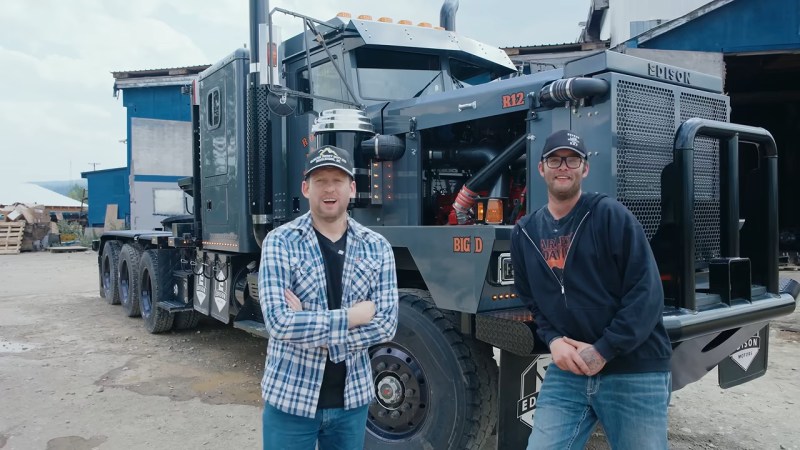
We’ve been following Canadian startup Edison Motors for some time now, but their latest offering caught us a bit off guard — their BDE series truck will be offered first without the electric hybrid drive that first piqued our interest. They make a good case for why in the video below, in which the production prototype tows around a junked Nikola semi as a sort of memento mori of what Edison does not want to end up as.

Now, make no mistake: Edison Motors is going to be selling the series-hybrid version of these big rigs eventually. That truck will have a Scania diesel rated at 500 kW driving electric motors rated at a combined 1800 kW peak power — that’s 2400 ponies. Along with the diesel generator those ponies will be driven by a big o’l battery, but none of that is in the truck in the video. It’s the same cab, and the same frame, but in order to get some revenue in while jumping regulatory hurdles and working the kinks out of the hybrid drive, they put a conventional Cummins diesel and 16-speed transmission in the “Big D” as the truck is known.

The business case makes sense: they don’t want to have their single new product hit a snag, possibly require a recall, and fall into bankruptcy the way the electric truck company Nikola did. The conventional drivetrain also lets them prove their engineering prowess to companies that might like the idea of a Made-in-Canada truck, but be nervous about new technology from a new company.

If you want to know more about the whole diesel-electric scheme, we covered that last year. Edison also has plans to offer its hybrid drive technology for smaller trucks in kit form, which is perhaps the most exciting part from a hacker perceptive.

Continue reading “Edison Motors Offering All-Mechanical Trucks, At Least To Start”

Building A Bicycle Dropper Seat Post

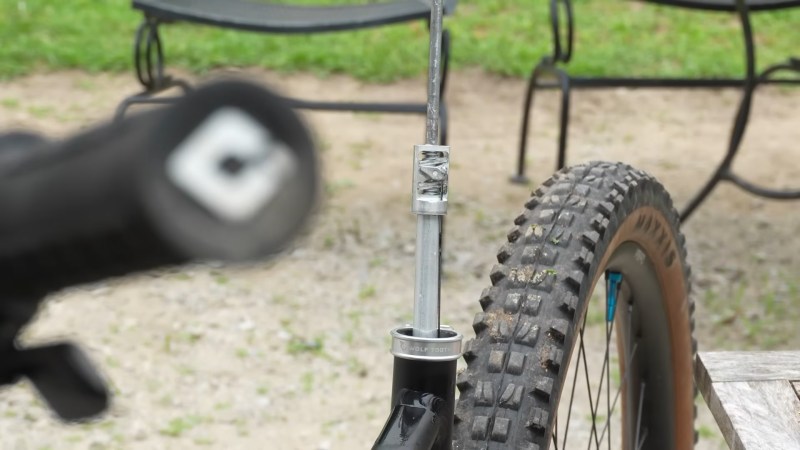
A recent addition to mountain bikes is the dropper seat post. This invention is in the vein of office swivel chairs, allowing the seat height to be adjusted with a simple handlebar mounted lever. They are rather fascinating inventions ranging in complexity from simple mechanical systems, to electronic monstrosities actuated by Bluetooth. Inspired by the panoply of possibilities, [kane components] set forth to create such a home-built dropper post. 

Inspired by woodworking bar clamps, [kane’s] design utilizing angled plates binding against a rail inside the dropper post. Two pairs of plates sitting at opposite angles resist opposite forces from either the rider sitting on the post, or the return spring. A simple cable actuated cam moves the plates to a nonbinding position when the lever is actuated, and springs return the plates to a binding rest-state. The return is handled by an air spring pressurized against a piston at the bottom of the shaft.

Continue reading “Building A Bicycle Dropper Seat Post”

3D Printing A Usable Airless Tire

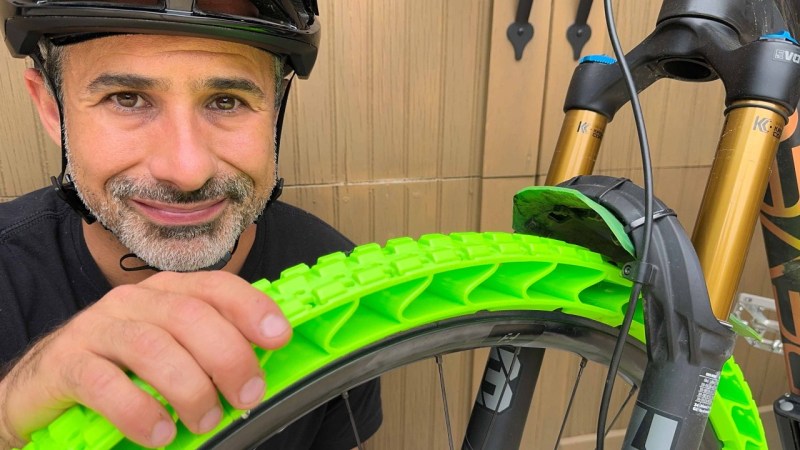
For decades now, companies like Michelin have been teasing us with futuristic-looking automobile tires that don’t use air. Instead, they use a polymer mesh of sorts which maintains the same pressure on the travel surface that a pneumatic tire does, with much less maintenance than their pneumatic counterparts. At least, in theory. There’s a reason that these tires live in the same mythical realm that Half Life 3 and the modern affordable Volkswagen do, and [Berm Peak] decided to discover those reasons for himself.

Of course, [Berm Peak] isn’t building these for his daily driver, an electric pickup truck featured in previous videos of his. He’s putting these on his mountain bike instead, a challenging environment for a tire like this in its own right. When mountain biking at the level he does, punctures and flats can become a real nuisance on the trail, so he set about experimenting with these designs with the 3D printer to see if he could make something rivaling pneumatic technology. After a few design iterations he settled on a TPU-based version with a compliant S-shaped spacing between the tread and wheel. The tire printed in sections that are installed by joining them together on the bike rim with a separate 3D printed rim interface.

At the end of this process [Berm Peak] ends up with a surprisingly capable tire that mostly holds up to his extreme off-road testing, an impressive feat for something 3D printed in his shop. Presumably a company specializing in bicycle tires could build something even more capable, but it turns out that a different technology has already solved all of the problems that airless tires solve. Mountain bikers today almost exclusively ride on tires with sealant, so punctures and flats are essentially a solved problem. But the neon-green airless tires were still a fun project for [Berm Peak] and quite the head-turner out on the bike trails.

Continue reading “3D Printing A Usable Airless Tire”

3D Printed Go Kart Designed To Fit In A Suitcase

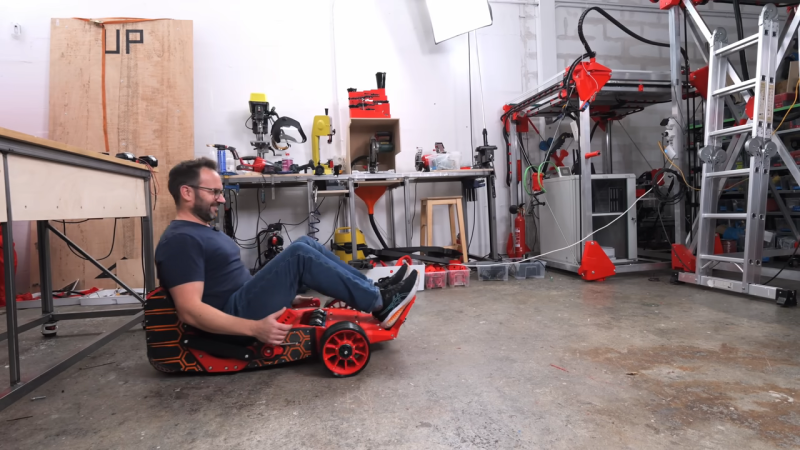
[Ivan Miranda] is famous for his large-scale 3D printed vehicles. They’re pretty fun, but they’re also pretty big and heavy—which can make transporting them around rather impractical. Hence, when he had reason to travel with a 3D printed go kart, he went back to the drawing board to create something light enough to pack in regular plane luggage.

The build started with some major compromises compared to [Ivan]’s previous go kart build. Notably, there are only three wheels instead of four, and a simplified control layout that eschews a regular steering wheel. These decisions were made to save weight and allow the design to be more compact. The kart uses a set of handles either side of the rider to handle steering. Drive is via a brushless motor, with power supplied from a series of 18 V drill batteries. Parts were produced on [Ivan]’s massive printer which comes in handy on large-scale projects like these.

All in all, the final build weighed around 20 kg. That’s light enough to be broken down across checked luggage and carry-on for a typical flight. We’d consider the project a success on that basis, even if quite a bit of assembly was required upon arriving at the destination. [Ivan]’s other builds in this realm are pretty fun too, from the printed scooter to the ride-on tank.

Continue reading “3D Printed Go Kart Designed To Fit In A Suitcase”

A black pickup sits in front of a snow-capped mountain range in the background. It has a white camper shell with a sci-fi looking "01" emblazoned on the side in black text. An orange, wedge-shaped tent pops up above the campershell and truck roof.

A Pop-Up Truck Camper For Less

We live in a veritable Cambrian Explosion of camping options, ranging from a tarp on the ground to multi-million dollar RVs. Somewhere around the middle is the pop-up truck camper, but [Further Fabrication] wanted to build his own.

As is often the case, he saw the cool pop-up truck campers on the market, but balked at the cost. To make matters worse, the options out there weren’t really available in his country. After getting a solid set of measurements from the truck and some materials, he set to work.

The most interesting part of this build is probably the aluminum/plywood sandwich [Further Fabrication] chose for building the main structure of the camper shell. While many would’ve chosen a tubing space frame for the build, he decided to sandwich two layers of plywood around plywood beams and large rectangular aluminum tubing. These were affixed with a combination of construction adhesive and screws to create a lightweight yet sturdy enclosure.

The tent portion uses a 600-denier PVC-coated waterproof polyester fabric, sewn with nice YKK zippers, and features large windows with screens for excellent ventilation. The roof consists of two sections of aluminum composite sandwich, and the side panels were made from cutoffs of the roof material. Instead of the standard cam-lock used on most camper shells, [Further Fabrication] chose a solenoid-actuated system and more conventional grab handles.

We’ve covered campers several times, including a solar-powered RV, a truck camper that expands lengthwise rather than up, and several bike-based campers.

Continue reading “A Pop-Up Truck Camper For Less”