
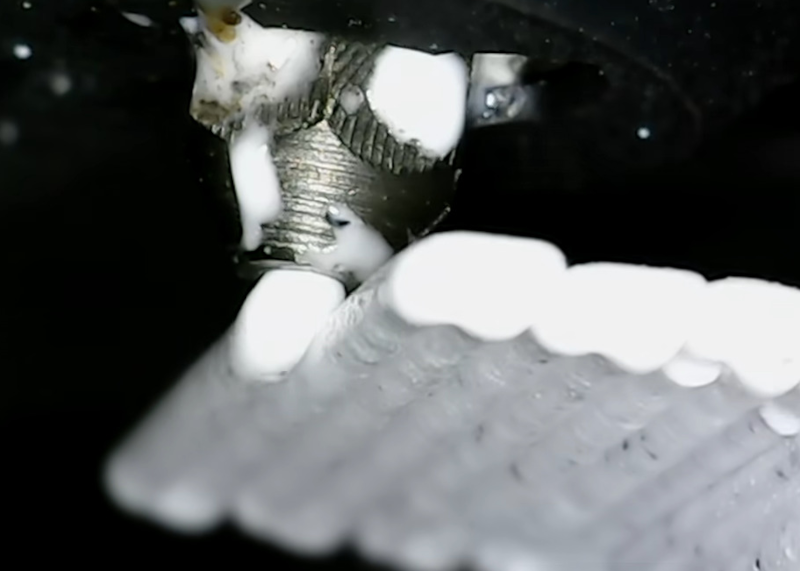
We’ve heard of wave overhangs before. It is a new technique for printing horizontal overhangs with no supports. Building on some other techniques like arc overhangs. The idea is to teach the slicer not to try to draw overhangs in the middle of free space. Instead, when the slicer realizes there is a horizontal overhang, it tries to “grow” the overhang from the main part. You can see an overview in the video below.
For example, imagine printing a letter ‘T’ vertically. The stem of the T is no problem, but when you try to print the arms it will normally need support. But if you could just print the arms starting at the stem with slight overlapping, the arms could grow as they hang onto either the stem or the last overhang line.
That makes sense, but it only works for very simple cases. Arc overhangs can fill more complex cases, but suffer from little dimples at the center of each arc. The realization for wave overhangs is to replace the arcs with waves as you would see in a pond. The waves diffract around holes and corners.
Perfect? Not quite. They are still experimenting with settings, but there seems to be some increase in warping. If you want to experiment, you can download a fork of Orca and contribute your results to the community.
We looked at this technique earlier, but we haven’t seen much about it in practice yet. Let us know in the comments if you’ve tried it and how it worked for you. There are more details in the paper on the subject, or you can jump right to the software.










This looks very promising! I think it can be even used to generate slight negative overhangs as the printhead can simply gradually move down as it gets farther from the “edge”. I don’t know what kind of math wuold be involved, but with a 3D printing pen I could demonstrate it, I guess.
Negative overhang would be limited by the cone made from touching the tip of the extruder to the widest/lowest edge of your hot end. Though you might be able to go low enough to counteract the curl demonstrated in the video.
a neat hack but a nit about the write up…the stem of the T is not “no problem”. towers also showcase weaknesses of most FDM printers.
I had a printer I built once that was extremely good at this, but entirely by accident. I should have looked into that more..