
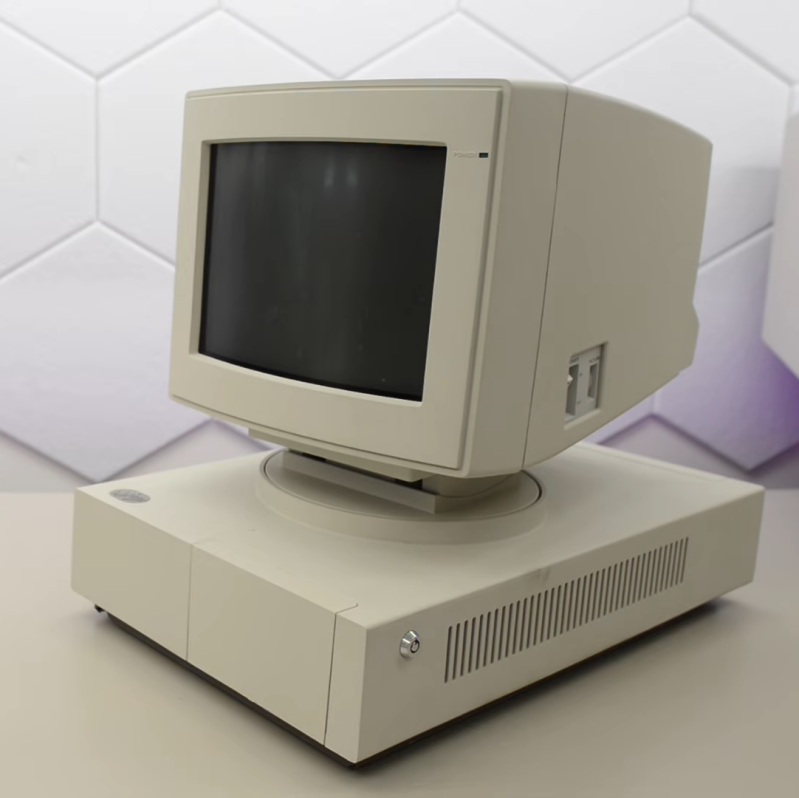
[Epictronics] happens to have a rather special machine in his possession. It’s a rare IBM PC prototype or concept machine from the late 1980s known as the IBM 7496 Executive Workstation. It’s a striking thing, with a rather enticing case design that has the monitor permanently attached on a nifty swivel mount. Only… the machine wasn’t working, so some repairs were in order!
The video is essentially teardown that gives a wonderful look at the internals of this oddball machine, which differs rather a bit from more mainstream IBM product of the era. The video is also about repairs and upgrades, too. The real work begins with pulling out the 720K double-density floppy drive, which has a number of faults preventing it from working reliably. Running a machine off floppies alone is as frustrating today as it was back then, so [Epictronics] goes further by adding in an XT-IDE card to allow the machine to interface with a hard drive. An AdLib clone soundcard completes the upgrades to make this unique unit as capable as you’d want it to be given those industrially good looks. The machine has the obscure, shortlived MCGA graphics subsystem, which really fits its oddball nature, but it will nevertheless play a fair few games of its era if such is demanded of it.
If you’re a fan of the early days of the IBM PC, or you just like watching retro computers pulled apart and delicately put back together, this is a great video to watch over lunch or dinner. If your tastes are more Commoderian, we’ve got some content more to your tastes as well. Video after the break.









So… tl;dw what was the fault?
I don’t care about yet another “I *verb* *adjective* *noun* EVER!” clickbait video.
+42
LOL. Glad someone else feels the same. I am surprised, though, that they didn’t also use the adverb “just” in the title, as is common with most of these clickbait titles nowadays.
But your accusations of clickbait are entirely off-mark here!
This is a lowkey, guy-repairing-a-super-rare-computer video. Which is pretty much what it says it is. If that’s not what you’re into, move on.
It is without a doubt a clickbait title, so it is not in any way off-mark. Just because you feel otherwise, doesn’t change that fact.
Also, I was replying to another commenter who feels the same way. I am not sure why you decided to reply to my reply. If you are so upset about the accusation and feel the need to defend this guy, rather reply to Eric instead.
Furthermore, I don’t really care what kind of person this guy is. If it is a clickbait title, I and others have the good sense not to click it.
Lastly, I’m not sure why you feel the need to tell us what we should do if we don’t like it. Maybe you should heed your own advice when it comes to comments you’re not into.
The modern curse is that there’s so much clickbait slop on Youtube that the legit creators have to emulate it to a great degree just to be seen among the noise.
I can’t remember who did it – probably multiple people have – but one of the more legit ones did a load of testing and proved it worked, including a greater number of clicks if you’re pulling the classic bloody stupid open-mouthed shock face that they all do.
How we fix this I’ve no idea – THE ANSWER WILL SHOCK YOU!
Having watched the video before it was posted here, It’s mostly floppy drive issues. An inductor that gave magic smoke, crusty presence detect switches, and misaligned read/write head.
System itself worked otherwise. Part of the video is actually assembling the XT-IDE card (IC sockets needed to be soldered).
IMO, The only IC’s that need to be socketed when building up XT-IDE cards are
the EEPROM and the IC’s responsible for interfacing with external devices.
So the 245/373 series buffers/latches.
He socketed all the IC’s for some reason, as seen @ 39:22 of the video.
He built an all through-hole variant and socketed the works.
Apparently, missing parts and a bad floppy drive. He also added an XD-IDE card.
Performance comparable to famicom?
“Running a machine off floppies alone is as frustrating today as it was back then”
This is a diskless workstation based on a PS/2 model 30. You wouldn’t boot such a machine from floppies but from the network. You could build large office infrastructures requiring minimal maintenance with these devices. This concept went out of fashion when PCs evolved to desktop datacenters.
Thin clients are a somewhat different approach, they usually boot from a local Flash ROM or similar.
Diskless PCs were a short-lived thing around the end of the 1980s, available from many manufacturers, IBM was actually a bit late in that game. The Machines were cheap (compared to a full-blown PC) and foolproof like a VT100 and corporations liked that. DOS and Windows up to 3.1 would happily run in such an environment, and often faster than with a local HD, because 10 Mbit/s Ethernet was twice as fast as a ST-506 HD. They were finally killed by Win 95, NT and OS/2 which require substantial local storage.
What if Windows 95 wasn’t invented? History of computing could be so much better.
and >2x better if in 1981 IBM had designed a real business desktop computer instead of an overpriced toy…
hartl, Respectfully…
I wouldn’t call the “IBM 5150” a “toy” at all.
The ZX spectrum, C64, etc were “toys”.
It was a capable/advanced machine for its time
and literally set a standard for what a “PC” should
be for many years to come considering all the clones
derived from it.
IMO, The only mistake IBM made was choosing Intel for
the CPU of their machine. They should have gone with
Motorola. IIRC, Motorola was taking “too long” to
provide a CPU for the “IBM PC” platform, so they
ditched Motorola and commissioned Intel instead.
Motorola did end up releasing the CPU they hoped
IBM would chose for their 5150, The 68008.
Considering how IBM 5150 wasn’t affordable for your
average consumer at the time anyway… Idk why IBM
didn’t just chose the “full” 68000 for the 5150 from
the get-go.
@Dima I mean, I think Hartl has a point.
The 5150 in its basic configuration (16KB of RAM, BASIC in ROM, datasette, no display adapter) was a mix between an electronic type writer and an oversized ZX81.
Both display options, MDA and CGA, were very limited in business applications.
The introduction of the Hercules graphics cards inn1982 and their clones changed that.
That’s when the IBM PC became usable to wordprocessing (wysiwyg), CAD, DTP etc.
To what I read, the 5150 wasn’t really officially available before 1983 in Europe, also.
Prior this in 1982, the Sirius 1/Victor 9000 already was available over here and was trying to becoming the standard PC.
Olivetti also was a big name at the time, a venerable typewriter company just like IBM.
Here’s a picture of an 5150 in the living room (on a tea waggon on flokati rug) running the melody program:
https://www.t-online.de/digital/aktuelles/id_48841920/bilder/foto-show-der-erste-ibm-5150-personal-computer.html
My mistake for conflating Sun workstations with their network boot feature and “thin clients”.
I think the portakabin full of 386PCs that I used during my undergrad degree course was diskless PC technology. Certainly, they booted into Windows 3.1, with shared profiles, pretty quickly. And once I figured out how to patch in a proper video driver so that they weren’t restricted to running at 640×480 in only 16-color mode, they were even more usable.
You’re absolutely right in general but I’d argue that IBM wasn’t really that late to the game here. Certain Unix-based systems (Sun comes to mind) and some CP/M-based systems were capable of doing this earlier in the 80’s (and even late 70’s), but none of them were hugely successful. IBM’s 1984 “PC Network” setup supported diskless booting, but was likewise not that commonly adopted. But by ’87 or so, IBM was heavily promoting networked boot setups for their PS/2 series of computers. Typically they were based on token-ring network adapters, not ethernet, but they were commonly used for diskless operation not just in high tech businesses but even semi-rural schools in the US (speaking from personal experience).
Most notable thing about this computer is when 8-bit Guy lost his credibility for cutting into one and blowing the power supply in his rush to make content. Otherwise as said earlier it’s a PS/2 model 30 in a strange housing.
With all the negative comments, can we at least give this guy a little credit for not using a paperclip?