
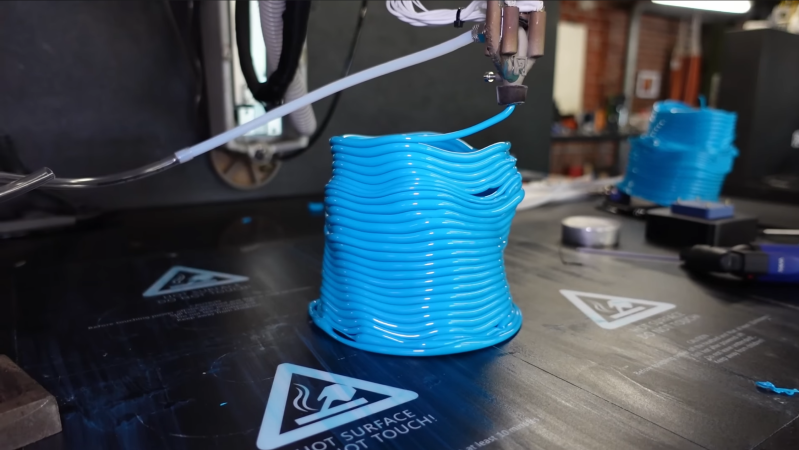
[Jan] of [Roetz 4.0] has a unique approach to multi-material 3D printing: he’s designed an extruder which takes two different materials and extrudes one as a shell around the other. This opens up some interesting possibilities, such as a conductive filament surrounded by an insulating shell; [Jan], however, didn’t have an immediate use for the process, so he moved on to a related technique: extruding plastic tubes with a compressed-air core.
The extruder he used for this was a variation on the dual-material extruder; it takes in two strands of filament, melts them, and extrudes them as a shell around the outlet of a compressed-air line, which was controlled by a high-precision pressure regulator. During testing with PLA, it seemed capable of extruding airtight tubes of filament, though it had a tendency to blow bubbles and form tubes with inconsistent diameters. The low thermal conductivity of the stainless steel extruder also proved problematic; coupled with the cooling effect of the compressed air, filament sometimes solidified inside the extruder.
[Jan] found it almost impossible to get consistent results using only pressure-based control; as the layer of molten plastic around the air gets thinner, it provides less resistance to further ballooning, leading to continuous expansion until the bubble bursts. Controlling the volume of air extruded provided much more consistent results, and in a second video, he built a peristaltic pump to do just that. He also switched to using TPU filament, which greatly improved layer adhesion. When inflated with compressed air, the finished TPU structures expanded slightly, though there were still air leaks. The results look promising, and TU Darmstadt has already carried out some research in this area.
In a separate research project, we’ve seen a similar multi-material co-extrusion approach used to print pneumatic channels. For more on the history of [Jan]’s multi-filament extruder, check out his Minuteman printer.
Thanks to [Tix] for the tip!










Might this lend itself to blow molding writ small?
Say an AMT Enterprise like mold (segmented) but with a 3D appendage like an orthoscopy snaking into the sprue/fill passages?
Endoscopic modeling might allow propellant lines, with air keeping things rigid… cyanoacrylate/baking soda concrete added next, etc.
That’s kind of interesting. Extrude the tube through the center of the mold until it hits a plug of some sort on the other side of the mold that blocks the end of the tube. If the mold were placed very close to the nozzle or extruded through a tube/die right up to the beginning of the mold would keep the tube from expanding above the mold. Keeping the tube warm long enough to let it expand into the mold cavity might be the killer. After all, there is air flowing through it. I guess it would be pretty hot air after it passed through the extruder, so maybe.
Do it all in some type of heated unit.
Raychem did tubing using radiated plastic they later used for THE STRANGE CHANGE TOY that Scott Manley did a video on after finding one in the attic with old vacuum cleaners.
One other concept might be a segmented “flying mold.”
We see exploded views of assembled objects. Imagine a Starship Enterprise mold cut apart…segments on robotic arms.
They assemble and a one piece replica is injected, shrinks, leaving the mold segments to Transformer disassemble themselves out from around the monoblock.
A second such machine applies paint and decals, etc.
Sausage case printer :p
It’s like a never-ending hot dog. Would be perfect for constant munching while watching Champions League.
So a parison then printer?
On a larger scale, for making building materials, filled with insulation?
Perhaps they could put the extruder in an airtight chamber and control the air pressure in the chamber to more closely balance the pressure inside the tube. That might control the wall thickness and reduce unwanted ballooning.
Pressure and temperature are linked, so it would be rather tricky to manage and predict the pressure differential vs cooling rate of the hot plastic filled with air inside the box that is probably going to get hotter the longer the print goes on.
Climate controlled chamber probably does make sense for the same reason it does with 3d printing in general, but I don’t think trying to active manage the pressure of the relatively large volume the enclosure must be will be that helpful unless you have active feedback on the actual size of the tube at this moment. And the only reason to control the chamber over control the air fed into the tube is it might be a simpler task to use off the shelf hardware for – that larger volume means much more normal scale air controls might do the job.
What about printing dissolvable filament core inside a tube?
Have fun getting all that out for a print that isn’t a vase-mode cylinder
Might it inflate into a sphere in space?
Starship spider spin an inflatable heat shield?