Showing posts with label rapid chess. Show all posts

26 July 2020

Slow Down

Over the past twenty years, I have played at least 100,000 games, most at three minutes with no increment (3 + 0). Adding games at five minutes, or with an increment, and adding bullet, which includes a great many 2 + 1 (more time than three minute when the game exceeds sixty moves), pushes the number over 150,000.

These crude minimums belie the point that I do not know the total number of online blitz games I've played. I have played online blitz regularly since 1998, often dozens of games in a day. I play a few games most days. My personal database currently holds 103,382 games. It excludes most bullet games, although I make an exception for 2 +1. It also has many games at longer time controls, including many hundreds of correspondence games. I have not been able to save every game, and have also lost tens of thousands through database errors.

When I started saving my games in a database, I was using Chessmaster 7000. About 2001, I began learning the free versions of ChessBase and Chess Assistant, both limited to database not exceeding 15,000 games. I recall that CB was more restricted than CA. In 2003, I bought CB 8 and attempted to gather all of my online games into one database.

What has been the impact of this massive amount of online blitz on the quality of my play?

The database contains a near endless supply of instructive positions that arise from sloppy play. Exactly the sort of play that my students see in their games.

It has certainly given me ample practice with pattern recognition, and may have developed my intuitive feel for many types of positions. It has given me immense experience in playing my favored openings, such that it is very difficult for an opponent to surprise me with something that I have not seen before.

Performing elementary checkmates with minimal time on the clock is gratifying, and helps me reinforce the skill in my teaching. But, it is also humbling that I have stalemated my opponent with queen and king against king more than once.

The most important detrimental impact has been that unsound risky play has been rewarded in such a way that it has become second nature. Making the effort to switch to 3 + 2, or even the 5 + 2 that I am currently playing in USCF online blitz rated tournaments has been rough. It is much more difficult to win lost positions on the clock when there is an increment. In my OTB games, I have bouts of impatience where blitz thinking interferes with careful calculation.

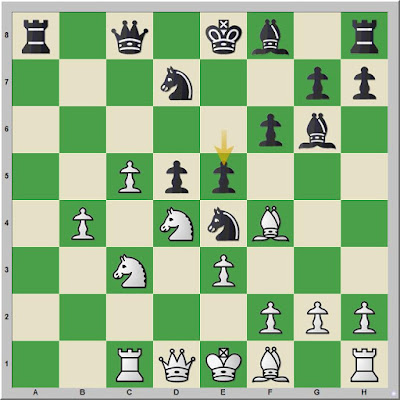
Last week, I had White and this position.

White to move

Confidently assuming that I had a strategic advantage, I was blind to tactics. I had plenty of time, but did not use it.

22.Bg2?? Rxd2 and I resigned.

The Morning Membership tournaments are short and fun, and they are at a time that is good for me both in terms of schedule and capabilities. Unlike the stereotypical late-night chess player, I am a morning person. These events last about an hour, are played at 5 + 2 on Chess.com, and draw 30-40 players. They begin at 8:00 am in my west coast time zone, which is late morning on the east coast.

In my first event on July 8, I was the third highest rated player, tied with two others with perfect scores, and won the first place trophy on tiebreaks. The free membership extensions that are awarded after the event are based on a random drawing, not performance. I played three more this week. The blunder presented above was my first loss. I scored 2/4 on Monday, lost my last round game on Wednesday, and on Friday, when I was the top rated player, gave up a draw in the second round.

My online blitz rating is going down. Nonetheless, I have signed up for the next sixteen--every one through the end of August. Learning to pace myself in slower blitz may be good for my game.

In "The Soul of Philidor", I presented a position where I was happy with my choice because it reflected the application of recent study. Strategically, it was a nice game and I was happy with my performance. Postgame analysis, however, quickly revealed to me that I missed several opportunities. Using the engine to check my postgame analysis revealed more missed opportunities. As I learn to slow down, perhaps I will increase my alertness to tactical chances. Intuitive play has its place, but some calculation is necessary for improving my game.

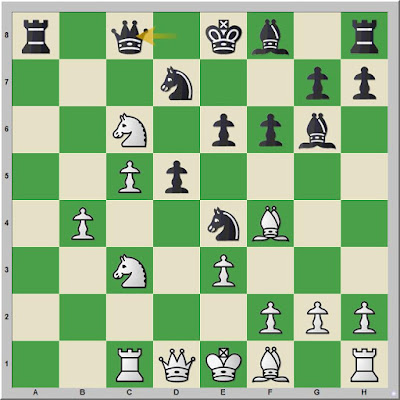
In each of these five positions, I had a better move than the one I played. Although I dominated most of the game and managed to win, I did concede the advantage and was even worse through part of the game.

White to move

I played 10.a3??

A couple of weeks ago, I was examining the tactics in a Grandmaster game that involved the type of position that occurs after the superior 10.b5!

White to move

15.Nd4?? walked into a fork, although that was not fatal and my pawns proved to be compensation for the knight. But 15.Nxe4 or 15.Bb5 were both better choices

White to move

16.Bg3?? turned out okay in the game, although Black now has a clear advantage. After 16.Nxd5 exf4 17.f3, White has a decisive advantage.

White to move

22.b5 Na4 23.Ra3 Nc2 leads to the next position, and I again have an advantage. However, 22.Re3 wins a piece. I also could have played 21.Re3, but 21.Bf3 was good enough to regain the advantage.

White to move

24.Rxa8! was a move that I considered, but without adequate calculation. Black is busted.

I played the seemingly safer 24.Qb3. A few moves later, my opponent returned the sacrificed piece which left me a clear pawn ahead. My bishops also controlled the squares my passed b-pawn needed.
I can play better.

28 October 2016

Winning

I won two USCF rated tournaments this week!

On Monday, I won a USCF online blitz rated game 10 on Chess.com. After winning two of the first three of such events that I entered earlier this year, I suffered poor results. Only once did I play well enough to raise my rating. But, this week, I played differently. Instead of playing super fast as is my usual pattern, I expended lots of time in the late opening and middlegame. Frequently, I found myself in serious time pressure near the end of the game, but usually with a very good position. Expending the time to calculate when I think I understand the position has been a focus in my training lately. My subpar performance through my last five weekend tournaments--dropping my rating more than 150 Elo--finally grabbed my attention and forced changes in my approach to chess.

After taking care of business against lower rated players in the first two rounds, I faced a strong opponent in the third.

Black to move

With the Black pieces, I spent 38 seconds in this position deciding that it was safe enough to castle queenside.

14...Qxe3 15.Bxe3 seemed to invite suffering.
14...O-O 15.Qxd4 exd4 looked to me like a losing proposition. Hanging on to the isolated pawn seemed futile.

14...O-O-O! 15.Bc2 Kb8 16.f3 Be6 17.Rd1

Black to move

Again, I spent nearly half a minute considering two possibilities.

17...Qxe3+

The alternative, which I seriously considered, was 17...Qxd1+ 18.Bxd1 Rxd1+ 19.Kf2 Rc8 20.Ke2

18.Bxe3 Rxd1+ 19.Rxd1 b6

This move was played after eleven seconds and had been part of my consideration in the twenty-one seconds spent on the previous move. During this time, I decided that I would fight to maintain a position with good chances for equality and let my opponent decide whether to press for a win and endure the risk for doing so.

20.a3 Rc8 21.Bd3 Bc4

White to move

My plan was to swap bishops and rooks and go into an ending of knight versus bishop, thinking that my knight was possibly slightly better. My opponent opted to keep more pieces on the board, but this let my pieces become more active. Eventually, a few errors by White allowed me to win the pawns on the queenside. When I finally got my knight versus bishop ending, I was ahead a pawn. When we exchanged these two pieces, I had an elementary winning pawn ending.

In round four, my opponent stepped into an elementary tactic.

White to move

15.Rxd5 cxd5 16.Bb5 1-0

Trying a somewhat new (to me) idea in the French Defense, exchange variation in the last round, I missed a thematic move that I routinely play in similar circumstances and had to fight for a draw. After we had repeated the position three times, the game was drawn on move nineteen.

Black to move

I played 5...dxc4, conceding the initiative. 5...Bb4+ is the correct move.

With 4.5/5, I won clear first.

Last night, I played in a rapid event at the Spokane Chess Club. In the first round, my use of the Dutch Defense against the English Opening led to an interesting game. I secured the initiative and won a pawn. As a result of my opponent's counterplay, we reached a rook ending where I was a pawn ahead, but his pawn structure was better and his rook more active. I initiated some exchanges to activate my rook, but reached a position that was probably objectively drawn. Luckily, my opponent blundered in a way that allowed me to remove his last queening threat and exchange rooks ito an easily winning pawn ending.

In round two, I played John Frostad, who beat me and everyone else this summer to win the Spokane Contenders (see "Ne2?"). After he equalized too easily against my Catalan, he lost his way in the middlegame. with a time control of 15 +3, he spent more that six minutes on this horrid position.

Black to move

Playing the same position against Stockfish this morning, I faced the same moves that John played after his long think. Again, I had trouble finding my way in a superior position. Stockfish, however, did not have the time trouble that John faced last night. I went on to win against John. This morning, I beat Stockfish also, but not on my first attempt. I required several draws and at least one loss before I found my way against the Silicon monster.

I do not always record my games in rapid chess, and so lack a record of last night's games beyond my memory of a few key positions.

In round four, I was way ahead on the clock after my opponent squandered a clear advantage. I returned the favor, but he had four seconds plus the three second delay to my five minutes as he tried to hold this drawn position.

White to move

Perhaps a gentleman would have offered a draw in such a position, but I am no gentleman in rapid chess. My opponent flagged after many moves where I kept giving him opportunities to err.

In the last round, I played Pat Herbers, who has returned to active play after nearly a decade of inactivity. As he had drawn another opponent earlier, I could win the event with a draw. Mentioning this fact before the game, Pat recalled a story from the mid-1970s when he beat a young Yasser Seirawan in a tournament in Seattle. Pat was Spokane's top junior player in the 1960s and nearly reached master when living in Seattle a few decades ago.

I played a thematic d4-d5 push on instinct. As we both slowed our play to consider the tactical ramification, Pat found the refutation and I was down a pawn. His subsequent errors in a clearly superior ending, however, let us reach this position.

White to move

I opted to exchange my h-pawn for his f-pawn. Although my king was never able to leave g2 and h2, the existence of a passed pawn of my own kept his king from waltzing over to the queenside.

I offered a draw in this position.

Black to move

Pat accepted the draw offer and settled for a share of second place.

18 November 2012

'Tis but a flesh wound

The Spokane Game 10 Championship was held yesterday. I did not win it. In fact, I finished quite a way down in the standings. There were fourteen players, and we played a double round robin. That would have been 26 games, but a few players could not stay for the marathon and left early. There was only one player whom I failed to beat (an international student from China who is attending high school in our city), but I also managed to lose to nearly every one as well.

I started the event giving up a draw to one of the weaker players (he's a strong sixth grader in the youth tournaments that I run).

Black to move

I played 30...Rd2??

In the second round, I played the other sixth grader. He let me get this nice position.

White to move

I played 12.Bg5 and 13.Bxh6, going on to checkmate my opponent on move 23.

In round three, my opponent missed my mate in one threat on move 14. After three easy games, I had 2 1/2 points.

I won a tough game in round four. I stopped keeping score after my 30.Kg2  because I was under three minutes on the clock.
Black to move

Then, in round five, I successfully navigated complications against last year's Idaho Girl's Champion, but walked into a simple discovery from this position.

Black to move

29...Qxa4 would have maintained my winning advantage. Instead, I played 29...Qxd6??

I continued keeping score for three more games, although only one other player was doing so and it was difficult to notate during such rapid time control. In round eight, my pencil ran out of lead. I might have borrowed a pen or pencil from the tournament director, but chose to cease writing down the games. A few games were instructive and would have been worth preserving, but likely all of them contain egregious tactical oversights that are best forgotten.

I was the second highest rated player. Number three won the event. My performance was a disaster, but at least it only affects my quick rating. It was an enjoyable day of chess with players from Idaho, Montana, and Washington.

At least the top player (the Montana participant) and I managed to get in some wine tasting at Nodland Cellars during the lunch break.