Showing posts with label Greco Attack. Show all posts

04 January 2025

Principle of Development

The first task of a chess player at the beginning of a game is rapid development. This means that a player should deploy the maximum number of pieces on squares where they are not vulnerable and work together with other pieces. They should be deployed with attention to the opponent's efforts to accomplish the same.

There are other ways to define the principle of development (see "What is Development"). The paragraph above is an effort to present the essence of the oldest definition of the principle that I have found in print. That definition is a translation of writing by Domenico Lorenzo Ponziani (although credited to Ercole del Rio by the translator). It was published in English 17 years before Paul Morphy was born (see "Principle of Development: Early History").

Morphy is usually credited as the "first player to understand the importance of swift development in open games", as Thomas Engqvist puts it in 300 Most Important Chess Positions (2018), 13. Engqvist offers 30 key positions from 24 games to articulate the concept of development in practical ways (13-32). There should be no question that Morphy's games illustrate well the principle of rapid development. They also show, as Engqvist elucidates well, how to sacrifice material to gain a decisive advantage against a player who neglects the principle.

I have spent that past ten days working through these 30 key positions as part of an effort to read the whole of Engqvist's book in 60 days (see "60 Days, 300 Positions: Day One"). This morning I reviewed all thirty positions after spending some time (too little) on numbers 26-30. I noted the key ideas that Engqvist offers through these positions, questioning how much was absent from Ponziani's articulation of the principle.

Engqvist includes center control, which I do not see in Ponziani's statement. He also shows Morphy's preference for avoiding "unproductive one-move threats" (14). Some of the most challenging positions in the first section of the book feature positions from modern grandmaster practice where the idea is to interfere with the opponent's harmonious development. The translation of Ponziani states, 
Whoever, at the beginning, has brought out his Pieces with greater symmetry, relatively to the adverse situation, may thence promise himself a fortunate issue in the prosecution of the battle.
J.S. Bingham, The Incomparable Game of Chess (1820), 32.
In the context, I suspect that harmony might make more sense than the word symmetry, but I have not examined Ponziani's Italian. Nonetheless, it is clear that the notion of attentiveness to the opponent's development exists in Ponziani's formulation.

William Steinitz is often credited with articulating the principles underneath Morphy's play. But, clearly other chess writers before Steinitz mentioned the principle of development. As for Morphy being the first to understand rapid development, I offer this position, which would be in my collection of 300 most important positions.

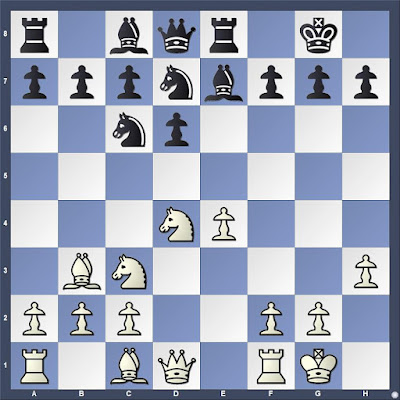
White to move
White has already sacrificed two pawns and here often plays 10.Qb3, sacrificing a rook for a winning attack. Black's best chance is 10...d5 11.Bxd5 O-O, as was played in Meyer,H. -- Ubbens,MH., 1926. Gioachino Greco is credited with the position and has both 10...Bxd4 and 10...Bxa1 for Black. In fact, Greco copied this position from the manuscripts of Giulio Cesare Polerio, or perhaps a book by Alessandro Salvio (see "Greco Attack Before Greco").

Searching ChessBase Mega 2024 for the position turns up nine games with 10.Qb3 prior to the first with 10.Ba3, which might be an improvement (see "Corte -- Bolbochan 1946").

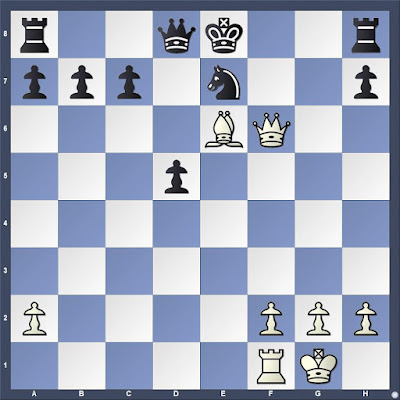
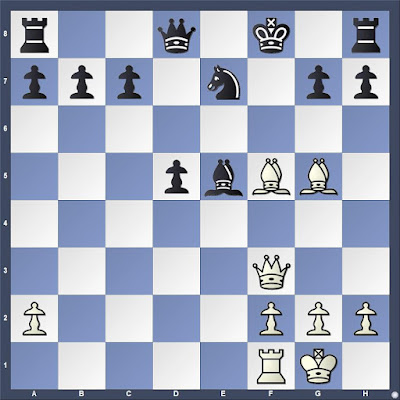
After 10...Bxa1 in Polerio's composition, we have a position that I like to show students in conjunction with this position from Morphy's Opera Game.

White to move
In both cases, White is behind a considerable amount of material but completely winning because Black's pieces lack mobility. It seems clear to me that Polerio and to an even greater extent Greco understood the pitfalls in neglecting the principle of development. It remained for the leading players of the so-called Italian school a century later to articulate the principle.

Nonetheless, Morphy's games remain the clearest early examples.


07 January 2023

Bramley -- Burgess 1946

Sometimes a particular game captures my attention. Tuesday morning I went through five games in Irving Chernev, The 1000 Best Short Games of Chess (1955). I have been working through this book since mid-September. I went through the games quickly and then returned to the first, spending considerable time examining variations that might have been played. Using the opening explorer on Lichess, I found another game with the same odd ninth move.

That afternoon, I showed the game to my after school chess club. On Wednesday, I spent more time exploring the game, annotated it, and created a worksheet for my students with positions derived from the game--mostly those that did not occur. Captions under diagrams indicate the positions on the worksheet.

I cannot find any information about the game beyond what Chernev offers--only surnames, location, and year. Another book includes the game, László Polgár, Chess: 5334 Problems, Combinations, and Games, but derived from Chernev. The game is number 500 in Chernev. Polgár includes it among 100 miniatures with sacrifices on f2/f7.

Bramley -- Burgess [C54]
Surrey, 1946

1.e4 e5 2.Nf3 Nc6 3.Bc4 Bc5 4.c3 Nf6 5.d4

5.d3 is the top choice of masters

5...exd4 6.cxd4

6.b4 Be7; 
6.e5 d5 7.Bb5

6...Bb4+ 7.Nc3

This move initiates the Greco Attack, which I have explored in several articles on Chess Skills.

7.Bd2 also preferred.

7...Nxe4 8.0-0

8.d5

8...Nxc3

8...Bxc3 9.d5 Bf6 10.Re1 Ne7 11.Rxe4 d6 Although approximately equal, Black tends to do better.

9.bxc3 Be7?!

Here we reach what struck me as a novelty when I first looked at the game. It has been been played by others, even at least once by a chess master.

White to move

Stockfish 14 on Lichess gave this move and White's response ?? in annotations to Boricsev,O. -- Sevostianov,P. 2017.

9...d5 10.Re1+ Be7 11.Bd3

10.Re1

Better is the immediate 10.d5 Nb8 (10...Na5 11.Bd3) 11.d6! (11.Re1 reaches the game) 11...cxd6 12.Bxf7+ Kxf7 13.Qd5+ Kf8

White to move
Analysis diagram

14.Re1 Na6 15.Ng5 Qe8 16.Bf4 Nc7 17.Qf5+ Kg8 18.Bxd6 Ne6 19.Nxe6 dxe6 20.Rxe6 Bxe6 21.Qxe6+ Qf7 22.Qxe7 Qxe7 23.Bxe7 Kf7 24.Bc5 Rhd8 and drawn in 63 moves. Chen,Y (2081) -- Kislik,E (2347) Budapest 2011.

14.Ng5 Bxg5 15.Bxg5 Qe8 16.Rfe1 Qf7 17.Qxd6+ Kg8 18.Re7 Nc6 and White won in 32 moves. Sizov,A -- Prikhodko,P Serpukhov 2001.

10...0-0

10...d5 11.Bd3 0-0 12.h3 Be6 13.Bf4 Qd7 14.Rb1 b6 15.Qd2 Bd6 16.Bxd6 Qxd6 17.Re2 h6 18.Rbe1 Rfe8 19.Bb5 f6 20.a4 Bf7 ½-½ Boricsev,O (2343) -- Sevostianov,P (2248) Mukachevo UKR 2017.

11.d5 Nb8

Both players have made errors, but White seems to be much better.

11...Na5 would be my inclination 12.d6! (12.Bd3) 12...cxd6 13.Bd5 Nc6 14.Ba3 Bf6 15.Qd3 (15.Rb1) 15...Ne7 16.Be4 g6 17.Bxd6+-

12.d6!

Lichess opening explorer shows that eleven other moves have been employed here, but none with the sort of results garnered by 12.d6! 12.Qe2 has been the most popular and Stockfish likes it almost as well.

12...Bf6

12...cxd6 13.Ba3 Nc6 14.Bd5 White's advantage is clear;
12...Bxd6?

White to move
Analysis: Exercise 2
13.Bg5 Qe8 14.Rxe8 Rxe8+-

White to move

13.dxc7

White could have struck now with 13.Bxf7+! Rxf7 14.dxc7 Qf8 (14...Qxc7 15.Re8+ Rf8 16.Qd5+ Kh8 17.Rxf8#) 15.cxb8Q Rxb8 16.Ba3 Be7 (16...Qxa3?

White to move
Analysis: Exercise 6
17.Re8+ Rf8 18.Qd5+ Kh8 19.Rae1+-)

17.Rxe7 Rxe7 18.Qd5+ Qf7 19.Qd6+-

13...Qxc7 14.Ba3

Again, White could have played 14.Bxf7+! Kh8 15.Bb3

14...Bxc3

Why not trade a rook for two bishops? 14...Qxc4 15.Bxf8 Kxf8?

White to move
Analysis: Exercise 1
16.Qd6+ Be7 17.Qxe7+ Kg8 18.Qe8#

15.Bxf7+!

Black to move
15...Kh8

During chess club, I was asked what if Black captures the bishop.

15...Kxf7

White to move
Analysis: Exercise 5
16.Qd5+ Kg6 17.Qg5+ Kf7 18.Qf5+ Bf6 19.Ng5+ Kg8 20.Qxh7#

Matters end more quickly if the rook nabs the bishop. 15...Rxf7 16.Re8+ Re7 17.Rxf8#

16.Bxf8 Bxe1 

16...d5 17.Ng5 Be6

White to move
Analysis: Exercise 4
18.Bxg7+ Kxg7 19.Nxe6+ Kh8 20.Nxc7+-

White to move
Exercise 3
17.Qd4

Black can delay, but not prevent checkmate. 1-0


15 March 2022

Progressive Tactics

Some of the worksheets for my after school students the past two weeks have been Progressive Tactics 1 and 2. The idea behind these worksheets is to present simple exercises such as a mate in one, followed by slightly more difficult mate in two, then longer mates or a combination with mate threats that wins material against best defense. What is "progressive" about the sequence is that they are taken from a single game, or a couple of closely related games. Students learn to visualize the combination by solving problems from simple to complex.

I have used this idea in the past and presented such worksheets in my "Lesson of the Week" on Chess Skills in March 2014: "Progressive Tactics" (11 March 2014) and "Progressive Tactics" (20 March 2014).

These are the current sets in use. 

Progressive Tactics 1

White to move

White to move

White to move

White to move

White to move

White to move

There are two source games from these six exercises, but in teaching the solutions to the students, I also reference Von Holtzhausen,W. -- Tarrasch,S. Frankfurt 1912, a game which has received some attention from Edward Winter (see Chess Notes 6382).

Piter,Slawomir (2070) -- Murach,T (1800) [C50]
POL-chT2 U18 Augustow, 1996

1.e4 e5 2.Nf3 d6 3.d4 exd4 4.Bc4 Be7 5.Nxd4 Nf6 6.Nc3 Nc6 7.0-0 0-0 8.Bb3 Re8 9.h3 Nd7 10.Bxf7+ Kxf7 11.Ne6 Kxe6 12.Qd5+ Kf6 1-0

Tal,Mihail -- Straicher [B06]
Riga-ch Semifinal Riga, 08.1950

1.e4 d6 2.d4 Nd7 3.Bc4 g6 4.Nf3 Bg7 5.Bxf7+ Kxf7 6.Ng5+ [6.Ng5+ Kf6 (6...Kf8) 7.Qf3#]  1-0

Progressive Tactics 2

White to move

White to move

White to move

White to move

White to move

White to move

The source game is Greco's best known. Most of the positions are derived from variations, some of which also appear in Greco's manuscripts.

Greco,Gioacchino [C54]
France and England, 1622-1625

1.e4 e5 2.Nf3 Nc6 3.Bc4 Bc5 4.c3 Nf6 5.d4 exd4 6.cxd4 Bb4+ 7.Nc3 Nxe4 8.0-0 Nxc3 9.bxc3 Bxc3 10.Qb3 Bxa1 11.Bxf7+ Kf8 12.Bg5 Ne7 13.Ne5 Bxd4 14.Bg6 d5 15.Qf3+ Bf5 16.Bxf5 Bxe5 [16...g6 17.Bh6+ Ke8] 17.Be6+ Bf6 [17...Ke8] 18.Bxf6 Ke8 [18...gxf6 19.Qxf6+ Ke8] 19.Bxg7 1-0


01 November 2021

Cultivating Error

Fast chess rewards weakness. Playing for cheap traps and succeeding stifles progress. Having spent many hours studying the games of Gioachino Greco, I have succeeded numerous times in replicating his best known miniature. This morning against a player with a Lichess rating near 2200, I found my opponent unprepared to meet the transparent threats offered in the not quite sound Greco Attack.

After this victory, and my postgame analysis, I decided that I have had enough. If I am to continue playing the Greco Attack, I must shift to the Aitken variation. Below is the game.

Stripes,J (2096) -- Internet Opponent (2153) [C54]
Rated Rapid game lichess.org, 01.11.2021
[Stripes,James]

1.e4 e5 2.Nf3 Nc6 3.Bc4 Bc5 4.c3 Nf6 5.d4 exd4 6.cxd4

6.e5 is better, according to William Lewis, Gioachino Greco on the Game of Chess (1819), which Lewis presents as a translation of a French collection of Greco's games.

6...Bb4+ 7.Nc3?!

7.Bd2 Nxe4 8.Bxb4 Nxb4 9.Bxf7+ Kxf7 10.Qb3+ is in the Ordini manuscript (1594) from the Polerio-complex. See "Greco Attack Before Greco".

7...Nxe4=/+ 8.0-0

Black to move
8...Nxc3

8...Bxc3 9.d5 is in Greco's Mountstephen manuscript (1623). It is the better move.

9.bxc3 Bxc3

The equalizing 9...d5 does not seem to appear among late-sixteenth century or seventeenth century manuscripts. It was played by Moller in 1902, according to ChessBase Mega 2020.

10.cxb4 dxc4 11.Re1+ Ne7 with equal chances: 0-1 (48) Piotrowski,O-Moller,J Hannover 1902.

White to move
10.Qb3?

I play this move because I get away with it. I have even told students, erroneously, that White is now winning.

10.Ba3 is Aitken's suggestion 10...d5 11.Bb5 Bxa1 12.Re1+ Be6 13.Qc2 Qd7 14.Ne5+-. See also Corte -- Bolbochán 1946 (2016).

10...Bxa1??

Now Black is lost. Black is also lost after 10...Bxd4, which also appears in Greco.

10...d5 11.Bxd5 0-0+/= (11...Bxa1?? 12.Bxf7+ Kf8 13.Ba3+ Ne7 14.Re1+- is credited to Don Antonio in the Doazan manuscript, which precedes Greco. Greco may have seen this manuscript.)

11.Bxf7+ Kf8 12.Bg5 Ne7 13.Ne5!

Greco's innovation, building on the work of Polerio and his associates.

Black to move

Greco analyzes several variations from this point. This game follows one of them.

13...Bxd4 14.Bg6 d5 15.Qf3+ Bf5 16.Bxf5 Bxe5 17.Be6+ Bf6 18.Bxf6 Qe8N

Black's move is the first new one.

White to move
19.Be5+ 

My last move misses checkmate in three. Nonetheless, Black resigned.

19.Bg5+ (or Bh4+) 19... Nf5 20.Qxf5+ Qf7 21.Qxf7#

I won because my opponent missed several well-known opportunities. 10.Ba3 avoids some of these.

24 October 2021

Greco Attack Before Greco

The first game with the Greco Attack in David Levy and Kevin O'Connell, Oxford Encyclopedia of Chess Games, Volume 1 1485-1866 (1981) is the first game therein credited to Gioachino Greco (1). Levy and O'Connell annotate this game according to variations presented in their source: Professor Hoffmann, Games of Greco (1900). Nearly the same game, but deviating with Black's move 18, appears in ChessBase Mega 2020 as games 47 and 99, the latter offering variations and a different date.

Eight of the seventeen games that precede the first of Greco's in the Oxford Encyclopedia feature the Italian Opening.

Greco,G - G-1 OECG [C54]
Europe, 1600

1.e4 e5 2.Nf3 Nc6 3.Bc4 Bc5 4.c3 Nf6

4...Qe7 is credited to Lopez in OECG, and also played by Boi, Polerio (four games), Lorenzo (against Polerio), and an unnamed player against Busnardo.

5.d4 exd4 6.cxd4 Bb4+ 7.Nc3 Nxe4 8.0-0 Nxc3 9.bxc3 Bxc3 10.Qb3

ChessBase Mega 2020 offers: "Greco invented free play with the pieces. Free pieces will win: free diagonals for the bishops, free files for the rooks!!" But, in fact, as will be shown below, all of these moves precede Greco.

Black to move
10...Bxa1

10...Bxd4 is Greco no. 2 in OECG; Also Game 2 in Hoffmann; third and fourth variations to game 1 in William Lewis, Gioachino Greco on the Game of Chess (1819).

11.Bxf7+ Kf8 12.Bg5

Black to move
12...Ne7

12...Nxd4 13.Qa3+ Kxf7 14.Bxd8 Rxd8 15.Rxa1 Nc2 16.Qb3+ Kf8 17.Qxc2+- Game 1, var. B in Hoffmann. Also second variation in Lewis. Absent as a Greco game from ChessBase Mega 2020.

13.Ne5 Bxd4

13...d5 14.Qf3 Bf5 15.Be6 g6 16.Bh6+ Ke8 17.Bf7# Game 1, var. A in Hoffmann. Also first variation in Lewis. Absent as a Greco game from ChessBase Mega 2020.

14.Bg6 d5 15.Qf3+ Bf5 16.Bxf5 Bxe5 17.Be6+ Bf6 18.Bxf6

Black to move
18...gxf6

18...Ke8 19.Bxg7 Is given as the conclusion in two Greco games in ChessBase Mega (both identical but one analyzed).

19.Qxf6+ Ke8 20.Qf7#

This is Game 1 in Professor Hoffmann, ed. Games of Greco (1900). Also Game 1 in Lewis, Gioachino Greco on the Game of Chess (1819). 

Peter J. Monté, The Classical Era of Modern Chess (McFarland 2014) lists eight Greco manuscripts containing this entire game, and another ending with 17.Be6+. He also notes that it appears as Gambett VI in Francis Beale's 1656 compilation of Greco's games (463). Monté does not mention the conclusion given in ChessBase Mega 2020.

Reading Monté last night and this morning, I returned to a book he mentioned and that I had downloaded from GoogleBooks several years ago: J.A. Leon, Forty-Six Games of Chess: by Giulio Cesare Polerio, rpt. from British Chess Magazine (1894). The BCM article appeared in August 1894 and was reprinted in Leeds by Whitehead & Miller. Following 24 King's Gambits, Leon offers the game that Monté notes, "presents the first Greco Attack" (224).

Polerio,Giulio Cesare [C54]
Rome, c. 1581

1.e4 e5 2.Nf3 Nc6 3.Bc4 Bc5 4.c3 Nf6 5.d4 exd4 6.cxd4 Bb4+ 7.Nc3 Nxe4 8.0-0 Nxc3 9.bxc3 Bxc3 10.Qb3 Bxa1 11.Bxf7+ Kf8 12.Bg5 Ne7

White to move
13.Re1

Leon's Polerio manuscript ends here with the note that White wins the queen and thus the game.

Monté lists two other lines from the Doazan manuscript, which has not been definitively dated, but precedes Greco.

Three alternatives to 13.Re1 appear in seventeenth century manuscripts.

1) 13.Rc1 Credited to Don Antonio in the Doazan MS (463). It is the only game attributed to Don Antonio, whom Monté believes was Don Antonio Mancino (270).

2) 13.Rxa1 Last move in Greco's Lorraine MS (1621)

13...h6 14.Bh5 d5 15.Bxe7+ Kxe7

White to move

16.Re1+ Kf6 17.Qe3 Qd6 18.Ne5 Bf5 19.Qf4 g5

White to move
20.Qf3 1-0

Contrary to the claim in the ChessBase database, Polerio should be the one credited with inventing "free play with the pieces". He likely originated the Greco Attack.


3) Greco improved Polerio's line with 13.Ne5.

Black to move
Greco's Innovation: 13.Ne5!

Polerio, as Greco, is poorly known by today's chess players (see "The Unknown Greco"). Much of what players learn from Greco was derived by him from the work of Polerio.

22 October 2021

The Unknown Greco

ChessBase Mega 2020 contains 82 games credited to Gioacchino Greco, most dated 1620 (which seems an arbitrary date). At the time of this writing, Chessgames.com has 90 games credited to the famous Calabrese. In "Gioachino Greco on the Game of Chess" (2013), I wrote about the abundance of Greco's variations that can be found in William Lewis's 1819 text of that name. The better known and more accessible (the notation is standard English descriptive) 1900 text by Angelo Lewis, writing under the penname Professor Hoffmann, also has variations that are absent from databases.

Peter J. Monté, The Classical Era of Modern Chess (McFarland 2014), which I described in "Monumental Scholarship" (2020), offers far more detail from Greco's manuscripts, and also permits the diligent reader to separate Greco's contributions from lines he learned from others. In Part I of the book, Monté describes manuscripts and history from Lucena to Greco, concluding with a discussion of the development of castling and the pawn's leap. Part II. Openings and Games of the Classical Era of Modern Chess is a thoroughly documented move tree (439-530). The so-called Greco Attack is documented across four pages (462-465).

The Greco Attack begins with the moves 1.e4 e5 2.Nf3 Nc6 (In some of Greco's manuscripts 2.Bc4 Bc5 is played, and the knights deployed on the following move) 3.Bc4 Bc5 4.c3 Nf6 5.d4 exd4 6.cxd4 Bb4+ 7.Nc3.

Black to move

Play continues:

7...Nxe4 8.O-O Nxc3

8...Bxc3 is the mainline today, and offers a very good reason not to play the Greco Attack.

9.bxc3 Bxb3

9...d5 or 9...Be7 have been recommended.

10.Qb3

A fine miniature that I learned from Leonard Barden and Wolfgang Heidenfeld, Modern Chess Miniatures (1960) continued with 10.Ba3. See Corte -- Bolbochán 1946 (2016).

10...Bxa1

Greco also has games that continue with 10...Bxd4.

11.Bxf7+ Kf8  12.Bg5

Black to move

In the ChessBase database, Greco's games all continue with 12...Ne7. Chessgames.com, however, has one game that continues with the line I present below.

12...Nxd4

This move was played against me in a rapid game on Chess.com on Sunday, and I had faced it at least four times prior.

13.Qa3

13.Qb4+? is a blunder that appears in the ChessBase database in ten games played 1996-2016.

13...Kxf7 14.Bxd8

Black to move

In 1619, Greco had access to a manuscript known today as Boncampagno -3, which contains the following variations (Monté, 277, 463). This manuscript is among those classified as the Polerio Complex. Monté dates it between 1594 and 1619. Authorship is uncertain.

A.
14...Rxd8 15.Ng5+ Kf6 (or Kg6) 16.Rxa1 Kxg5 17.Qe7+

B.
14...Nxf3 15.Qxf3+ Bf6 16.Bxc7

Black to move

Greco's original contribution to this line begins from this position and appears in two manuscripts from his sojourn in England, the Mountstephen manuscript (1623) and the Grenoble manuscript, which is undated, but believed to precede Mountstephen.

16...Re8 Qh5+ Kf8 18.Bd6+

Mountstephen ends here.

Black to move

18...Be7 19.Re1 h6 20.Rxe7 Rxe7 21.Qe5 and Qxe7 follows.

Not everything credited to Greco was his own work, and yet much of his work remains unknown to most chess enthusiasts.