Showing posts with label Lasker (Emanuel). Show all posts

29 December 2024

Corresponding Squares

My quest to learn 300 chess positions in 60 days is proving time consuming. Most of the time that I could spare today was expended laboring to understand number 37. The first day was a review of some pawn endings that I know: positions 151-155 in Thomas Engqvist, 300 Most Important Chess Positions (2018). My quest is an effort to read all of this book in less than two months. On the second day, I reviewed some Paul Morphy positions that I know well. An obscure line in the Slav Defense captured my interest yesterday. Today, I went back into endgames with numbers 156-160 in Engqvist. Number 157 is a much analyzed study by Emanuel Lasker (some books employ the version published by Gustavus Reichhelm after Lasker and he discussed Lasker’s composition).

First, I set up Lasker’s position on my iPad and spent some time analyzing it. Then, I played against the engine, backing up and trying again when I failed. I have worked with this position in the past and knew the basic ideas, but have not developed well my ability to calculate the whole series of corresponding squares. Looking for help drove me into other books on the shelf. I confirmed that Jeremy Silman, Silman’s Complete Endgame Course (2007) lacks the position. I know that corresponding squares are mentioned early in Mark Dvoretsky, Dvoretsky’s Endgame Manual (2003) and the concept is trumpeted in Paul Keres, Practical Chess Endings (1974). I opted to check John Speelman, Endgame Preparation (1981) and was pleased with the instruction.

Speelman offers a digested version of what he found in Yuri Averbakh and Ilya Maizelis, Pawn Endings (1974), which I consulted later in the day. My process was to read some in Speelman, and then construct a position derived from Lasker/Reichhelm. First, I sought to find positions with Black to move that were winning for White. With all the pawns fixed as in Lasker’s study, I placed the Black king on a8. Where must I place the White king for the position to be winning if Black is on the move?

Black to move
Then, I repeated the process with Black’s king on b8. After several such efforts, I went back to Reichhelm’s version of the original study and played against the computer. Then, additional modifications and more play against the engine.

This version was one of the easier ones.

White to move
After many hours of play against the engine and study of several books, I have the sense that I am beginning to scratch the surface of this difficult position.


31 July 2023

Unsourced Quote


Garry Kasparov, My Great Predecessors, Part 1 offers a quote that he attributes to Lasker. He does not indicate whether Emanuel or Edward. Nor does he indicate the text where the quote appears. The brief reference list in Part V lists nothing by either Lasker. Two weeks ago I noted criticism of Kasparov's My Great Predecessors for poor documentation in "Plagiarism and Related Crimes".

The quote comes at the end of Kasparov’s brief discussion of Gioachino Greco, where he presents four games with light annotations to the fourth.
The masters of that time found a sound and fruitful plan: disregarding pawns, achieve a rapid development of the pieces for a swift attack on the enemy king. To oppose this, a counter-plan was worked out: develop the pieces in solid positions, accept the sacrifices and then win thanks to material superiority. The masters of the first type found and carried out brilliant combinations, whereas the second type discovered the Giuoco Piano, the fianchetto and the Sicilian Defense. (12)
It is an interesting narrative that would benefit from some illustrative examples.

I would like to locate the original source of this quote. Was it in an article or a book? I do not recall seeing this sort of historical discussion by Emanuel Lasker in Common Sense in Chess nor in Lasker’s Manual of Chess, although the assertion does seem preliminary to Lasker’s purpose in the latter to explicate and build upon ideas of positional play credited to William Steinitz.

Can anyone help?


Edit:

Eight hours after posting I found a version of the quote. No doubt, Kasparov is working from a Russian translation of Lasker’s original German. I am working from Lasker’s English edition, which he wrote because he thought a translation would be too literal to remain faithful. The quote derives from Lasker’s Manual of Chess (1947). I am using the 1960 Dover paperback edition.
The modern history of the art of planning began at the time of the Renaissance in Italy. The Italian Masters of that period conceived a fertile and sound plan: to get the pieces rapidly into play, to leave the pawns out of consideration and to institute a sudden and vehement attack against the king. The counter-play on its part did not fail in evolving an antagonistic plan: to develop the pieces and post them at safe points, to accept the sacrifices and to exchange the threatening pieces of the opponent, add to win by superiority in material force. The masters of the attack invented the brilliant combinations which began by cramping the king and proceeded to sacrifices in order to gain time and space for a direct assault on the king. The masters of the defense invented the systematic exchange of pieces which decreases the vigour of the hostile onslaught and at last breaks it. The masters of the fierce attack, discovered the Gambits, those of the defense the Giuoco Piano, the Fianchetti Openings, and the Sicilian Defense. (179-180)
Even accounting for differences in translation, it appears that Kasparov edited the passage slightly.

10 September 2022

Try, Try, Again

Reading chess books is an almost daily activity for me, but finishing one is rare. In 2021, my embrace of ebooks, especially Everyman Books in Chessbase format, altered an old pattern. Prior to 2021, I could count on my fingers the number of chess books that I had read from cover-to-cover. The first four months of that year, I ran out of digits. This was not due to amputation, but rather to finding that I could look at every move in every chess game in a book much faster and with more enjoyment by viewing it on my computer screen.

Nevertheless, I still have not played through every game in any issue of Chess Informant, even though I have been getting the ebook version since Informant 113, and the ebook and print edition together since 124. In "Determination" (2016), I wrote about my resolve to go through all of Informant 128. I failed.

A couple of days ago, I worked through all of the games classified ECO A that were published in the games section of Informant 152. I ran through the games quickly in two sittings and made few notes in the print edition. I noted in the margin next to Mamedyarov -- Keymer, Berlin 2022 152/22 that the game contained "interesting imbalances".

Starting the B section, I am moving slower. The first game in the section, Ali Marandi -- Hungaski, Saint Louis 2022 152/30 sent me to The Week in Chess for more games with 4.b4 against the Scandinavian. I went through 28 of the 141 games in that database this morning, then a few more in ChessBase Mega 2020. Emanuel Lasker appears to have been the first player to try the move, employing it in two simuls in 1905 and 1908. The only prior game published in Informant with 4.b4 was a rapid game played on chess24, Nakamura -- Firouzja 144/24, which White won in 16 moves.

After relishing the tactical blow that ended Maurizza -- Pelletier 152/35, I took a moment to create this post. Now, it is time for me to resume the effort to succeed where I have failed so many times in the past.

26 January 2022

The Bad Pin

A pin is a restrictive contact that either prevents a piece from moving because doing so would violate the rules of the game (absolute pin), or that discourages moving the piece because the consequences could be dire (relative pin). Pins can be potent weapons in the chess struggle (see "A Lesson in Pins").

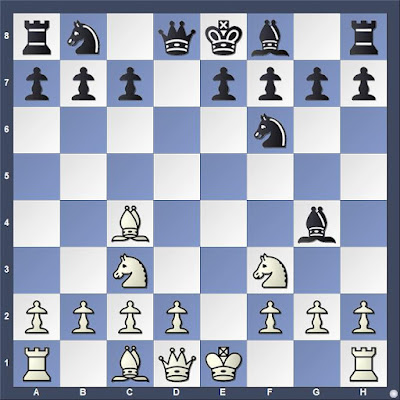
Relative pins are double edged. They can backfire, presenting the player facing the pin with an opportunity. Many of my students the past two weeks have seen this position from a game I played 16 January on Lichess.

White to move
After 5...Bg4??
How should White deal with the pin on the knight? Once you understand certain patterns, the correct answer is instantaneous. 

Evidently I am not the only player who has had this exact position. The position just before I played 8.Qxf7# has been examined in the ChessBase cloud more than 1500 times. Certainly some of the games that could have led to the moves in my game continued 6.Ne5 Bxd1 7.Bxf7#. It seems likely that a few players of the Black pieces also would have found 6...Be6 (the best choice after White exploits the bad pin).

Years ago, perhaps 1999, I bought and began reading Georges Renaud and Victor Kahn, The Art of the Checkmate, trans. W. J. Taylor (1953). I wrote about this book and how it first came to my attention in "Checkmate Patterns) (2015) and again in "Learning Checkmate (Or Teaching It)" (2021). I am rereading it, now in a new translation that has algebraic notation.

The Art of the Checkmate is my first recommendation when players are looking to learn checkmate patterns. Renaud and Kahn do far more than present basic patterns and then offer exercises. They offer detailed discussion of the variability of the basic pattern and how to bring it about. They use mostly full games. The chapter, "Legal's Pseudo-Sacrifice" (11-21) offers 17 complete games arranged by what they refer to as the "four aspects" of Legal's mate. They explain:
First and foremost we ask you not to learn it by heart but to grasp the precise mechanism, to understand that the bishop on g4 in "hanging", that is to say exposed to capture if the knight moves to threaten mate. But this mechanism appears in many positions as a latent threat and the opponent, if he pins your king's knight, is obliged to take this into account.
The Art of the Checkmate, trans. Jimmy Adams (2015)
I missed my chance to show the knowledge I should have acquired from the book in this blitz game played in 1999 on the Internet Chess Club.

White to move
Cleary, 9.Nxe5 is the correct move. I played 9.Nbd2, still managed to get a clear advantage, worked it into a decisive advantage, and lost on time in the endgame.

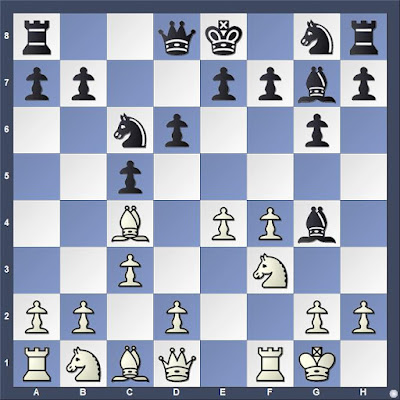
In 2000, I showed further incomprehension by maneuvering my way into the losing side of one of the combinational motifs enabled by "the bad pin".

White to move
My opponent understood the ideas and seized a clear advantage.

7.Bxf7+ Kxf7 8.Ng5+ Ke8 9.Qxg4

White has a decisive advantage and went on to win.

Genesis of the Instruction

It might be a stretch to claim that Renaud and Kahn invented the genre of checkmate pattern books. The manuscripts of Gioachino Greco, and many books grounded in these manuscripts offer more in the way of elementary checkmates than any sort of positional insight. But, when it comes to naming and classifying checkmate patterns, I know of nothing earlier than The Art of the Checkmate.

In the annotations to Kermer de Légall's famous game in the Jimmy Adams translation, Renaud and Kahn credit Emanuel Lasker with articulating a general principle of open games: "it is not always advisable to pin the opponent's king's knight before he has castled" (the 1953 translation makes no reference to Lasker). They are referring to lectures Lasker presented in London in 1895 and which were later published in outline as Common Sense in Chess (1917). I presented "Lasker's Rules" to my students and on Chess Skills in 2013, and then discussed Erik Kislik's (Applying Logic in Chess [2018]) critique in "Knights Before Bishops" (2018). It is notable that Renaud and Kahn qualify Lasker's rules in a manner that anticipates Kislik's critique. 

Lasker, Common Sense in Chess presents two short games at the beginning of the chapter. It is not clear that they derived from actual play as all the instances of his two miniatures that I find in the database are relatively recent (late-twentieth century to the present). This position arose in the second.

Black to move
6...Nxe4 7.Bxd8 Bxf2+ 8.Ke2 Bg4#

Renaud and Kahn begin with Legall's well-known game. However, the version they offer differs from that found in George Walker, A Selection of Games at Chess (1835). Edward Winter inquired in 2008 about the earliest known publication of Legall's game (Chess Notes 5720, 18 August 2008). Dominique Thimognier has been researching Legall and published some of the results in French at Heritage des Echecs Francais.

The variation presented in Walker is unsound. White blunders with 5.Nxe5. Yet, the Walker variation is the one found in ChessBase Mega 2020. Chessgames.com has the variation presented in Renaud and Kahn, but with White's rook on a1 absent.

Although there is plenty to doubt about the original game, the endless variations of the ideas have appeared in a great many games. Renaud and Kahn explicate the possibilities well.

Practice

I created an interactive lesson on Lichess.org with some instructive games and 20 exercises. The Study is called "The Bad Pin". I may add to it as I find time. Take a look. Let me know what you think.


14 October 2021

Lasker's Originality

I am watching chess videos that are part of the Fritz Trainer DVD, Master Class, vol. 5: Emanuel Lasker (2015). Mihail Marin makes the argument that Emanuel Lasker was an original strategic player who sought to bring new ideas into familiar openings. In the fourth game of his World Championship match with Siegbert Tarrasch, Lasker brought his rook to the fifth rank, then transferred in to the fourth, where tactical complications ensued. Tarrasch made a few small errors, leading to this position.

Black to move

How should Black deal with the fork?

27 April 2021

Lasker Resigns the Match

One hundred years ago today, Emanuel Lasker submitted his resignation in the world championship match with José Raúl Capablanca. The referee also submitted to Lasker acceptance of his resignation. These two letters were printed in the May-June 1921 issue of American Chess Bulletin (101). They were then reprinted in Capablanca's book on the match, which ACB published in a limited edition of 600 copies.


Lasker's name was left off in ACB, but included in Capablanca's book.


There was no closing ceremony. It is reported in Miguel A. Sánchez, José Raúl Capablanca: A Chess Biography (2015) that Capablanca refused to attend any ceremony. The new champion felt "outraged" by Lasker's behavior (251).

The two contestants would continue to dispute certain aspects of the match well into 1922, while also praising one another's play in their respective books on the match.

This post is number 26 in my centennial series on the match. I plan at least one more.

23 April 2021

Championship Match Postponed?

Was the fifteenth game of the World Chess Championship scheduled for Saturday, 23 April 1921? Perhaps it was scheduled for Friday. In either case, it did not occur. It seems from the narrative in José Raúl Capablanca: A Chess Biography (2015) by Miguel A. Sánchez that Capablanca appeared at the Casino de la Playa ready to play game 15, but that Lasker failed to appear. Sánchez is not explicit that Capablanca appeared and waited, but is quite clear that Lasker did not arrive. Newspapers covering the event reported that per Lasker's request, game 15 was postponed until Tuesday, 26 April 1921.

Sánchez presents an Associated Press story concerning this postponement, and asserts, "the explanation provided to the press was not true. It was a means to buy time, trying to save face for Lasker, and not inform the public or the press what was really happening" (250). He notes that Lasker had already decided to resign the match, but that Judge Alberto Ponce, the referee, and others of the committee, spent the weekend attempting to convince Lasker to continue.

I spent some time scanning the pages of the New York Evening Post, searching for what had been reported there. There was nothing specifically about the match between the conclusion of game 14 and an announcement of Lasker's pending resignation on 27 April. The lengthy Saturday edition did carry a game played in New York Metropolitan League competition that included a snarky comment about the style of play in Havana.

This post is number 25 in my centennial series on the World Chess Championship in Havana. 
Vigorous tactics, offering a refreshing contrast to the conservatism displayed at Havana, were the order of the day in the Metropolitan League match, which decided the interclub championship once more in favor of the I.L. Rice Progressive Chess Club. Among the most forceful attacks carried out was that by Oscar Chajes, champion of the club, against Alfred Schroeder of the Brooklyn Chess Club.
Herman Helms, "Over the Chess Board"
Chajes was a naturalized American originally from Austria, according to Sánchez (182). His loss to Capablanca in the Rice Chess Club Tournament (11 July 1913) is presented in the José Raúl Capablanca: A Chess Biography. Also presented is his loss in the 1915 American National Tournament, where Chajes finished third behind Capablanca and Marshall (214-215). Schroeder also has a loss to Capablanca from the Rice Memorial Tournament (29 January 1916) in the book (218).

While neither are top masters, they occupy the tier below Capablanca and Marshall who helped keep the Cuban relatively sharper in his play through World War I, while Lasker suffered a lack of play and other stresses (see "Lasker arrives in Havana").

Helms, who annotated this game, was the founder and publisher of American Chess Bulletin. He had some competitive success over the board. Among his games at chessgames.com are a win over Frank Marshall and a draw with Capablanca.

Chajes,Oscar -- Schroeder,Alfred [C61]
Metropolitan League New York, 04.1921
[Helms,Herman]

1.e4 e5 2.Nf3 Nc6 3.Bb5 Nd4

A somewhat bizarre defence popularized by the late H.E. Bird of London, who played many stirring games with it against the veteran Blackburne in the long ago.

White to move
4.Nxd4

White more often continues with 4.Bc4 Nxf3+ (Bird was wont to play 4...Bc5 5.Nxe5 Qg5 and no doubt frequently caught an unwary opponent in this trap: 6.Nxf7 Qxg2 7.Rf1 Qxe4+ 8.Be2 Nf3#) 5.Qxf3 Qf6 6.Qg3.

4...exd4 5.0-0 g6

Not the most likely continuation. Preferable is 5...c6 6.Bc4 Nf6 7.d3 d5 8.exd5 Nxd5 9.Re1+ Be6.

6.d3 Ne7 7.c3 Bg7

Black tries to avoid yielding the centre to his opponent, who invites 7...dxc3.

White to move
8.e5

A bold proceeding and worthy of the best tenets of the romantic school.

8...c6 9.Ba4 Bxe5

He must either do this or play 9...dxc3 which would have been the less valorous, but wiser.

10.Re1

Black to move
10...d6

If 10...Bf6 then 11.Bh6; or 10...Bd6;
Or if 10...Bg7 11.Qe2 f6 12.Bb3 d5 and White may continue with 13.cxd4 (or 13.a4 in either case giving Black a playable game.)

11.Bg5 Be6

If 11...f6 12.Bh6 -- threatening 13.h4

12.Bb3

Very well played and going directly to the heart of the conundrum.

12...h6 13.Bh4 g5 14.Bxe6

Black to move
14...fxe6

If 14...gxh4 15.Bh3 with the better game.

15.Bg3 Bxg3 16.hxg3 Qb6

If 16...Qd7 17.Qh5+ followed by cxd4.

17.Rxe6 Qxb2 18.Nd2 b5

In order to prevent Nc4 by White

White to move
19.Qh5+ Kd7 20.Rae1 Rh7 21.Qg4

This powerful stroke leaves Black without any defense.

Black to move
21...Kd8 22.Rxd6+ Ke8 23.Qd7+ 1-0

In my view this game is interesting, but sloppy. The dismissive, "refreshing contrast to the conservatism" of the world championship match, asks for a style of play that should horrify us at the top levels. I prefer the draws that come from accuracy.

Sources

Helms, Herman. "Over the Chess Board." New York Evening Post (23 April 1921), 20.
Sánchez, Miguel A. José Raúl Capablanca: A Chess Biography. Jefferson, NC: McFarland, 2015.

21 April 2021

Lasker -- Capablanca, Game 14 (concluded)

Readers of the New York Evening Post on 22 April 1921 were informed that in game 14 José Raúl Capablanca had "improved his prospects by breaking up Dr. Lasker's pawn formation" (9). Hartwig Cassel, reporter for the paper and for American Chess Bulletin on the scene in Havana, had judged Emanuel Lasker's position at the time of adjournment as somewhat better than his opponent. Lasker and Capablanca, in contrast, viewed Capablanca's position as winning, although their comments were published after Cassel filed his story. Lasker's assertion that Black's 29th move was the game winner would be included in his dispatch to Amsterdam's De Telegraaf on 30 April, and Capablanca's assessment would appear in the summer.

American Chess Bulletin published Amos Burn's annotations from The Field. Burn noted that the Brooklyn Daily Eagle stated that Lasker's move that invited a check and then the fork that lost the exchange, "was not a blunder, but was deliberately planned." Burn continues, "If so, it is inexplicable, as White obtains no compensation whatever for the sacrifice" (106). Herman Helms wrote the article for the Brooklyn Daily Eagle

Analysis by the players, as well as journalists Helms, Cassel, and Burn, was featured in "Lasker -- Capablanca, Game 14" yesterday. Now, in post number 24 of this centennial series, we conclude the game. Today is the 100th anniversary of the conclusion of the last game of the match. However, Capablanca expected the match to continue and showed up for game 15 only to be disappointed.

The game was adjourned with this position and Capablanca's move recorded and sealed.

Lasker,Emanuel -- Capablanca,José Raúl [C66]
World Championship 12th Havana (14), 20.04.1921
[Capablanca, Lasker]

Black to move
32...Qf6!

Helms's and Cassel's insights into the game may lack the understanding of the players, but their journalism is how we know which move was sealed. 

33.a4

"To prevent b5. There are a number of variations where White would regain the quality in exchange for a pawn had he played 33.g4, to be followed by e5 and Ne4, but the ensuing ending would be so much in favor of Black that the course pursued by White may be considered the best" (Capablanca, 29).

33...g6!

Clearly, the "none too comfortably placed" queen, as Helms or Cassel judged it,  has taken up a strong position that can apply pressure to White's center.

34.fxg6 fxg6 35.Re3 Bf5!

White to move
36.Qd3

A variation beginning with 36.Rd3 was Lasker's sole annotation to the second day's play. 36...Bxe4 37.Rxd6 Qg7 38.Nh4 Bf5 39.g4 (Capablanca offered 39.Nxf5 gxf5 40.Rxh6 Re1+ 41.Kh2 Qe5+ 42.g3 and White is lost (29) 39...Re3! and Black wins (Lasker 30).

36...g5 37.Nd2 Bg6 38.b4

"White's idea is to change off as many pawns as possible, hoping to reach an ending where the advantage of the exchange may not be sufficient to win" (Capablanca, 29).

38...Qe6 39.b5 axb5 40.axb5

Black to move

40...Ra8 41.Qb1 Qe5 42.Qe1 Kh7 43.bxc6 bxc6 44.Qg3

Black to move
44...Qxg3

Helms/Cassel noted that Capablanca never refused the opportunity to exchange queens in this match.

45.Rxg3 Ra3 46.Kh2 Rb7

White to move
47.c5

"Forced, as Rb2, winning a piece, was threatened" (Capablanca, 29).

47...dxc5 48.Nc4 Ra1 49.Ne5 Rc1!

White to move

"The moves of this rook are worth studying. I believe that Black had no better way to play" (Capablanca, 29).

The Capablanca and Lasker Master Class DVDs insert piece path images here and at move 55 for this rook.

50.h4

"This brings the game to a climax, for which Black is now ready" (Capablanca, 29).

50...Re7 51.Nxc6 Re6 52.Nd8 gxh4 53.Rd3 Rf6

White to move

"The key to Black's defense. The holding of the f-file" (Capablanca, 29).

Capablanca's use of the word defense is interesting. White's king seems hardly more secure, and the rook prepares as much to connect with the other on the first rank as to protect the Black monarch.

54.Rd7+ Kh8 55.Nd5 Rff1 56.Kh3 Bxe4 0-1

Lasker 3:30 Capablanca 3:40

In his 30 April 1921 dispatch, Lasker offered an explanations of his difficulties:
I liked his chess very much, I was happy to have a steel opponent, but the circumstances did not allow me to play the way I had planned. Due to the conditions of the climate and the way of life, my skills melted. My positional judgment, the accuracy of my combination, even the simple seeing of the position were weakened and confused and almost nullified in the contemplation. I could not escape this, although I never demoralized. The effect had physical causes: sweating, loss of body weight, inability to sleep well, and therefore inability to concentrate for long periods of time. Although the effect extended to my mentality, it did not affect my character nor my determination nor my self esteem. (31) 
Capablanca leads 4-0 with 10 draws. The likelihood of turning the match around with ten games left to play appeared quite remote to Lasker, and the weather was not cooling as April neared its end.

Edit (correction): I have credited assessments published in the newspapers to Hartwig Cassel, but that appears inaccurate. Lasker complained about Cassel's journalism, and others have noted that Cassel was on the scene in Havana. Cassel certainly provided the moves, but who wrote the commentary? Further research has shown that the unsigned articles in the New York Evening Post, which I relied upon for my narrative, are nearly identical to articles in the Brooklyn Daily Eagle. Herman Helms, publisher of American Chess Bulletin, and an accomplished player who had defeated both Frank Marshall and Harry Pillsbury is the author. Collaboration between Cassel and Helms go back to the first issue of American Chess Bulletin in 1904.

Sources

Burn, Amos. "Fourteenth Game--Ruy Lopez." American Chess Bulletin, vol. 18, no. 5 (May-June 1921), 105-106.
Capablanca, José Raúl. World's Championship Matches, 1921 and 1927. New York: Dover, 1977.
"Capablanca Takes Fourth Chess Game." New York Evening Post (22 April 1921), 9.
Chess Base. José Raúl Capablanca: Master Class, vol. 04 (2015). DVD.
_______. Emanuel Lasker: Master Class, vol. 05 (2015). DVD.
"Dr. Lasker Resorts to Favorite Opening," New York Evening Post (21 April 1921), 6.
Helms, Herman. "Capablanca Exchange Ahead in Fourteenth Chess Game." Brooklyn Daily Eagle (21 April 1921), 1.3.
_______. "Lasker Defeated for Fourth Time." Brooklyn Daily Eagle (22 April 1921), 1.3.
Lasker, Emanuel. Mein Wettkampf mit Capablanca. Berlin and Leipzig: Walter de Gruyter, and Co., 1922.


20 April 2021

Lasker -- Capablanca, Game 14

On Wednesday and Thursday, 20-21 April 1921, Emanuel Lasker and José Raúl Capablanca contested the fourteenth game of their historic world championship match. Chess Skills has been following this match as a centennial celebration, and will continue doing so through the end of the month. Game 14 was to be Lasker's last world championship game after twenty-six years at the top. It was not known to be his last when it was played, nor for several days after. The match was scheduled for 24 games; more than a week transpired before it was determined that this game would indeed be the last.

As referenced in "Refuge from Havana's Sun" and "Lasker -- Capablanca, Game 8", after the match Lasker raised issues concerning distribution of the game scores by Hartwig Cassel, a journalist working for American Chess Bulletin and the New York Evening Post. The score for game one was published in the New York Evening Post on 18 March 1921, and that paper continued to provide news on the match with game scores as it progressed.

Near the end of Mein Wettkampf mit Capablanca (1922), Lasker addressed the differences between a responsible chess press, as he saw it, consisting mostly of master commentators, and the work of journalists with limited understanding.
The press in general has behaved worthily and meritoriously. The reporting and criticism have high responsibility. Messrs. Helms, Burn, Schelfhout, Mieses, Dr. Tarrasch--leaders of the chess press in the United States, England, Holland and Germany--made a factual, reasoned judgment. Good chess criticism includes, in addition to objectivity, a love of the game of chess and an understanding of master chess: that is why these chess writers stand out from the others. Mr. Hartwig Cassel is indifferent to the game of chess. (37)
In this post, number 23 in a series, I have placed commentary provided by Cassel to the New York Evening Post alongside that of Lasker, Capablanca, and Amos Burn.* Compare the contrasting perspectives at critical moments in the game. The juxtaposition will show that Cassel's understanding of the game lacks some depth. On the other hand, Cassel's worth as a journalist is not limited to these comments. He an introduction and other information to Capablanca's book on the match. Early in Capablanca's career, Cassel helped arrange some of his simultaneous exhibitions and related matters.

Lasker,Emanuel -- Capablanca,José Raúl [C66]
World Championship 12th Havana (14), 20.04.1921
[Capablanca, Lasker, Others]

1.e4 e5 2.Nf3 Nc6 3.Bb5 Nf6 4.0-0 d6 5.d4 Bd7 6.Nc3 Be7 7.Bxc6

Black to move
Having the white pieces again and being obliged to essay an opening which held out better chances than the drawish variations of the Queen's Gambit declined, Dr. Lasker, in the fourteenth game of the championship match at Havana, last night, resorted once more to his favorite Ruy Lopez, which had been previously adopted in the third, sixth, and twelfth games. All three of these had been drawn, to be sure, but, with a greater variety of safe lines of attack, Dr. Lasker evidently hopes to get his watchful opponent off the beaten track.
Hartwig Cassel, NYP, 21 April 1921
Amos Burn's commentary in The Field was reprinted in American Chess Bulletin. He comments that he recommended 7.Bxc6 in his "notes to the sixth game" (106).

7...Bxc6 8.Qd3 exd4 9.Nxd4 Bd7 10.Bg5 0-0 11.Rae1 h6 12.Bh4

Black to move
12...Nh7

Lasker and Burn both call this move a "favorite" of Capablanca.

12...Ng4 13.Bxe7 Qxe7 14.f4 Nf6  was drawn in 55 moves Schoenmann,W -- Bluemich,M, Berlin GER 1920.

13.Bxe7 Qxe7 14.Nd5 Qd8 15.c4

"White has now a powerful position and Black has to play with extreme care in order to avoid drifting into a hopeless position" (Capablanca, 28).

15...Re8 16.f4

Black to move
16...c6

"This weakens the d-pawn, but something had to be done to obtain maneuvering space for the Black pieces. Besides, with the advance of the f-pawn, White's e-pawn becomes also weak, which is somewhat of a compensation" (Capablanca, 28).

"Black is constrained and must weaken the queens' pawn in order to free himself" (Lasker, 29).

17.Nc3! Qb6 18.b3 Rad8

It is noteworthy that both Capablanca and Lasker balance self-criticism with insight into their opponent's critical errors.

18...Re7 "was the proper move" (Capablanca, 28).

White to move
19.Kh1

This move "already reveals the slackening of my abilities. I could have gone over to the attack with h2-h3 and g2-g4. From here on to the gross mistake in the 29th move, I played without ideas" (Lasker, 30).

19...Nf6 20.h3 Bc8 21.Rd1

"This is waste of time. In order to obtain an advantage, White will have to make an attack on the kingside, since Black's d-pawn, though weak, cannot be won through a direct attack against it" (Capablanca 28).

21...Re7 22.Rfe1 Rde8 23.Re2

Black to move

"It will be noticed that Lasker loses much time with his rooks in this game, playing them with strange indecision. Much better than the text-move would have been g4, restraining the movements of Black's bishop and knight and preventing his queen going over to the king's side via a5" (Burn, 106).

Cassel suggests that Lasker's rook shifting was a psychological ploy: "Capablanca was not to be disconcerted" (6).

As noted above, Lasker stated that from move 19 up to the blunder on move 29, "my game was without any ideas."

23...Qa5 24.Rf1

Burn thought g4 could still be played at this point.

24...Qh5 25.Kg1 a6 26.Rff2

"A simple a2-a4 would be better to prevent the possibility of b7-b5" (Lasker, 29).

26...Qg6 27.Rf3

Black to move

 "White has now made seven moves with his rooks, but could have had them in the same position in three moves. A serious loss of time" (Burn, 106).

27.Nf5 Bxf5 28.exf5 Qh5 29.Rxe7 Rxe7 and Black has a good game" (Capablanca 28).

27...Qh5

27...Nxe4 "would have cost a piece" 28.f5 (Cassel, 6).

28.f5

"Of doubtful value. While it shuts off the Bishop, it weakens furthermore the e-pawn and also creates a hole on e5 for Black pieces. The position, at first glance, looks very much in favor of White, but careful analysis will show that this is much more apparent than true" (Capablanca, 28-29).

"Hastiness, ruining the entire plan of attack. By playing b3-b4 or a2-a4, White would have a perfect position" (Lasker, 30).

28...Qh4

White to move
29.Kh2?

"A blunder, made under time pressure combined with difficulties attached to the position" (Capablanca, 29).

"Also, a serious mistake. It would better to play Rf3-e3. Possible was and a2-a4" (Lasker, 30).

29...Ng4+

"[B]oldly invited" by Lasker (Cassel, 6).

"Winning an exchange and the game" (Lasker, 30).
Dr. Lasker sacrificed his rook for Capablanca's knight, although superficially, it might appear that the Cuban had caught him napping. A glance at the position, however, will show that the black Queen, while not in immediate danger, has all too little scope and that great care must be exercised in order to bring about a wholly satisfactory state of affairs for the Cuban.
Herman Helms, Brooklyn Daily Eagle, 1.3
30.Kh1 Ne5 31.Qd2 Nxf3 32.Nxf3

Black to move

Capablanca sealed his 32nd move. The conclusion of the game will be presented tomorrow in "Lasker -- Capablanca, Game 14 (concluded)".

The article in the New York Post expressed optimism regarding Lasker's chances: "Dr. Lasker, although the exchange behind, had blocked off Capablanca's Bishop and altogether was left with excellent prospects, as the black Queen was none too comfortably placed."

*Edit (correction): I have credited assessments published in the newspapers to Hartwig Cassel, but that appears inaccurate. Lasker complained about Cassel's journalism, and others have noted that Cassel was on the scene in Havana. Cassel certainly provided the moves, but who wrote the commentary? Further research has shown that the unsigned articles in the New York Evening Post, which I relied upon for my narrative, are nearly identical to articles in the Brooklyn Daily Eagle. Herman Helms, publisher of American Chess Bulletin, and an accomplished player who had defeated both Frank Marshall and Harry Pillsbury, is the author. Collaboration between Cassel and Helms go back to the first issue of American Chess Bulletin in 1904.

Sources

Burn, Amos. "Fourteenth Game--Ruy Lopez." American Chess Bulletin, vol. 18, no. 5 (May-June 1921), 105-106.
Capablanca, José Raúl. World's Championship Matches, 1921 and 1927. New York: Dover, 1977.
"Dr. Lasker Resorts to Favorite Opening," New York Evening Post (21 April 1921), 6.
Helms, Herman. "Capablanca Exchange Ahead in Fourteenth Chess Game." Brooklyn Daily Eagle (21 April 1921), 1.3.
Lasker, Emanuel. Mein Wettkampf mit Capablanca. Berlin and Leipzig: Walter de Gruyter, and Co., 1922.

19 April 2021

Capablanca -- Lasker, Game 13

Perhaps I am out of step with most chess enthusiasts in my views, but I find a large number of draws--even short draws--a good thing in World Championship matches. The players respect each other and they know when a position merits the expenditure of energy seeking more than than half a point. If there was a boring draw in the Capablanca -- Lasker match of 1921, it was the 13th game. It lasted a mere 23 moves and was agreed drawn when knights and pawns remained. In an online blitz game, I would play this one out. With enough time on the clock--plus the level of skill exhibited by the word's best--there would be no point.

Despite the seeming simplicity of the game, Lasker attempted to complicate matters while Capablanca had no reason to take chances. In his comments on game 13, George A. Thomas suggested, "after the strain of the difficult twelfth game, both players were perhaps not sorry to avoid complications" (349).

This post is number 22 in a centennial recollection of the match played in Havana, Cuba in March and April 1921. Game 13 was played one hundred years ago today, on Tuesday 19 April 1921.

Capablanca,José Raúl -- Lasker,Emanuel [D63]
World Championship 12th Havana (13), 19.04.1921
[Capablanca/Lasker]

1.d4 d5 2.Nf3 Nf6 3.c4 e6 4.Bg5 Be7 5.e3 Nbd7 6.Nc3 0-0 7.Rc1 Re8 8.Qc2 h6

"Not right away 8...c5 because of 9.cxd5 Nxd5 10.Nxd5 Bxg5 11.Nxg5 and wins" (Lasker). 

White to move

Here Lasker deviates from game 11, which did not go well.

9.Bh4 c5 10.cxd5 Nxd5 11.Bxe7 Nxe7

White to move
12.dxc5

"With 12.Bb5 the position would be more difficult. Black will then probably move 12...cxd4 and white should then 13.exd4. Then 13...a6 14.Bd3 Nb6 (14...Nf8 would be easier and healthier) 15.0-0 Bd7 16.Ne5 Nbd5 17.Bh7+ Kf8 18.Ne4 Bc6 19.Rfd1 Rc8 20.Qd2 A position full of deep problems. Incidentally, I am giving the above series of moves only as an attempt and by no means as the only possible one. I am giving it as an attempt to show that White's game can be laid deeper than Capablanca did" (Lasker).

12...Nxc5 13.Bb5

"Not best. The move 13.b4 was more energetic and perfectly safe" (Capablanca).

13...Bd7 14.0-0

"Happens here or before 14.b4 so the knight gives way 14...Na6 (Lasker); And if here 14.Rd1 then 14...Qc8 All such attacks are useless" (Lasker).

14...Qb6 15.Bxd7 Nxd7 16.Rfd1 Red8

White to move
17.h3

"Loss of time. 17.Qa4 at once was the proper move" (Capablanca).

17...Rac8 18.Qa4 Nc6 19.Qb5 a6 20.Qxb6 Nxb6 21.Rxd8+ Nxd8 22.Ne2 Kf8 23.Rxc8 Nxc8 ½-½

White to move

Capablanca 1:05 - Lasker 1:15

"Not much of a game. With three points to the good, I took matters too easy. My opponent, having the Black pieces, could not have been expected to do much" (Capablanca).

Sources

Capablanca, José Raúl. World's Championship Matches, 1921 and 1927. New York: Dover, 1977.
Lasker, Emanuel. Mein Wettkampf mit CapablancaBerlin and Leipzig: Walter de Gruyter, and Co., 1922.
Thomas, George A. "Game No. 4,866." British Chess Magazine, vol. 41, no. 9 (September 1921), 349-350.

16 April 2021

Lasker -- Capablanca, Game 12

In the twelfth game of the 1921 World Chess Championship, Emanuel Lasker found a forcing combination that left him with a clear material advantage, but perhaps a somewhat worse position. José Raúl Capablanca considered his combination "all wrong". The game was adjourned with an incredible imbalance, but instead of playing it out, they agreed to a draw.

After nine games, British Chess Magazine stated in the May issue, "These games are perhaps models of accuracy, but are mainly incredibly dull, but as a matter of record we will publish them in the Magazine, beginning next month" (184). Then, when George A. Thomas annotated game 12 in the September issue, he expressed regret:
...that this ending was carried no further. It is difficult to say which player, if either, held an advantage. But there was obviously still a great deal of play in the position, which is of a most uncommon type, owing to the widely dissimilar character of the opposing forces. The continuation could scarcely have failed to be both interesting and instructive. (349)
Thomas called the game, "thoroughly interesting" (349). The game was played one hundred years ago today. This post is number 21 in a series on the match. As has been the norm, annotations by the players offer insights into where they think they could have improved.

Lasker,Emanuel -- Capablanca,Jose Raul [C66]
World Championship 12th Havana (12), 16.04.1921
[Capablanca/Lasker]

1.e4 e5 2.Nf3 Nc6 3.Bb5 Nf6 4.0-0 d6 5.d4 Bd7 6.Nc3 Be7 7.Re1 exd4 8.Nxd4 0-0

Up to this point, the moves have been the same as in game 6. This position was also reached via a different move order in game three when Capablanca had White.

White to move
9.Bf1

"White can of course make many moves here without taking any damage, for example what usually happens, 9.Bxc6. Or 9.b3 and the text is not bad either" (Lasker).

Even today, half a dozen moves are played when White eschews the main line. It is not a common position, having appeared only 220 times in the entire run of The Week in Chess. 9.Bxc6 is the most popular move and 9.Bf1 the second choice. 9.b3, 9.f4, 9.h3, 9.Bf4, 9.Nxc6 and others have been played.

9...Re8 10.f3 Bf8

The following year, Capablanca played 10...Nxd4 11.Qxd4 Be6 12.Qf2 c6 13.Bd2 Qb6 14.Na4 Qxf2+ 15.Kxf2 0-1 (38) Euwe,M -- Capablanca,J, London 1922.

11.Bg5 h6 12.Bh4 g6

"The defense that Capablanca chooses here is difficult" (Lasker).

13.Nd5

Thomas in BCM gets to the heart of what the players of the game concluded: "This leads to some very interesting play; but the ensuing complications seem, on the whole, somewhat unfavourable to White who only just succeeds in maintaining equality" (348).

I am reminded of Cyrus Lakdawala's comment on Lasker's gambling tendencies in game 11.

13...Bg7

"I cannot very highly recommend the system of defense adopted by me in this variation" (Capablanca).

White to move
14.Nb5

"The combinations beginning with this move are all wrong. White's proper move was simply to hold the position by playing 14.c3 After the text move, Black should get the better game" (Capablanca).

14...g5

"The only alternative was 14...Rc8 whereupon white with 15.c4 restricts Black badly and yet forces 15...g5"  (Lasker).

15.Ndxc7

"If 15.Bf2 Nxd5 would give Black the better game. The combination indulged in by White is good only in appearance" (Capablanca).

15...gxh4 16.Nxa8 Qxa8

White to move
17.Nc7

"Here I made a mistake. It was better to take a central pawn than an exchange. By playing 17.Qd6, White would get a strong game. For example, Rd8 18.Qf4 h3 19.Rad1 and White has a rook and two pawns for two light pieces with better development" (Lasker).

17...Qd8 18.Nxe8 Nxe8

White has gained material, having two rooks and a pawn for three minor pieces. However, Black's pieces seem much better placed than White rooks.

19.Rb1

"Now the d6-pawn serves as a support point and White has no minor pieces to take it. Because of this, all efforts of White to win the game must ultimately fail" (Lasker).

19...Be6

White to move
20.c3

"If White plays 20.c4, the hole on d4 is worse than the loss of the pawn, and Bf1 would be condemned to inaction. The Field [Amos Burn] gives the next continuation 20.c4 Qa5 21.a3 Bc4 22.Bc4 Qc5+, but I believe that  Black with 20...Be5 21.Qd2 Qf6 can continue the game much better" (Lasker).

20...Bxa2

"A mistake. The question of time at this point was not properly appreciated by Black, who went in to recover a pawn, which was of no importance whatever. Worse yet, the capture of the pawn only helped White. Black had here a won game by playing 20...Be5" (Capablanca).

21.Ra1 Be6 22.Qd2 a6

"22...h3 was better. After the text move Black has an extremely difficult game to play" (Capablanca).

23.Qf2

Black to move
23...h5

"23...Qg5 would have given Black better chances to win. After the text move there is nothing better than a draw" (Capablanca).

24.f4 Bh6

White to move
25.Be2

"With this White wins a pawn, but the important e4 pawn is exchanged. 25.Bd3 h3 26.Kh1 was more sustainable and the rooks would come into their own" (Lasker).

25...Nf6 26.Qxh4 Nxe4 27.Qxd8+ Nxd8 28.Bxa6 d5

White to move
29.Be2

"On 29.Bd3 there would be 29...Nc5" (Lasker).

29...Bxf4 30.Bxh5 Bc7 31.Rad1

"This move is not a clever move because it exposes the rooks too much to the attacks of the minor pieces, but White cannot win in any way as long as Black restricts himself to defense" (Lasker).

Black to move

The game was adjourned here, and presumably Capablanca sealed a move. But a draw was agreed without resumption.

½-½

Lasker 2:05 - Capablanca 1:54

"Having had twenty-four hours to consider the position, we both came to the conclusion that there was nothing in it but a draw" (Capablanca).


Sources

Capablanca, José Raúl. World's Championship Matches, 1921 and 1927. New York: Dover, 1977.
Lakdawala, Cyrus. Capablanca: Move by Move. London: Gloucester, 2012, Everyman ebook.
Lasker, Emanuel. Mein Wettkampf mit Capablanca. Berlin and Leipzig: Walter de Gruyter, and Co., 1922.
"The World's Championship." British Chess Magazine, vol. 41, no. 5 (May 1921), 184.
Thomas, George A. "Game No. 4,865." British Chess Magazine, vol. 41, no. 9 (September 1921), 347-349.

14 April 2021

Capablanca -- Lasker, Game 11 (concluded)

The eleventh game of the 1921 World Chess Championship between José Raúl Capablanca and Emanuel Lasker concluded one hundred years ago today. It began, as so many others of the match, with the classical variation of the Queen's Gambit Declined, but Lasker then played an unusual seventh move. The game up to the point of adjournment is at "Capablanca -- Lasker, Game 11".

This post is number 20 in a centennial series on the match. As with game ten, this game has been annotated by many commentators, but I favor  Capablanca's instructive approach in A Primer of Chess (1935) supplemented with annotations from his book on the match (1921), and Lasker's relatively light annotations in Mein Wettkampf mit Capablanca (1922).

Capablanca,José Raúl -- Lasker,Emanuel [D66]
World Championship 11th Havana (11), 13.04.1921
[Capablanca/Lasker/]

White to move

32.Nd2


"This was my sealed move and unquestionably the only move to keep the initiative" (Capablanca 1921, 24).

32...Nf8

"Better 32...Rc3 33.Qa1 Nf8 34.Ne4 Rc7 Black gains an important tempo" (Lasker, 25).

Some commentators have suggested 33.Qd6 in reply to 32...Rc3, but Capablanca offers 33.Qa1 as White's reply both in the book on the match (24) and in A Primer of Chess (221). Kasparov suggests the line after 33.Qd6 would likely draw; the ChessBase DVDs give Qd6 a question mark.

White to move
Analysis diagram after 32...Rc3 33.Qa1 Nf8 34.Ne4 Rc7

How does White play? Kasparov suggests 35.g3 when White has a "marked advantage" that is still less than in the game (273).

33.Ne4

Black to move

"The White knight stands in a very commanding position. Black's game is far more difficult than appears at first glance and I believe that the only good system of defense would have to be based on f5 after h6, driving back the White knight" (Capablanca 1921, 24-25).

33...Qd8 34.h4

"There is much more than meets the eye in this position. This is a crucial point in the game. Apparently there is not much on either side, yet if Black can save the game it must be done at this point, and the chances are that the only move that may save the situation is h6, threatening to drive the knight away with f5. 34...f5 at once would not do because of 35.Bg5 Rc7 36.Ng5 Re7 37.Bc4 and Black would be helpless. The situation is most interesting and will repay study" (Capablanca 1935, 222).

34...Rc7

"This might be said to be the losing move. Black had to play h6 in order to continue with f5, forcing the White knight to withdraw" (Capablanca 1921, 25).

"A natural enough move, yet it will be seen that Black seems lost from now on" (Capablanca 1935, 222).

35.Qb3

"White's plan consists in getting rid of Black's powerfully posted Knight at d5, which is the key to Black's defense" (Capablanca 1921, 25).

35...Rg7

White to move

Capablanca notes in A Primer of Chess that this move induces g3 so as to deprive White's queen of using that square to harass Black's king (223).

36.g3 Ra7

"It is already too late to counterattack f6-f5-f4. The loss of tempo now reveals its effect" (Lasker, 25).

37.Bc4 Ra5 38.Nc3 Nxc3

"Leaving the knight on d5 and here to exchange it would lead to a long and difficult game for Black" (Lasker, 25).

After this exchange, "Black's weaknesses will be indefensible" (Kasparov, 274).

39.Qxc3

Black to move

39...Kf7 40.Qe3 Qd6 41.Qe4

Black to move

41...Ra4

"Neither one of us had very much time left at this stage of the game. Black's alternative was Ra7, which would have been met by 42.d5, leaving Black with what in my opinion is a lost position" (Capablanca 1921, 25).

"Suicide! Starting from here, Black plays very passively. Better Ra5-a7 to keep close the game after d4-d5, e6-e5" (Lasker, 25).

42.Qb7+ Kg6

White to move

43.Qc8

43.h5+ leads to a clear win.

Here Kasparov again faults Capablanca's "inclination towards play on general grounds," suggesting that would hurt him in the match with Alekhine (274).

43...Qb4 44.Rc1 Qe7 45.Bd3+ Kh6 46.Rc7 Ra1+ 47.Kg2 Qd6

And an exercise for my students, as Lakdawala makes it one for his readers.

White to move

48.Qxf8+ 1-0

Capablanca 3:00 Lasker 3:05

After eleven games, Capablanca leads 3-0 with eight draws.


Works Cited

Capablanca, José Raúl. 
World's Championship Matches, 1921 and 1927. New York: Dover, 1977.

_______. A Primer of Chess. New York: Harcourt, 1977.

Chess Base. José Raúl Capablanca: Master Class, vol. 04 (2015). DVD.

_______. Emanuel Lasker: Master Class, vol. 05 (2015). DVD.

Kasparov, Garry. My Great Predecessors, Part 1, trans. Ken Neat. London: Everyman Chess, 2003.

Lakdawala, Cyrus. Capablanca: Move by Move. London: Gloucester, 2012, Everyman ebook.

Lasker, Emanuel. Mein Wettkampf mit Capablanca. Berlin and Leipzig: Walter de Gruyter, and Co., 1922.