Showing posts with label Eric Klinenberg. Show all posts

Monday, July 6, 2026

Book review: Palaces for the People


Eric Klinenberg speaking on stage in front of a drum set
Eric Klinenberg at CNU34
Twenty-first century social infrastructures are already reviving civic life in nations across the planet: public plazas in low-lying cities that double as massive water storage systems during extreme weather events; massive levees and berms that masquerade as bike paths and parks. Americans should have all these things. (Klinenberg 2018: 293)

Eric Klinenberg, Palaces for the People: How Social Infrastructure Can Help Fight Inequality, Polarization, and the Decline of Civic Life (Broadway, 2018), 293 pp.

(7/3/2026) There is supposed to be a theory of human evolution where we humans have since hunter-gatherer days differed in our response to strangers. Some see strangers as inherently dangerous, a threat to our precarious food supply; others see strangers as bringing welcome variety, so we could trade lunches or at least hear new jokes. Both of these perspectives are adaptive--some strangers are dangerous--but decades of auto-centric development has left us with a lack of places to encounter strangers in low-stakes, non-threatening ways. The results include an epidemic of loneliness, physical unfitness, and vulnerability to violent crime, homelessness and climate catastrophes. 

Eight years after the publication of Palaces for the People, Eric Klinenberg began his keynote address to the Congress for the New Urbanism in Bentonville, Arkansas, last month, with the question: What has happened to the fabric that supports community life? He urged his listeners to "make every project you do work as social infrastructure," whether it's a playground or something less obviously connected, like flood control. We should also fund public libraries, a lot more than we currently are.

Klinenberg grew up in Chicago, and was just about to start graduate school when the deadly 1995 heat wave struck the city. The factors that affected who survived and who didn't, and the factors affecting the geographic distribution of mortality, inspired his field research, and eventually his first book, Heat Wave (University of Chicago Press, 2002). He continues to ask: If sudden natural disasters, as well as the slow corrosive effects of loneliness and despair, have predictable effects, "What conditions in the places we inhabit make it more likely that people will develop strong or supportive relationships and what conditions make it more likely that people will grow isolated and alone?" (2018: 6)

short bookshelves, carpeting, fake fireplace in background
Social infrastructure: The Union (young adult room), 
Cedar Rapids Public Library

Social infrastructure is defined as "the physical places and organizations that shape the way people interact," creating the context for individual-level relationships of all levels of intensity. It can take many forms--public institutions, open spaces, privately-owned establishments--but the common element is "people are welcome to congregate and linger" (16). His first example is public libraries (ch. 1), which "do all kinds of unexpected things for surprisingly large numbers of people... by providing free access to the widest possible variety of cultural materials to people of all ages, from all ethnicities and groups" (37). He describes his visits to the New Lots and Seward Park branches in New York City, where he sees the elderly, teenagers, the unhoused, and immigrants in places where they can find meaning and encounter other people. 

Chalkboard, The Union (young adult room)
Chalkboard in The Union:
The youth have something to say

Chapter two argues social infrastructure is useful for improving public safety, where outcomes of long-term policies in Philadelphia "suggest that place-based interventions (fixing up vacant and abandoned properties, planting trees and grass) are far more likely to succeed than people-based projects" like tougher criminal sentencing and cracking down on petty crime (70).

Chapter three starts at elementary school, spends most of its time at college, and then goes back to the library. Any of these places can serve as community gathering spaces, but that doesn't happen automatically; they also can fail by putting up barriers or designing for institutional efficiency.

playground behind locked gate
School playgrounds can be community gathering spaces,
but only if they're unlocked

One big social change since the publication of this book is that the number of people living on the streets has increased by 50 percent, which may affect the real or perceived ability of the community to gather in these types of spaces.

Chapter four focuses on the public health impacts (opioid addiction, food deserts, isolation especially among the elderly and poor) of glaring failures of social infrastructure. Chapter five highlights the role of sports facilities and teams in bringing together people of different backgrounds, which might be a major reason racists fought so strenuously to keep beaches and pools segregated (and why "boys in girls' sports" is such a potent argument today). The epilogue points out the limits of social media, and other billionaires' moonshots, in doing what simple contact can achieve.

Chapter six on climate change is an extension of the argument. Incredibly, as I write this eight years after this book was published, with heat domes over much of the northern hemisphere, widespread fires and flash flooding, the crew in charge of the American national government still insists there's nothing to see here. Even in 2018, it was undeniable that (a) the climate is changing, (b) its effects fall most heavily on those at the margins of society, and (c) we're going to have to build or rebuild a lot of our infrastructure in order to prepare for this. 

grassy area with wide sidewalks, buildings in background
Social infrastructure: The McGrath Amphitheatre,
park and concert venue and flood protection

Klinenberg makes the case for making the new physical infrastructure work as social infrastructure as well, as had been planned along the FDR Drive in New York City:

The berms would block and absorb storm surges when necessary, but their everyday function, as parklands and recreational areas for inhabitants of an especially gray and unpleasant part of an especially gray city, is at least equally as important.... Deployable walls, camouflaged as a series of murals that hang from strong hinges on the ugly underside of the FDR Drive, are another key part of the proposal. Most of the time, the structures, which will be designed by local artists, operate as decorative ceiling panels that enhance the experience of walking beneath the highway, which, lacking good alternatives, thousands of residents do each day. (2018: 202)

Klinenberg makes a strong argument for urbanist design. Loneliness and all its ill effects, physical fitness, political polarization, and vulnerability to crime and climate can all be traced to the lack of social infrastructure. In his 2026 talk, he said that if communities design, build, maintain and program it, democracy and civil society will benefit, and there exists a "palpable sense of possibility" in this moment in history, especially among the young. We surely can do with more public libraries, playgrounds, and plazas (with shade for sure!), if they're done right. The alternative, as he said in Bentonville, is "we are all more likely to hunker down in private places."
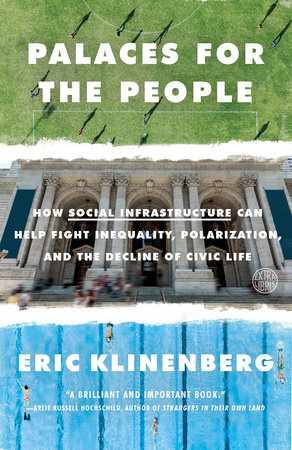
Palaces for the People cover
(Source: crownpublishing.com)

Pete Saunders, "Preparing for the Climate Migrants," Corner Side Yard, 2 July 2026

Angie Schmitt, "Ross Chapin on How the 'Pocket Neighborhood' Can Address Loneliness," Love of Place, 24 June 2026

Wednesday, May 13, 2026

CNU 34 Diary: Northwest Arkansas

people walking towards building topped by a smiling yellow ball
Hi from the town with the big friendly ball!
Which smiles as it watches, and floats above all

Wednesday, May 13, 2026

I don't know what it must have felt like for a medieval peasant to visit Rome, but I am in a similar position at the 34th annual Congress for the New Urbanism. Wal-Mart, the enormous conglomerate where many Americans shop, is headquartered here, the longtime home of founder Sam Walton. The Waltons and their fellow townspeople have used all the money we've sent here over the years to build a place that--surprise!--looks nothing like a Wal-Mart.

Jane and I arrived about 6:00 this evening after an all-day drive from Iowa. I psyched myself up on the way listening to John Simmerman's Active Towns interview with Michael Bruntlett about bike infrastructure development in China.

The conference had already kicked off yesterday, and today featured a day of panels and activities in Fayetteville, about 25 miles south of here. That included the keynote address by economist Raj Chetty. However, I am used to traveling to the conference on Wednesday, and did not make the necessary adjustments. Coe College has just finished its spring semester, and I only got my grades in Monday; I'm not sure I could have gotten here sooner, but next year I'll try to adjust myself to the conference schedule.

We're staying at the 21C Museum Hotel on A Street, which is closed to traffic. We spent the evening walking around downtown, which is exactly as advertised, if more pricey than a simple Arkansas country town. 

cars and stores on downtown street
Main Street, downtown Bentonville

There are a ton of bicyclists of all ages, maybe particularly on a night like tonight, which was incredibly lovely.
glass building with trail zigzagging up the side
People even ride up the Ledger building!
The streets are narrow, and cars drive slowly, and they yield to pedestrians. The public library is spacious and well-stocked, including a copy of Paved Paradise by Henry Grabar

book stacks and people
Children's section, Bentonville Public Library
The chess club was hosting a large number of matches in the park by the county courthouse. We found, for the second year in a row, some outdoor dining to start our visit to the host city.

outdoor dining tables in front of two story brick building
Al fresco dining at Tavola Trattoria

Tomorrow, I will start the serious business of this conference. First, I need to find where, among numerous sites scattered across several Northwest Arkansas towns, I check in and get my name badge.

row of vehicles all sticking out from their parking spots
Bentonville, like all towns, suffers from vehicle gigantism

Thursday, May 14, 2026


Urbanists wait for the venue to be opened
The strain of a multi-venue conference showed early today. Fayetteville got breakfast at the Graduate Hotel and information on where to get badges; Bentonville got neither of these. We waited outside the locked First Baptist Church, pelted by canned Christian pop, until 9:15. (The first round of panels began at 9:30.) Once in, I was directed to another building a block away to get my badge. All in a day's adventure, though. 

The highlight of the morning was meeting Lydia Fletcher, whose firm is in charge of public relations for the conference. She needed to get in to get set up, and told me how she would accomplish that by talking to people, what they would say and how she would respond. And lo, it came to pass exactly as she had foretold. She apologized for not getting me in as well, but I was okay just to watch a truly badass woman at work. She also recommended Ozark Mountain Bagels for breakfast, which proved to be very good.

This afternoon I went on a bike tour of the city. I knew it was a serious bike tour because John Simmerman was making a video for Active Towns, my first CNU bike tour to receive his imprimatur since Charlotte in 2023.
speaker David Wright recorded for video by John Simmerman
John Simmerman recording David Wright of
the City of Bentonville
Our tour took us on the Razorback Greenway, which runs through the Walmart campus.
Walmart campus, Bentonville
It is truly a beautifully landscaped campus. The trail runs through rather than around it, because corporate hoped to encourage 10 percent of their employees to ride to work. I had a real medieval-punk-at-St.-Peter's-Basilica moment. It's hard to connect all this beauty and philanthropy to the footprint of Walmart stores around the country.
vast parking lot, Marion IA
Marion IA Walmart, Black Friday 2024
Other highlights from the tour:
pink metal art that look like pigs' ears
These speech bubbles on the A Street Promenade (which opened in
October 2025) are among 322 works of art in the public
realm of Bentonville
Town Branch Apartments, 300 SE D Street
Town Branch, mixed use trail oriented development:
oriented to the trail not the street
construction site, 500 block of SW 8th Street
Under construction: Future AI-focused university at
the former Walmart campus site

outdoor semi-sheltered coffeeshop in a forest
Coffeeshop in the woods;
Airship Coffee at Coler
I also attended a panel on transect-based zoning featuring the planning directors of Bentonville and Rogers, and a main stage talk, "Building Places People Love," featuring veteran urbanists Matthew Lister (Gehl-Americas) and Carol Coletta (Bloomberg Center for Public Innovation). At the book sale run by Underbrush Books, I bought Palaces for the People by Eric Klinenberg (Broadway, 2018), who's speaking tomorrow, and Building the Cycling City by Melissa and Chris Bruntlett (Island, 2018). And Jane and I briefly stopped by the reception honoring the imminent publication of Art of the New Urbanism volume 2 (Wiley, 2026). 


Friday, May 15, 2026

people milling about at event space
Closing party at the Momentary
There are still some things going on tomorrow, but the curtain rang down on CNU 34 this evening in the form of the closing party at the Momentary, a contemporary art museum that also boasts an event space, the RODE House.

This morning, we had the closing keynote, presented by Eric Klinenberg of New York University, author of Palaces for the People, which I'd just bought yesterday.
Eric Klinenberg on stage with microphone
Eric Klinenberg at First Baptist Church,
resisting the temptation to perform a drum solo
He talked about the value of playgrounds as a lead-in to advocating consideration of social aspects of infrastructure projects. He's not the only one to notice that America (and much of the West) is in a very dark place right now. As much as we need to modernize water management in an era of routine torrential rains, we also need places that bring people together in order to build community life. Otherwise, we are more likely to "hunker down" in private spaces, which exacerbates social tensions. For example, in addition to pipes that can be overwhelmed by even a couple of inches of rain if they come too quickly, we can benefit from "softscape" like parks and community gardens to "hold" the water until the pipes are ready for it, as well as revitalizing the civic culture while they do it.

He concluded by urging practitioners to "make every project you do work as social infrastructure."
Crossing SE D Street on our walk:
Note the grassy median on 8th Street,
not unlike Mount Vernon Road in Cedar Rapids
From there I went on a walking tour of SW-SE 8th Street led by people from Toole Design, the City of Bentonville, and Walmart. 8th Street has in a very short time become a ferocious stroad, which despite separated bike lanes and sidewalks is not a very comfortable or pleasant place to be. They discussed further infrastructure initiatives, like a new Gateway Park west of I Street with "iconic" bridges across 8th; various ways of reducing conflicts at the intersection with Walton Boulevard; and a "greenway hub" of arts spaces, small shops and cafes across from the Momentary along SE G Street. The tour ended at the Walmart campus, where I was yesterday.
cyclists and walkers on cement path going under bridge
The Razorback Greenway runs through the Walmart campus
I also attended the Chapters Networking Breakfast this morning, where I sat with members of the Minnesota and Wisconsin chapters. Minneapolis will be next year's host city!

Saturday, May 16, 2026

people walking on closed street between farmers' market tables
Fayetteville Farmers Market
To wrap up this year's CNU, a number of speakers presented ideas and fielded questions at the Fayetteville Town Center, just off the square where the Saturday farmers' market was going on. The local urbanism dial was set on MAX.
Joe Minocozzi at the podium
Joe Minocozzi at Fayetteville Town Center

I happened by just as Joe Minocozzi was beginning his presentation. Minocozzi is the founder of Urban3, an Asheville-based consulting firm that helps cities understand and take control of their finances. He's best known for promoting the measurement of taxable-value-per-acre, which puts efficient productivity ahead of sheer size in terms of value to the city. I've used the concept to analyze local issues, such as here and here and here. Today's was an excellent, accessible introduction to the idea, with detailed application to Northwest Arkansas. After the talk, I ran into some friends who love Minocozzi's work, and we commiserated about how difficult it is to get people in and out of local government to accept it. Is it mathphobia? Entitlement? Exceptionalism? I'm going back to a city that is over the moon about our new data centers and the casino.

This conference was a novel approach to CNU. It will be interesting to read and hear people's reflections on regional urbanism, and how it will affect our meeting in Minnesota next year. Since I spent most of my time in Bentonville, I can say that I love a lot of what they've done, but will have trouble drawing many lessons for Cedar Rapids. Bentonville reminds me more of Naperville, Illinois, where I went to college and spent some time after that. Naperville is an upper-middle class exurb, very wealthy, very clean, without a lot of the problems that bedevil cities. Everyone faces limitations at some level, but Bentonville, like Naperville, can do a lot before they hit those limitation. And they can afford to be bolder because mistakes will be less catastrophic.

At the same time, Bentonville had to seek new ways of doing things because of growth pressures, and because Walmart demanded action when it was having trouble competing for talent with places like Seattle and the San Francisco Bay area. Cedar Rapids, whose 2025 Census estimate is exactly 193 souls larger than its 2020 population, faces neither growth pressures nor a sense of urgency to change our way of doing things. 
Ashleigh Walton
Ashleigh Walton, incoming CNU president

LAST YEAR'S POST: "CNU Diary 2025: Weekend in New England," 11 June 2025

SEE ALSO: 
Robert Steuteville, "Urbanists in the Land of Walmart," Public Square: A CNU Journal, 15 May 2026

Book review: Escaping the Housing Trap

$185,000 bought this house five blocks from me Charles L. Marohn Jr. and Daniel Herriges, Escaping the Housing Trap: The Strong Towns Respon...