
Yoga, Interruptions, and the Path to Stability
Anyone of us, in any given project—at work, home, sports, athletics, arts, or even in our daily responsibilities—faces innumerable interruptions and obstacles. The ability to navigate these disruptions and return to our course is a necessary skill in all areas of life.
Just as in regular life, so too are interruptions and obstacles present in a yogi’s or spiritual seeker’s path. Since this journey is an inward one, even recognizing these markers can be challenging. But only when we diagnose the problem can we find the right remedy.
Patanjali, in the Samadhi Pada, outlines nine obstacles that interrupt progress on the spiritual path. He also explains how these obstacles manifest externally, making them easier to recognize and address. The depth of these teachings reveals the refined, scientific minds of the spiritual sages who structured this wisdom.

The gains we make on our path can be interrupted by:
Disease
Mental fatigue
Doubt
Carelessness
Lethargy
Sensual attraction
Frustration
Delusion
Mental distractions
While some obstacles may be momentary, others persist like background noise, making them harder to detect and resolve.

Patanjali tells us in Sutra 1.31 that these obstacles manifest externally as:
Sorrow
A troubled mind
Tremors in the body
Irregular breathing
Recognizing these signs allows us to take appropriate measures to regain stability.
Patanjali’s framework also provides tools to counter these interruptions.
Asana (Posture Practice): Helps develop physical resilience and stability, ensuring that the body does not become a limiting factor on the path.
Pranayama (Breath Regulation): Helps regulate energy, address mental fatigue, and stabilize the nervous system, counteracting disturbances in the mind.
Through consistent practice, even inch by inch, day by day, we establish an external rhythm that supports our inner stability.
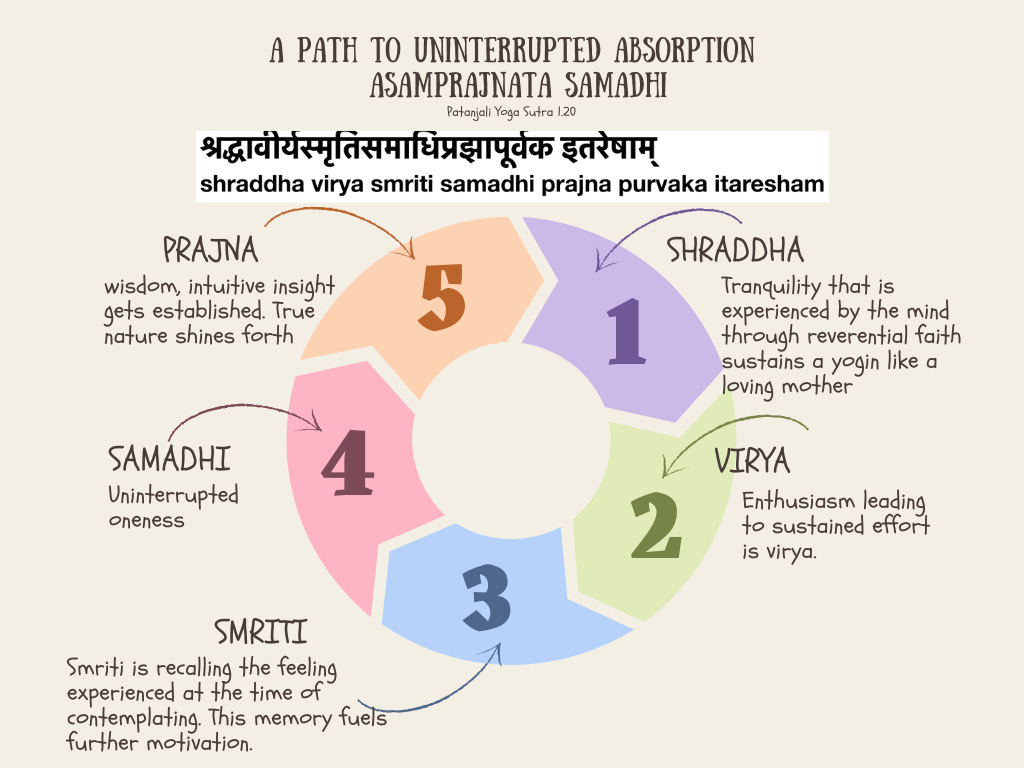
All wisdom traditions emphasize the importance of faith and trust in our objectives.
“People who have no reverential faith in their objectives cannot apply any energy to attain them.”
“All sorrows can be cured through good conduct, reverential faith, enthusiasm, remembrance, concentration, and correct knowledge.”
— Lord Buddha, The Dhammapada
Cultivating faith helps us align our energies with our practice. By doing our due diligence—verifying sources, observing the efficacy of these teachings over time—we gain confidence in the journey.
Patanjali, in Sutra 1.20, suggests another invaluable tool: memory.
Recall the joy experienced in past practices.
Remember the calmness from mindful breathing.
Reflect on the peace felt during meditation.
Share experiences with others to reinforce commitment.
Accessing these felt states helps us rekindle our motivation and return to the practice with renewed enthusiasm.
Interruptions and obstacles are not unique to any individual. Anyone who sincerely seeks to understand their essential nature and the intelligence that supports our existence will inevitably face these challenges. But this is a worthy quest, and perseverance is key.
May blessings accompany each of us as steadfast companions on this journey.
No posts
Comments
Nothing yet. Say the first thing.
Sign in to join the conversation.