
Yoga is an eternal practice and the latest technology - yes, both at once. I say eternal because it has existed, exists now, and will continue to exist in the future. When we look at even a random sampling of Yoga definitions across timelines - from the Vedas, Puranas, and Itihaasa - we see this truth reflected consistently.
Let us explore some key definitions that reveal yoga's profound depth:
The Fundamental Definition "Yujyate anena iti yogah" - This foundational definition describes yoga as the method through which individual consciousness (jivatma) unites with Universal Consciousness (paramatma). The path to this union can take various forms:
Through action (karma yoga)
Through devotion (bhakti yoga)
Through other systematic approaches
Etymology in Panini's Dhathupatha The root word "YUJ" reveals multiple dimensions:
Fourth group (divadi gana): To concentrate (vuj samadhau) - Patanjali's usage
Seventh group (rudhadi gana): To unite (yujir yoge)
Tenth group (curadi gana): To bind (yuj samyamane)
Amarakosha's Definition The ancient Sanskrit dictionary defines yoga as "Yogah sannahanopaya-dhyana-sangai-yuktishu," encompassing:
Sannahanopaaya: An armor for higher pursuits
Upaaya: A technique or method
Dhyana: Concentrated meditation
Samgat: Unity
Yuktisu: Logical framework for union
From Sacred Texts
Sage Vasistha: "Manah prasamanopayo yoga ityabhidhivate" - A skillful method to calm the mind
Kathopanishad: "Tâm yogamiti manyante sthiramindrtyadharanăm" - Mastery over senses and mind
Bhagavad Gita's perspectives:
"Samatvam Yoga uchyate" (BG 2.48): Evenness of mind between success and failure
"Yogah karmasu kausalam" (BG 2.50): Discretion in action with surrender to the Divine
"Tam vidyad duhkhasamyogaviyogam yogasamjnitam" (BG 6.23): Dissociation from sorrow
Patanjali's Classic Definition "Chitta Vritti Nirodhah" - Yoga is the tool to restrain mind's fluctuations, leading to effortless manifestation of our true nature.
In my classes, retreats, workshops, and teacher training sessions, I've witnessed something remarkable. When we introduce these definitions, participants experience an immediate sense of lightness, an unburdening. Their faces light up with hopeful recognition as they discover how many pathways are available to reach this safe, organic homeostasis.
The practice reveals itself not as a narrow tunnel but as a multi-dimensional approach:
Top-down - (Intention Setting, Affirmations, Visualization, mindfulness) and bottom-up -(Asana, Pranayama)
External (Yama, Nisama, Asana, Pranayama, Pratyahara) and Internal ( Dharana, Dhyana, Samadhi)-
World-engaging(Yama) and Self-centering ( Niyama)
Body-mind bidirectional practice - Asanas influence physiology and nervous system. Brain, the seat of mind receives these cases from body and relaxes the ever alert organ system. This provides the peaces and further helps body to restore and heal
What we're really exploring here are aspirations and intentions - seeing the world and ourselves without distortions. In that clarity lies the recognition of our Oneness with the Totality.
When I teach Patanjali's framework, we talk about how these pathways cane visualized and depending on each model, we access a different way of connecting to that. For example:
A well rooted tree blossoming with fruits and flowers
A ladder we climb at our own pace, each step giving a better view of ourself
An eight-petalled flower, where each petal's opening creates space for the next
Different entry points into the same highway
Links in an interconnected chain where pulling one lifts the whole
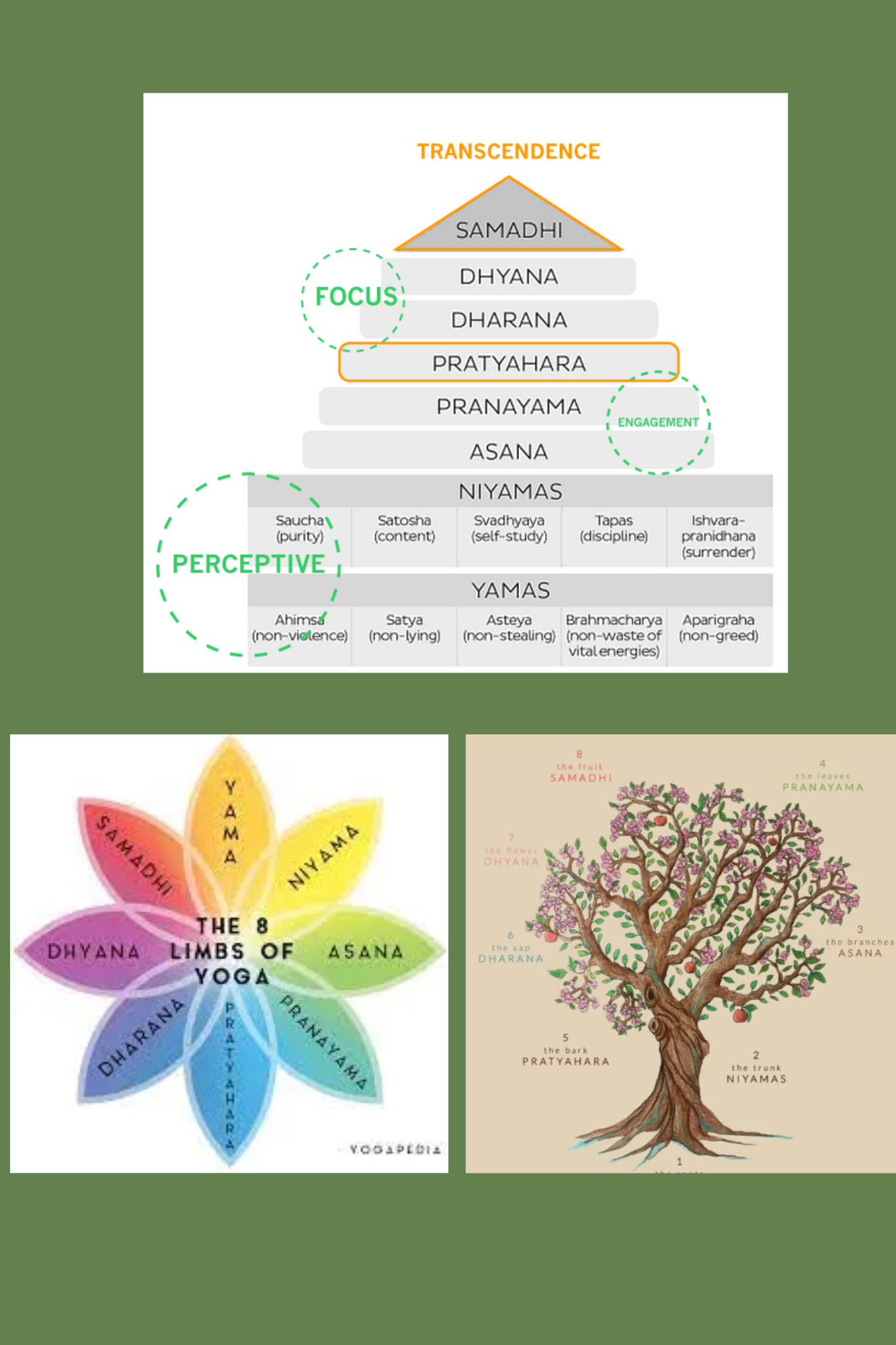
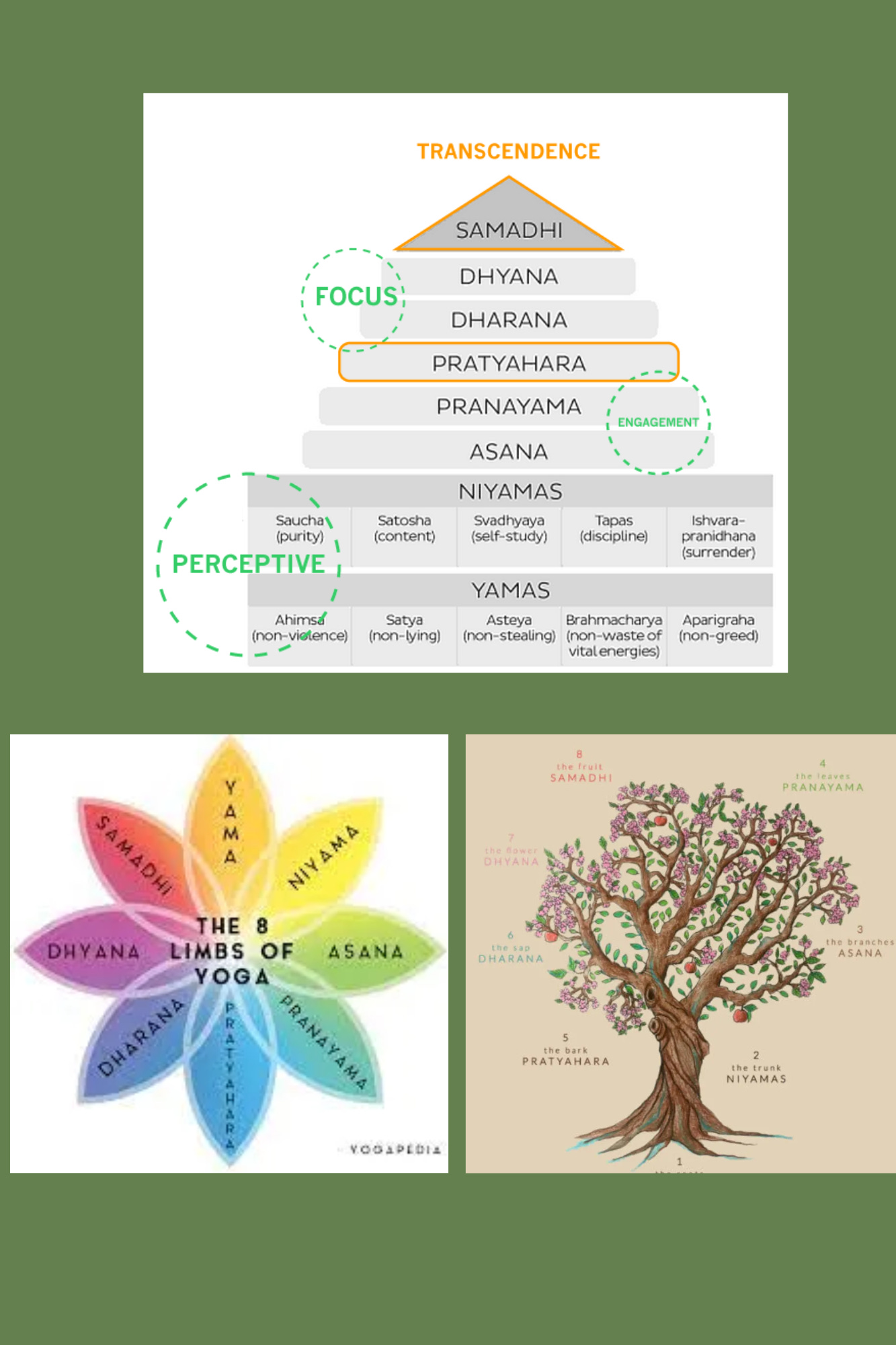
Yama - Social Guidelines: Recognition of our social fabric, interconnectedness. "Whatever is disagreeable to yourself, do not do unto others"
Niyama - Personal Disciplines: Personal Behaviors - Building safe spaces, connecting self-growth to collective growth
Asana - Physical Strength: Safe base foundation for strength and ease
Pranayama - Energy Management: Managing, channeling and optimizing energy
Pratyahara- Interoceptive Feeling State: Dropping into our feeling state - Developing self-knowledge through inner attunement
Dharana(Focus), Dhyana(Deepening Awareness) and Samadhi(Total absorption): Moving from feeling to focused, absorbed states - Full engagement with any pursuit
This comprehensive science has validated itself through millennia of experimentation, yet remains perfectly suited to modern life. The model:
Harmonizes all personality facets
Applies across ages, geographies, and life roles
Avoids bias against any aspect of personality
Recognizes multiple paths to mental peace
Is elegant, simple and universal
Validates itself through millennia of experimentation
Let us move beyond calling this science merely "ancient" - a word that can mistakenly suggest something mysterious or disconnected from our modern lives. Instead, let us recognize yoga for what it truly is: an eternal science that renews itself in every era, speaking as clearly to us today as it did thousands of years ago. It's a living technology for human flourishing, personally relevant to each practitioner while remaining universally applicable.
The spiritual sages, the scientists of the Self, have been exploring, studying, learning about the very subject the Self, with their own, body, breath and mind. Through millennia of axioms, hypotheses, and lived experiences, debating, refining, enriching this body of knowledge and giving us the applied tools and made it relevant. When we truly grasp how this framework guides us to develop our full potential - leading us through a spiraling journey until we recognize our infinite self in everything - how can we not be moved by its profound vision?
Though the ultimate connection to Self emerges when mental fluctuations (vrittis) cease, yoga's beauty lies in offering us multiple pathways to reach this state - each one valid, each one true to the seeker walking that path.
When we study and practice yoga, we become both beneficiaries and channels of this timeless wisdom. Receiving this knowledge fills me with profound gratitude and an instinctive desire to share it, however new we might be on our own journey. Practice, experience, share, pass it on, reminisce and keep it going. As long as you practice you keep the flame of knowledge alive for future generations.
No posts
Comments
Nothing yet. Say the first thing.
Sign in to join the conversation.