
To be fully present in life, pursue our passions, and navigate responsibilities, we require a sense of ease and stability in our bodies. This universal truth was recognized by Patanjali, who emphasized that our presence should be both easeful and stable in any posture “Suka Sthira Asanam”—whether sitting, standing, or moving through life’s many demands.
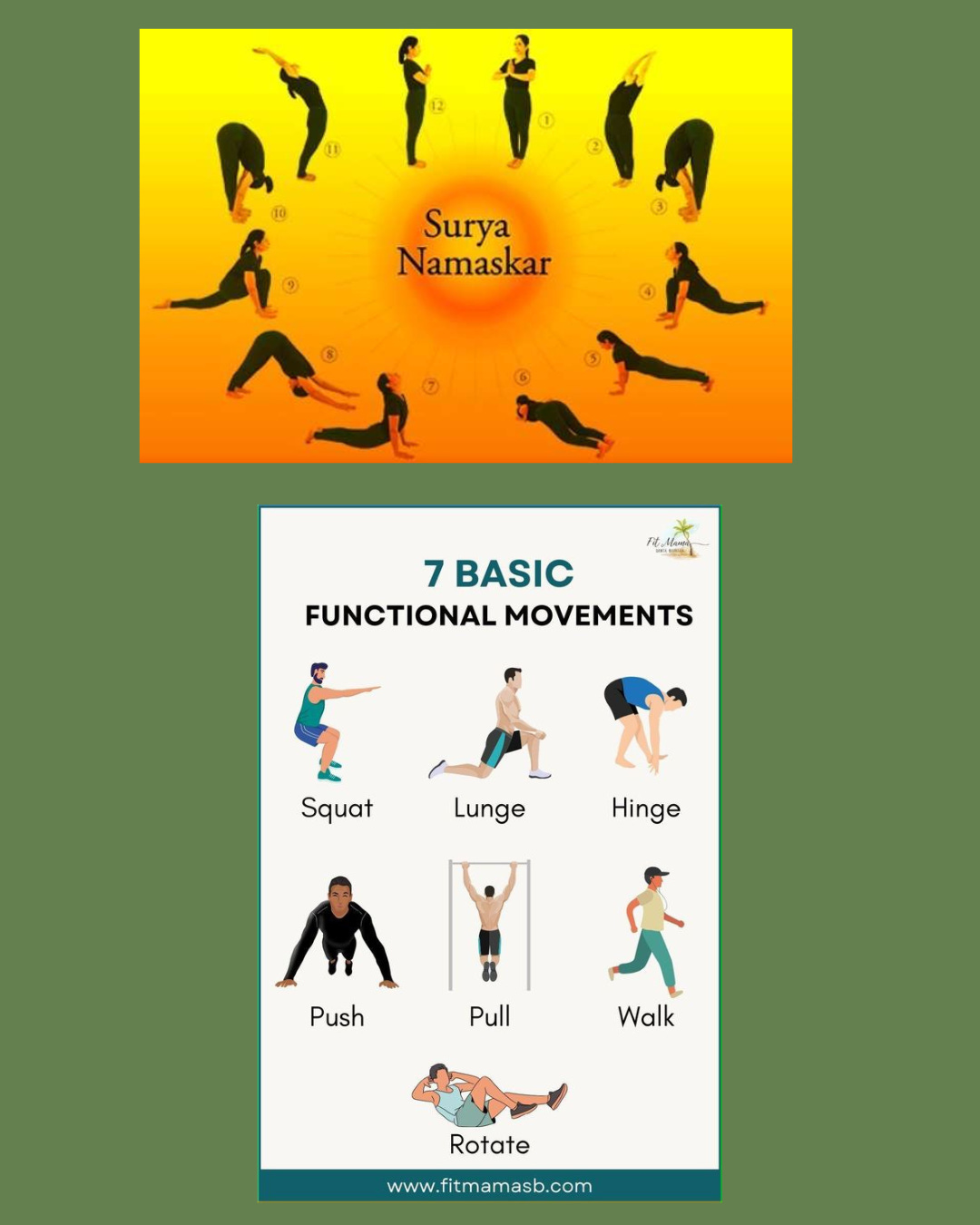
Everyday actions—reaching for an item on a shelf, bending to pick something up, kneeling to tie a shoelace, turning back to check surroundings—are fundamental to our daily existence. Whether we are awake or asleep, our bodies perform essential movements that allow us to function effectively. These fundamental movements include Hinge, Squat, Lunge, Push, Pull, Rotate, and Walk (Gait Pattern), engaging major muscle groups and ensuring mobility, strength, and balance.
Functional fitness refers to training that prepares the body for real-life activities by mimicking natural movements. As the Mayo Clinic defines it, functional fitness “trains your muscles to work together and prepares them for daily tasks by simulating common movements you might do at home, at work, or in sports.”
Fitness professionals across disciplines—physical therapists, strength coaches, athletes, and yoga practitioners—agree on the importance of incorporating seven primary movement patterns into training.
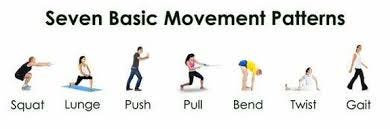
Hinge – Bending safely, lifting, and maintaining spinal health.
Key Benefits: Strengthens the posterior chain, improves posture, and supports lower back stability.
Examples: Deadlifts, forward bends, hip hinges.
Squat – The foundation for sitting and standing.
Key Benefits: Strengthens the legs, stabilizes the knees, and enhances joint mobility.
Examples: Bodyweight squats, sitting down and standing up.
Lunge – A critical movement for balance and lower-body strength.
Key Benefits: Builds unilateral stability, flexibility, and coordination.
Examples: Climbing stairs, stepping forward, lunges.
Push – Pressing and resisting force.
Key Benefits: Develops upper-body strength, arm endurance, and shoulder stability.
Examples: Pushing a door, overhead presses, push-ups.
Pull – Essential for lifting and gripping.
Key Benefits: Improves upper back strength, posture, and injury prevention.
Examples: Pull-ups, rows, lifting objects.
Rotate – Engaging the core for stability and movement.
Key Benefits: Improves spinal mobility and coordination between the hips, spine, and shoulders.
Examples: Turning to check surroundings, rotational exercises.
Walk (Gait Pattern) – The foundation of human movement.
Key Benefits: Enhances core engagement, leg strength, and cardiovascular endurance.
Examples: Walking, jogging, running.
Recent discussions in the New York Times Well section have highlighted functional fitness principles, leading to reflections on how these movements are approached in strength training versus yoga.
Exercises are performed in isolation, repeating each movement 6-8 times for 2-3 sets.
Progressive overload is applied by increasing weight to build strength and endurance.
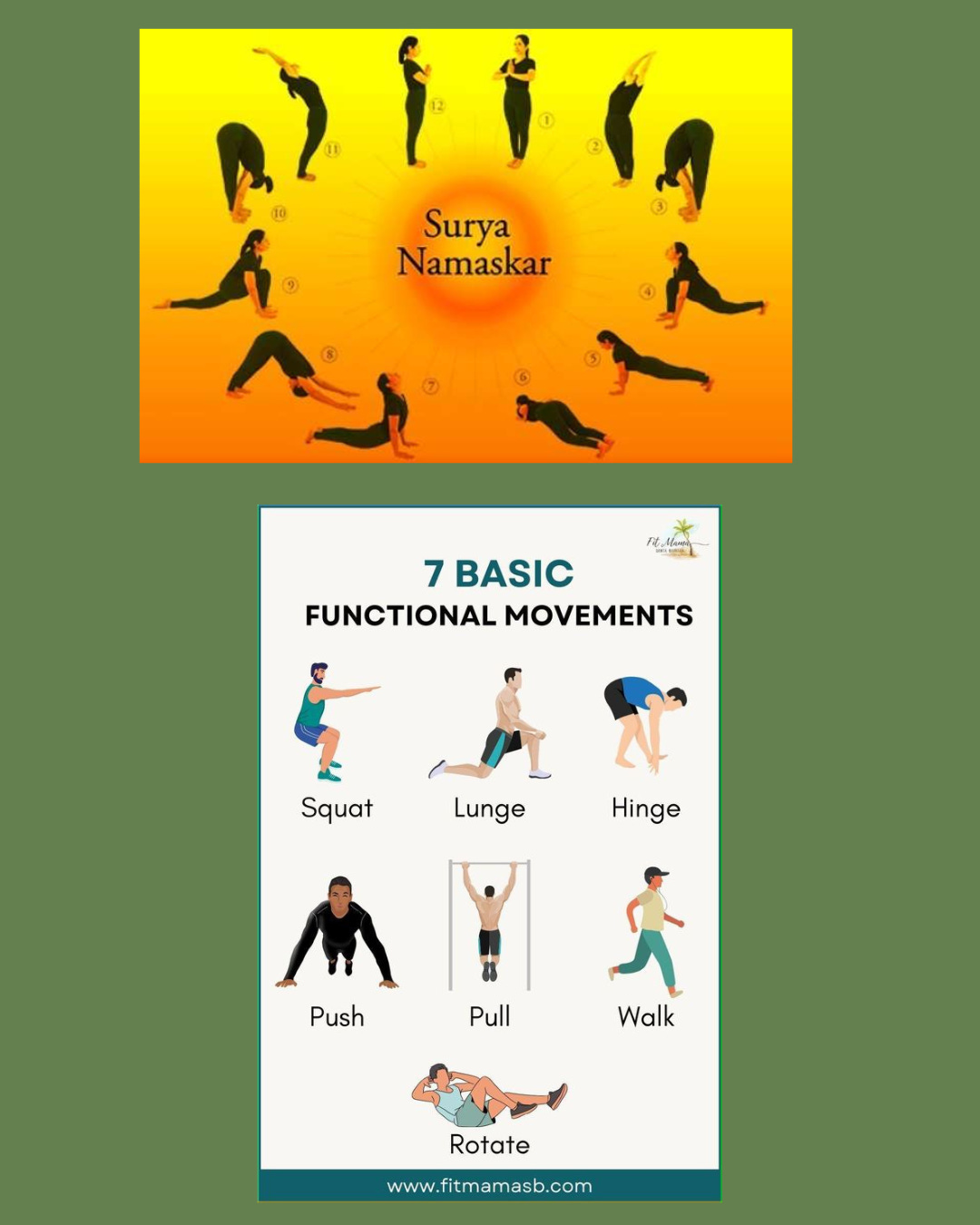
Surya Namaskar is unique in that it seamlessly weaves these functional movements into a dynamic flow, reflecting how movement occurs in real life.
Engages all primary movement patterns in an integrated sequence.
Transitions the body through standing, kneeling, prone, and inverted positions.
Integrates movement with breath in a rhythm calms the nervous system.
Combines strength, mobility, balance, and endurance while synchronizing breath and movement.
✅ Strength – Engages major muscle groups without external weights. ✅ Mobility – Enhances joint flexibility and range of motion. ✅ Balance – Requires full-body coordination and alignment. ✅ Endurance – Sustains movement through breath control and repetition.
Beyond the physical, Surya Namaskar also refines mental awareness by encouraging breath control, inner focus, and mantra chanting, making it a holistic practice that integrates mind and body.
A single round of Surya Namaskar incorporates:
Hinge – Uttanasana, Ardha Uttanasana (Forward bends that initiate from the hips).
Squat – Transition from Half Forward Bend to Ashwa Sanchalanasana (Lunge), which involves a squat-like position.
Lunge – Ashwa Sanchalanasana (Varied lunges with the knee down or leg straight).
Push/Pull – Phalakasana (Plank), Bhujangasana (Cobra) (Using arm strength to resist gravity).
Rotate – Although not always included, can be easily incorporated through a Revolved Lunge.
Gait/Walk – Stepping forward and backward between postures engages whole-body balance and proprioception.
Yoga practitioners no longer need to debate whether yoga is purely strength training, stretching, or flexibility-focused—it is all of the above. Likewise, fitness enthusiasts can explore Surya Namaskar to experience how functional movements flow together when combined with breath awareness and inner focus.
Life happens in a split stance, one step at a time. By training with awareness, we invest in our health and well-being, ensuring that we not only move well but also live well.
🔹 “Your body is your greatest instrument—train it with awareness, strength, and grace.”
No posts
Comments
Nothing yet. Say the first thing.
Sign in to join the conversation.