
The FDA’s Cellular, Tissue, and Gene Therapies Advisory Committee (CTGTAC) is scheduled to meet on July 29, 2026, to review Capricor Therapeutics’ (NASDAQ: CAPR) Biologics License Application (BLA) for Deramiocel, also referred to as CAP-1002.
The day represents another stop along a winding journey for Capricor Therapeutics that provides a remarkably instructive study into the rare disease regulatory framework currently operative in America.
The story starts with Eduardo Marbán, a Cuban-American cardiologist with an MD/PhD from Yale who has built one of the most distinguished careers in cardiovascular research of the past four decades. He trained at Johns Hopkins, rose to Chief of Cardiology there, and in 2007 moved to Los Angeles to become the founding director of the Smidt Heart Institute at Cedars-Sinai. Marbán’s laboratory was the first to isolate and characterize a type of cardiac stem cell called cardiosphere-derived cells (CDCs) from patients using minimally-invasive endomyocardial biopsies. The foundational paper was published in Circulation in 2007. The basic concept as described in the paper: biopsy a small piece of heart tissue, culture the cells into three-dimensional clusters called cardiospheres, then dissociate those clusters into individual CDCs that could be expanded and delivered back to patients. In the initial autologous design, a patient’s own cardiac cells would be grown and returned — a personalized cardiac regenerative therapy.
This has been the holy grail for cardiologists involved in heart failure research for decades. If the delivery of these cardiac stem cells could actually regenerate the failing heart, this was a paradigm shift that would have implications well beyond cardiology. Marbán went on to found the biotech company Capricor to commercialize the product — the company licensed the process from Johns Hopkins and Cedars-Sinai — and Linda Marbán, his wife and a molecular biologist, became the company’s CEO. The hard work of showing that something mechanistically exciting in the lab would translate to patients lay ahead.
The initial clinical translation from lab to patients was promising. In February of 2012, Marbán & co. published CADUCEUS — the first randomized trial of cardiosphere-derived cells in post-MI patients. Seventeen patients received autologous CDCs intracoronary, eight served as controls. By six months, cardiac MRI showed statistically significant reductions in scar mass, increases in viable myocardium, and improvements in regional contractility in the treated group. The paper made waves. “Stem cell infusion regenerates healthy heart muscle in heart attack patients” was how Cedars-Sinai’s press office described it. It appeared Marbán may have actually solved the hardest of cardiac problems.
But the news was not all perfect. The same trial that was suggesting cardiac regeneration showed no significant change in other important cardiac parameters that should have also improved — like the pumping function of the heart (ejection fraction), or a reduction in chamber sizes (end-diastolic volume, end-systolic volume). The news was still good enough to take the company public.
The next study launched was the ALLSTAR trial, a randomized, double-blind, placebo-controlled trial of Marbán’s allogeneic CDCs in post-MI patients. 142 patients enrolled. The drug in question was CAP-1002 — from donor hearts rather than the patient’s own tissue, which meant it could be manufactured at scale. This trial was designed to confirm the CADUCEUS signal with donor hearts rather than patient-derived cells.
Unfortunately, not only was there no improvement in any cardiac parameters, ALLSTAR didn’t even replicate the scar reduction seen in CADUCEUS. The trial was stopped for futility at the pre-specified interim analysis in May 2017; the primary endpoint — percent change in infarct size as a percentage of left ventricular mass by cardiac MRI — showed no difference from placebo. Capricor’s own press release described being “disappointed that the ALLSTAR six-month data did not demonstrate evidence of scar size improvement.” The adult cardiac program was functionally dead.
This should have been the end of Capricor, but for a life-saving pivot. The company reframed the mechanism of benefit from scar regeneration to immunomodulation. That opened a new target: inflammatory myopathies, of the sort thought to drive the progressive muscle wasting of Duchenne muscular dystrophy (DMD).
Was this pivot based on science, or a last gasp to keep the valuation of the founder and CEO from dropping to zero? Answering that question requires understanding a little bit about the basic science behind deramiocel. Thankfully, a follower on X sent me his brilliant post on Capricor and deramiocel that I encourage anyone interested — and everyone at the FDA, and anyone who sits on their AdComs — to read in its entirety. A brief summary of some of the most concerning problems raised about the mechanism of action follows.
The biodistribution of the drug is fatal to the cardiac improvement claim. Only 1% of injected CDCs end up in heart tissue even in animal models. The pericardium is a physical barrier. There is no intrinsic tropism. The cells mostly circulate, get lysed within days, release exosomes with a half-life as low as 7 minutes, and are cleared. By the time you work through that chain — 1% cardiac sequestration, exosomes with sub-hour half-lives, no demonstrated retention at the site of injury — the fraction of payload actually acting on cardiac tissue is vanishingly small.
The anti-inflammatory claim is contradicted by Capricor’s own data. Capricor’s own batch release studies show IL-6 upregulation in CDCs. Their own slide deck shows CXCL8 upregulation. Problematically, both IL-6 and CXCL8 are pro-inflammatory. A drug whose manufacturer’s own quality control data show upregulation of pro-inflammatory cytokines is being marketed as anti-inflammatory.
The Spanish swine study. CDCs injected directly into the pericardial sac — the most favorable possible delivery route, bypassing every biodistribution problem with IV administration — showed no difference from placebo in LVEF in a post-infarct swine model. If the drug doesn’t work when delivered directly onto the heart in an animal model, the mechanism by which quarterly IV infusions are going to improve cardiac function in DMD boys is what, exactly?
The nested delivery and payload problem. We are asked to believe the mechanism of action is injecting CDCs which contain exosomes which contain the payload which happens to coincidentally act upon cardiac and skeletal muscle tissue. The “payload” is not an engineered product. These are not CAR-T cells, where you know exactly what gene has been inserted and what protein it produces. They are a naturally occurring population of stromal cells derived from donor heart tissue, expanded in culture. Their contents are whatever biological cargo those cells happen to carry: a heterogeneous mixture of exosomes containing microRNAs, growth factors, cytokines, and signaling proteins that vary from batch to batch, from donor to donor, and even from cell to cell within a batch. On top of that, the CDCs → exosomes → payload MoA is three layers of attrition before anything pharmacologically active reaches target tissue. Each layer has its own biodistribution, half-life, and retention problem. The compound probability of sufficient payload reaching cardiac tissue to produce a couple of percentage points of ejection fraction is, on first principles, extremely low.
The post goes on to outline in remarkable detail why almost nothing in the Capricor story adds up, raising the possibility that the CDC concept rests on unreliable data. The replication record is not reassuring. Independent groups that tested allogeneic CDCs for cardiac repair — a Spanish swine study, a Brazilian group — found no benefit. Capricor's own randomized trial in adults, ALLSTAR, found no benefit. The positive results in this field come almost entirely from studies Capricor ran or Marbán authored. More troubling still, the post documents what appears to be an alteration in the presentation of the safety data, removing words like "anaphylactic" and "severe" from the clinical documentation.
But even if we assume Capricor is an ethical company that hasn’t committed fraud, it’s worth exploring the ecosystem that allows Capricor to be an FDA approval away from selling a product that may net $750,000 per patient per year for the life of the patient.
The rare disease community had a problem with the conventional drug approval market as it existed prior to 1983 — there were no drugs being developed for these patients because the community was too small to support the type of research and development needed to create breakthroughs in the space. The rare disease community appealed to Congress for help. And help they did, via a number of mechanisms.
The original Orphan Drug Act provided a federal tax credit equal to 50% of qualified clinical testing expenses for drugs targeting rare diseases — defined as conditions affecting fewer than 200,000 Americans. Clinical testing expenses include clinical trial costs, investigator wages, supplies, and contract research costs. The credit was cut to 25% by the Tax Cuts and Jobs Act of 2017, but it was 50% during the years Capricor was developing HOPE-Duchenne. If a clinical trial costs $100 million, the government effectively pays $50 million of it. Not as a grant that must be repaid. As a tax credit — money directly offset against tax liability, or carried forward if the company is operating at a loss, which most small biotechs are. The government becomes a silent co-funder of the development program, with no equity stake and no claim on the resulting revenue.
Upon approval of an orphan-designated drug, the sponsor receives seven years of market exclusivity. During that period, the FDA cannot approve a competitor’s drug for the same indication even if the competitor’s drug is superior. In a disease with 15,000 U.S. patients, seven years of exclusivity at $750,000 per year — assuming even half the eligible population gets treated — is $26 billion in protected revenue. Essentially a government-granted monopoly where the drug manufacturer sets the price. The pricing consequences of this structure are now the subject of active reform proposals.
Filing a Biologics License Application — the formal submission a company files with the FDA requesting permission to sell a biological product to the public — costs over $4.6 million in user fees for fiscal year 2026. Orphan drug sponsors pay nothing.
The Rare Pediatric Disease Priority Review Voucher program, created in 2012 and reauthorized through 2029, is perhaps the most extraordinary component of the package. When a company receives FDA approval for a drug treating a rare pediatric disease, it receives a Priority Review Voucher — a transferable certificate entitling the holder to priority review of any subsequent drug application. Priority review cuts FDA review time from approximately ten months to approximately six months. The voucher is freely transferable and can be sold to any company for any application. Four months of accelerated review time is valuable to large pharmaceutical companies racing to bring blockbuster drugs to market. The reported purchase prices of PRVs to third parties average about $100 million, ranging from $67.5 million to $350 million. AbbVie paid $350 million for a PRV in 2015. Sanofi and Regeneron paid $67.5 million for another.
Capricor has Rare Pediatric Disease designation and is eligible for a voucher upon approval.
And the voucher is not the only thing that arrives with an approval letter. Capricor’s distribution agreement with Nippon Shinyaku is structured as a series of tranches, disclosed in the company’s 10-K: $30 million upfront in 2022, $10 million when the HOPE-3 futility analysis cleared, $10 million on BLA submission in December 2024 — and “another potential milestone of $80.0 million due to Capricor upon receipt of marketing approval,” followed by sales-based milestones of up to $605 million and a 30 to 50 percent share of product revenue. So an approval on August 22 is worth $80 million in cash plus a voucher that has historically fetched somewhere between $67.5 and $350 million, before a single vial is sold to a single patient. Whether that $80 million actually gets paid is now itself uncertain: Capricor sued Nippon Shinyaku and NS Pharma in May 2026 seeking rescission of the very agreement that contains it.
The final cherry on top relates to the evidentiary basis put into place for rare disease approvals. Given the impossibility of generating randomized controlled data with hard clinical endpoints in rare disease populations, approvals for rare diseases operate under a completely different evidentiary standard than common disease approvals. The FDA accepts surrogate endpoints, functional scales, single-arm trials, and smaller sample sizes that would be rejected for adult drugs.
All of these justifications in rare disease are perfectly acceptable. They also allow for systematic exploitation. The FDA approved eteplirsen for DMD in 2016 on the basis of a clinically insignificant dystrophin increase of 0.22–0.30% above baseline in a twelve-patient study, with no functional benefit demonstrated. The advisory committee had voted 7–6 against accelerated approval and 7–3 against traditional approval. The FDA’s own review team recommended rejection. Ellis Unger, who supervised the review, and Luciana Borio, the agency’s acting chief scientist, both opposed approval. Janet Woodcock, the CDER director, overruled them. Unger filed a formal appeal to FDA Commissioner Robert Califf, who deferred to Woodcock. In his written appeal, Unger warned that approving an ineffective drug — “essentially a scientifically elegant placebo” — would give thousands of families false hope. He lost.
The second precedent is worse, because we now know how it ended. Elevidys, Sarepta’s gene therapy for DMD, received accelerated approval in June 2023 on a microdystrophin expression surrogate, and an expanded approval for non-ambulatory patients in June 2024. Both times, Peter Marks, the CBER director, overruled his own review staff, who had recommended rejection on the evidence. In March 2025 a teenage boy who had received Elevidys died of acute liver failure. In June, a second. In July, a 51-year-old man in a trial of a related Sarepta gene therapy. Sarepta initially declined the FDA’s request to stop shipping, then paused all U.S. shipments on July 22, 2025. The FDA required a black box warning for acute liver injury and acute liver failure. A drug the career scientists said no to, approved anyway by a center director, went on to kill children.
Those approvals created an exploitable precedent. Enter Capricor.
Capricor’s DMD program rests on two randomized controlled trials, HOPE-2 and HOPE-3, and neither was built to answer a cardiac question.
HOPE-2 was small. Twenty-six patients were enrolled and twenty randomized — eight to deramiocel and twelve to placebo, with six screening failures. Eight treated boys. That is the entire evidentiary base on which the original BLA for a cardiac indication was built.
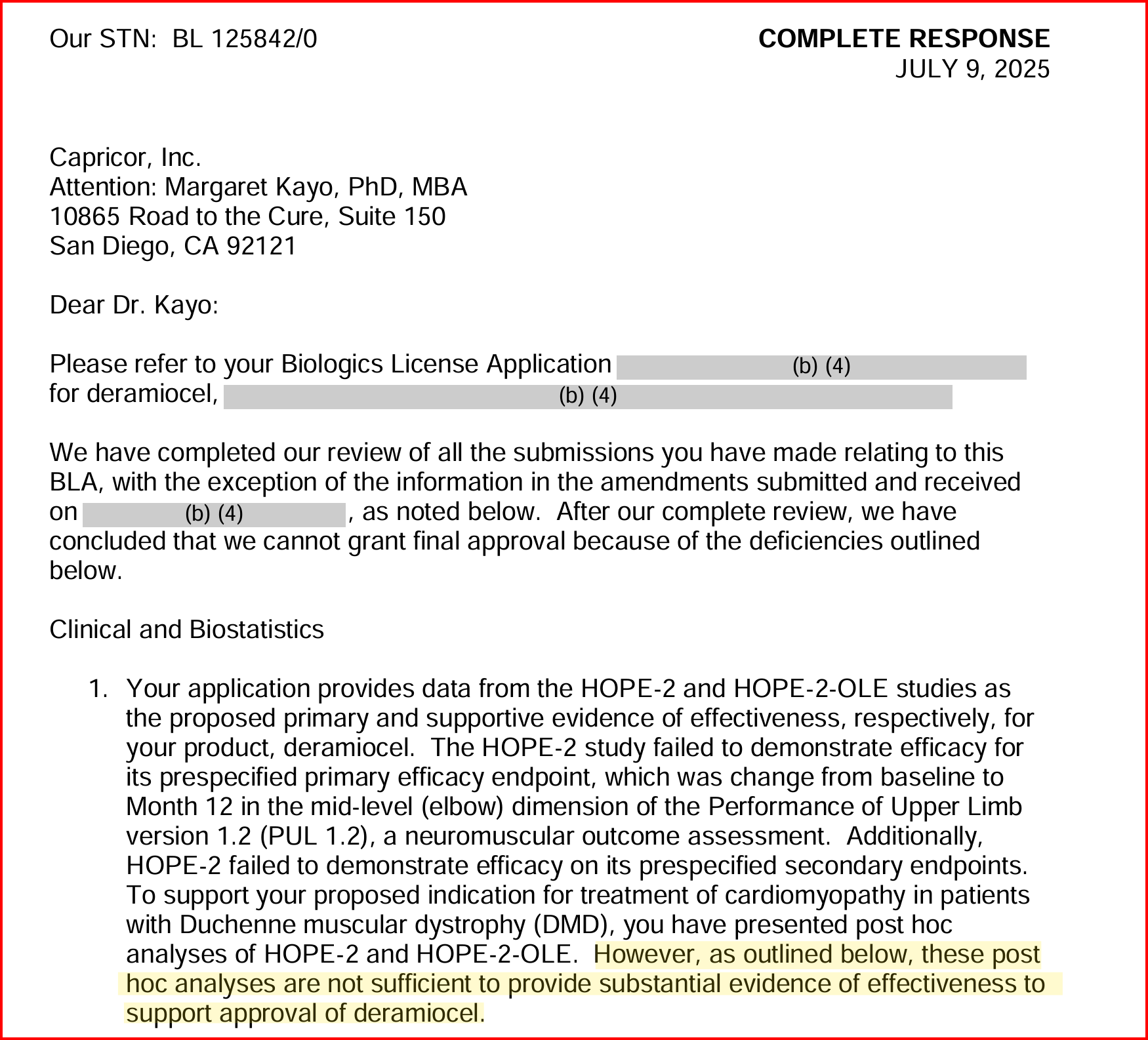
And HOPE-2 failed. The FDA Complete Response Letter (publicly available thanks to former FDA commissioner Marty Makary) is unambiguous: the study “failed to demonstrate efficacy for its prespecified primary efficacy endpoint” and “failed to demonstrate efficacy on its prespecified secondary endpoints.” Capricor later argued that the original analysis had relied on an assumption of normality that was not met, so they reran it non-parametrically and obtained significance. The FDA did not accept a post hoc statistical reanalysis of a failed prespecified endpoint.
Capricor’s shareholders have been told something different. The company’s annual report, filed with the SEC in March 2026, states that HOPE-2 “met its primary efficacy endpoint of the mid-level dimension of the PUL v1.2 (p=0.01).” Same trial, same endpoint, opposite conclusion from the one the agency reached in writing eight months earlier.
The cardiac case was assembled after the fact. The BLA contained 50 secondary and exploratory endpoints, including post hoc analyses of 26 cardiac MRI assessments — none prespecified for hypothesis testing. The open-label extension reported a +3.0 percentage point LVEF change in the subgroup with ejection fraction at or above 45%, and +1.2 points overall at five years.
Then came HOPE-3: Phase 3, randomized, double-blind, placebo-controlled, dual-cohort, 106 participants across 20 US sites, average age about 15, all on stable corticosteroids. Roughly 90% were on cardiac medications at baseline and over 75% carried a clinical diagnosis of cardiomyopathy. Four intravenous infusions of 150 million cells, one every three months, over twelve months.
The primary endpoint was a measure of upper limb strength called PUL v2.0. The Performance of Upper Limb (PUL) scale is a physiotherapist-administered measure of arm function, developed by a working group to track the proximal-to-distal pattern of upper limb decline characteristic of DMD. Version 2.0 comprises 22 items plus an entry item that establishes the patient’s starting functional level, scored across three regional domains: shoulder (6 items, 12 points), elbow (9 items, 17 points), and wrist and hand (7 items, 13 points). Total possible score, 42.
Capricor reported positive results in its December 3, 2025 topline release: 54% slowing of progression on PUL v2.0 (p=0.029), and 91% slowing on left ventricular ejection fraction (p=0.041). PUL was analyzed in 105 patients. LVEF was analyzed in 83 — the number with “centrally reviewed and evaluable cardiac MRI LVEF assessments at 12 months.” Twenty-three of the 106 randomized patients have no evaluable cardiac imaging, which should be quite a problem for a drug that’s going for a cardiomyopathy indication in the trial submitted specifically to answer a Complete Response Letter demanding cardiac evidence.
That 91% slowing translates to a 2 to 3 percentage point difference in ejection fraction between treatment arm and placebo. That is at or near the limits of interstudy reproducibility for cardiac MRI, even with central reading. For context: every approved therapy for heart failure with reduced ejection fraction — sacubitril/valsartan, dapagliflozin, empagliflozin — produced EF improvements in that range or larger, in trials enrolling hundreds to thousands of patients, and in each case the EF change was a secondary biomarker. Mortality and hospitalization were the primary outcomes that led to regulatory approval. There is no adult drug that gets approved on the strength of a 2 to 3 percentage point difference in ejection fraction, because no one can determine whether that is a clinically significant number.
The FDA’s Complete Response Letter of July 9, 2025 said, in effect: run ALLSTAR again in DMD. Having found the exploratory cardiac analyses unconvincing, the agency concluded that “the few nominally significant findings could be spurious,” and its recommendation was explicit — conduct adequate and well-controlled studies “whose primary objective is evaluation of cardiac outcomes.”
Capricor did not. It ran another arm-function trial. And it is worth being clear about what is actually being submitted, because the naming convention obscures it: CAP-1002 and deramiocel are the same product — the same allogeneic cardiosphere-derived cells from the same donor-heart manufacturing process, renamed. The drug that could not move infarct size or ejection fraction in a 142-patient randomized placebo-controlled trial in adults is the drug now seeking a cardiac indication in 106 boys, on the strength of a secondary endpoint that was evaluable in 83 of them.
Was the pivot science or salvage? We can’t tell. Nothing in the Orphan Drug Act, the exclusivity provision, or the voucher program distinguishes between a company that moved to a rare pediatric disease because the mechanism actually fit and a company that moved because its adult program was dead and the rare disease framework offered subsidized trials, monopoly pricing, and a transferable certificate worth hundreds of millions of dollars. Both companies file the same paperwork, clear the same lowered bar, and collect the same voucher.
An incentive structure that cannot distinguish between companies with sophisticated placebos and actual working products will, over time, produce more sophisticated placebos, because actual breakthroughs are much, much harder to achieve.
For desperate patients and their loved ones, this question remains the most salient one. The answer isn’t as easy as it appears.
Seven years of exclusivity is a blockade, not a reward. If deramiocel is approved and doesn’t work, the FDA cannot approve another therapy for DMD cardiomyopathy for seven years. This essentially dries up the funding for any other competitor in the space that has an actual working product. The boys who are eight years old today will be fifteen when that block finally lifts. The disease has a life expectancy in the mid-20s. There are only so many shots on goal these kids have.
Nobody knows what infusion number forty looks like. Three of the eight patients in the deramiocel arm of HOPE-2 had hypersensitivity reactions, one severe enough to require epinephrine and to end that patient’s participation in the trial. That was over four infusions. The response was a premedication regimen of glucocorticoids plus H1 and H2 blockers, which is usually where the story stops — reactions happened, premedication solved them. It didn’t, quite. Capricor’s own extension protocol records that across the 42 infusions given after premedication was introduced, one allergic reaction still occurred, in a patient on his third exposure, requiring overnight observation. All three patients who reacted were kept overnight. Sensitization to foreign antigen generally escalates with repeat exposure rather than diminishing, and the proposed regimen is quarterly, indefinitely.
The burden falls on the time the boys have left. Quarterly infusion visits, premedication starting the night before, two hours of post-infusion monitoring, indefinitely. That is a meaningful fraction of the remaining life of a boy with advanced DMD, spent in an infusion chair, for a 2 to 3 percentage point ejection fraction difference of unestablished clinical meaning.
The confirmatory trials don’t run. They never do. Post-market commitments in rare disease become suggestions, timelines slip a decade, and there is no consequence for non-compliance because the alternative — withdrawal — is politically untenable once families are on the drug. The evidentiary gap the FDA identified does not close after approval. It closes never.
The burden of proof has quietly inverted. In adult cardiology, a sponsor proves its drug works. In rare diseases, the agency is increasingly asked to prove it doesn’t — and to do so against the testimony of patients who have nothing else, in a room where the scientific question and the moral one have been deliberately fused.
They are not the same question. The FDA shouldn’t be the only backstop for desperate, vulnerable patients against those hawking sophisticated placebos. Regardless of what the FDA decides, clinicians should independently evaluate the data behind the drugs they are prescribing. Unfortunately, many of today’s clinicians are fairly algorithmic in their practice. If the FDA approves it, a Key Opinion Leader recommends it, and an insurance company or payer will pay for it, the clinician will write for it. The financial incentives for the clinician in the buy-and-bill model here are not small. This is a drug that will net the infusion center delivering it roughly 6% of that presumed $750,000 payment for each patient. The sad reality is that in today’s ecosystem, the only thing standing in the way of kids getting a potentially useless drug with unclear long-term toxicity is an FDA approval.
The FDA to date has had the wisdom and spine to make the right call on Capricor and deramiocel. But there has been a changing of the guard at the FDA, engineered to a great extent by a rare disease ecosystem unhappy with an agency that operated on facts rather than feelings. The two prior DMD therapies that couldn’t show meaningful clinical benefit in trials, were rejected by FDA staff, and required a center director’s overrule to be approved — eteplirsen and Elevidys — would not have been approved by the Makary/Prasad/Høeg FDA. Those three science heavyweights are gone, replaced by a regime that has promised to be more flexible.
The CRL of July 9, 2025 told Capricor that fifty exploratory endpoints with no multiplicity adjustment could not substitute for a cardiac trial, and that some of the nominally significant findings could be spurious. That letter was the agency doing its job.
The Cellular, Tissue, and Gene Therapies Advisory Committee convenes on July 29th — two days from now. Is the regulatory system still working to parse sense from nonsense? We’ll find out this week.
The deramiocel Complete Response Letter (BLA 125842) is publicly available in full at the FDA’s website: CRL_BLA125842_20250709.pdf
Anish Koka is a cardiologist writing on medicine and health policy. He cohosts a weekly medical podcast : The Doctor’s Lounge. He is on @x : @anish_koka .
No posts
Comments
Nothing yet. Say the first thing.
Sign in to join the conversation.